
Doing science with awe and humility is a powerful act of reciprocity with the more-than-human world.
— Robin Wall Kimmerer, Potowatami scholar
A blog by Valerie
Most of us when asked what ‘science’ is will start to think of beakers and men in lab coats doing chemistry experiments. However, that is a limited Western perspective on studying and cataloguing knowledge within a controlled environment. The root of the Latin word ‘science‘ is ‘to know’, which comes from an older root word meaning ‘to cut/split.’ This is why a Western scientist when trying to gain knowledge about a butterfly will likely describe the environment of its capture, then kill and preserve one to do things like measure its wing dimensions, look at parts of it under a microscope, document the patterns on its wings, and label it with a Latin title. This is a way to gain knowledge through cutting or splitting the butterfly from its environment.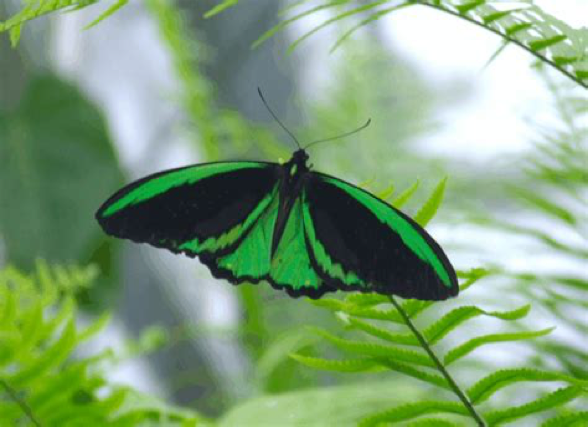
In Indigenous science, we do not aim to gain knowledge through separation and examination in isolation with such an individual focus. We instead want to study the butterfly in its environment, and it might take a while, a year or more, to observe patterns of behaviours and direct relationships a butterfly is part of. For example, we may observe that the butterfly pollinates certain flowers that the bee does not tend to favour. We may observe that the butterfly blends very well against one tree, but is very visible against another tree, and this may tell us something about where its chrysalis is likely to be hiding. We may learn about cultural lore of an important butterfly dreaming site on country. And we may feel awe when a butterfly flutters by or, if we’re lucky, feels safe enough to land on our hand. We may feel inspired when reflecting on the butterfly’s lifecycle that is filled with immense physical change to make a change in our own lives, or to appreciate immense change we have been through ourselves. (Image from here)

Indigenous science offers us a different lens, a holistic perspective, for building and testing knowledge. Most of us are aware of the Western calendar with four seasons (winter, spring, summer, fall) and the equinoxes and solstices that mark celestial moments in an annual cycle. But many Indigenous cultures celebrated seasons specific to their country and its cycle of life. Here is a representation of the Jawoyn seasonal calendar from the land where we currently live around Katherine, NT:


In nomadic or empire-building cultures where people travelled a lot, especially by boat, it made sense to mark seasons by celestial moments. But in Indigenous cultures where people developed deep relationships with a place where they experienced belonging, it made more sense to mark seasons by weather patterns, plant and animal movements and food sources. This included marking times of year to avoid certain foods too, like no fishing of barramundi during their breeding season out of respect. (For those of you in Sydney, here is a D’harawal seasonal calendar explaining six seasons of that country.)
Considering the opening quote, I find that Western science may be done with awe, maybe even humility, but rarely reciprocity with our non-human kin. And for those of us living off of our traditional country, I find it helpful to keep in mind what Kenneth Jacob of Wellesley Islands, Queensland explains:
Our law is not like whitefella’s law. We do not carry it around in a book. It is in the sea. That sea, it knows. Rainbow knows as well. He is still there. His spirit is still watching today for law breakers. That is why we have to look after that sea and make sure we do the right thing. We now have to make sure whitefellas do the right thing as well. If they disobey that law they get into trouble alright.
I leave you with the following principles of Indigenous science to consider, based on work by Oneida-Gaul scholar Apela Colorado:
- Nothing is objective
- Non-humans are included in research
- Research is done as a ceremony
- Time is nonlinear & cyclical
- Privileges relationships
- Holistic, draws on all senses (spiritual, emotional, physical, psychic)
- Healing, ends with feelings of peace, balance, vitality
- At the end, we have not transcended but are more fully present and embodied
- Humour and light-heartedness are important to the process
 If you value this content, please engage in reciprocity by living, sharing and giving.
[…] write this piece. For me, this is the essence of being alive and embodying an earth ethos, for in Indigenous science, timing is synchronicity. This underlies indigenous seasonal calendars, and many familiar sayings […]
[…] by the land, peoples, and ancestors of Australia. I find myself in flow navigating life through Indigenous Science. Though I am very far from ancestral lands, increasingly I feel, for the first time in this life, […]
[…] Indigenous science, all disease including trauma is indicative of “disruption in the natural order of humans’ […]
[…] we can simply say that things are different, but also the same. In Indigenous science, the practicality of this might hinge on where we are, who we’re talking to or what we’re […]
[…] Indigenous science teaches us to derive the heart — or perhaps the root — of our understanding in situ: meaning, in this context, that our human capacity and potential cannot be separated from our environmental context. […]
[…] lived in a shed. We did ceremonies to connect and honour the land and allowed it, the ancestors, and our intuition to be our guides. Going on bush walks and to the beach was free and fulfilling. A cafe lunch was a […]