
Blog by Valerie
I recently received German denazification records for my great grandfathers and grandfather. I paid the state archives to scan them for me after finding out how that process works in an article in der Spiegel, a German news publication. At the same time as this I found out laws have changed and I should be eligible for German citizenship so I ordered a copy of my father’s birth certificate.
Denazification was a process following WWII that Germans and Austrians were put through. People who had been Nazi party members were required to fill out forms listing their involvement. They were then judged by a committee. After the Allied Powers decided on high level prosecutiond at Nuremberg, the denazification process was run by the newly established German government. They decided on five levels of Nazi participation, and a person’s length of prohibition from public life or business was meant to be based on their crimes.
My Opa, my father’s father who was young and conscripted into the marines towards the end of the war, had a short file. He had joined the party when forced to enrol in the military at age 18 and had become a war prisoner in Norway. He was judged as young and forced in and quickly exonerated. (Below: photo of my Opa, Werner Schwans)

His father, however, had a long file. He admittedly believed the Nazis were the solution to Germany’s problems after WWI, and had joined the party early on. As director of the employment department for the city of Oldenburg, it seems his primary work was dismantling labour unions at odds with the party and centralising Nazi power. He was judged unfit for public service, which was upheld on appeal. He then lodged another appeal, writing that he had been unable to find any work in the private sector in the years since the judgement, and included a character reference letter from the then City Administrator of Oldenburg. The second appeal overturned the ban, and presumably he had enough relationships high up in the city administration he was able to find work again. He expressed feeling victimised and did not seem remorseful but stubbornly proud. Interestingly he wrote under religion that he was a free thinker and had broken with the church years earlier. He also had refused to pay church taxes and been in trouble for that at some point.
My grandmother’s father had a medium length file. He had joined the party early on because of a promise to support farmers. At the time, a number of farmers in the area were facing foreclosure. He said he was forced to sign up for the reserves and was named local propaganda leader for a year because they demanded fees he couldn’t afford once he had joined. He was removed as propaganda leader for not doing the work and sent to fight instead. He was a POW in Bavaria for over a year after the war ended before he went home. He expressed desperation and naivetete at the outset, and remorse and disgust as he experienced more and tried to leave the party. He was judged exonerated, with the committee writing that he was not political and known to them as “a harmless man”.
The final document I received recently was my father’s birth certificate. In 1952 the West German birth certificates have the parent’s names and religions as well as the religious affiliation of the hospital where the child was born. (My father, Karsten Schwan)

Given my great grandfather’s overt rejection of religion a generation before, it was interesting to see how embedded in the society this still was. It also gave me perspective on my father, for though his name ‘Karsten’ is the German equivalent of ‘Christian,’ and he was confirmed Lutheran as a teenager, he was a staunch atheist. And one of the few areas of life in which he was highly judgmental was of others’ choices to be Christian or religious at all.
How this information aligns with my family’s stories, I’m still working out. In many ways it’s left me with more questions that I can’t get answered because people have died and much was left unsaid, and I’m not sure what was said was honest anyway.
There’s a story that my Opa tried to hide in a barn to avoid conscription, and was caught and tortured by the Nazis. This is still possibly true. I have had some dreams and visions of this, and it helps explain a depth of trauma that was acted out in the family. And he needn’t have reported any of that in these files. I’ve tried a few times over the years to get copies of files of his career service in the West German military after the war, but I was told I needed to visit an office in Freiburg in person to view them.
There’s a story that my Opa hated his father who was a Nazi believer and saw the party as his way to social power. I’ve seen family photos of my great grandfather wearing a Nazi pin when my grandfather was young. This seems plausible and yet I wonder how my great grandparents survived for years when he wasn’t working before he became exonerated. Did my Opa try to support them, his sister, and his own wife and young boys? I know when my dad was young they lived at my great grandparents farm. I’ve seen photos of him in lederhosen chasing chickens.
I learned where my grandmother’s family farm was, halfway between Oldenburg and Bremen. And saw on Google Earth the house where my grandfather grew up in Oldenburg. It was only a ten minute walk from the apartment my grandmother grew old in after he died and her kids had all moved out.
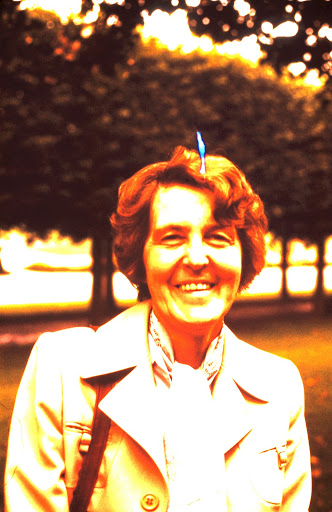
And there’s a story that my grandmother told me about walking through Oldenburg with her father early in the era of Nazi power where he pointed at homes and asked his kids who had lived there? And pointed at a closed synagogue and asked them what it had been? This was shared with me as an example of quiet resistance, because children were coached to report in school any anti-Nazi behaviour of their parents. He was being cautious while still trying to make his children aware of what was going on. (Photo of my Oma, Erika Kreye Schwans)
And there’s a story about him that during the war he drove trains. I didn’t find much about what he did during his time in the military in the file. The denazification was focused on examining his entry into the party, being an early reserve fighter, and his year as local propaganda leader in 1938. I’ve a meditative vision of someone driving a train of goods and soldiers and seeing another train of emaciated Jews and others being sent to a camp. I’ve even felt a depth of unsettled emotion as if I were that witness.
The last time I was with my Oma, my grandmother, she described being hidden by her parents when the war was ending, and hinted at being sexually assaulted by Allied soldiers who saw the amoral Germans they had conquered as subhuman and worthy of punishment. She also hinted this was why her cousin Gerda had taken the unusual path of never marrying.
I also know my Opa saw Germans as a lost people, told his children America was better and encouraged them to move there. I know nothing about what the women in my family did or what they thought of the Nazis and their husband’s choices to engage.
I remember my father saying that he didn’t learn about WWI or WWII until he was older because it was too painful for people to talk about. He said in school they always stopped history lessons before WWI.
These are the puzzle pieces I’ve managed to assemble.
I once watched a documentary of an Israeli Jew whose grandparents had emigrated to Israel from Germany in the 30s. He was going through his grandmother’s house when she died and was shocked to find letters with high level Nazi officials who had maintained friendly correspondence for years. He said that the first generation lives it, the second generation tries to survive the trauma and move on, and the third generation has enough space to question it with curiousity.
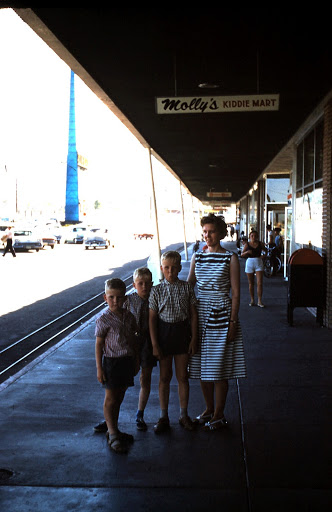
As I’m fourth generation to those more deeply involved in the Nazi project, perhaps my role isn’t to question with curiousity but to hold the known and unknown with compassion as best I can. To let go of trying to understand where the trauma has come from, and instead to keep accepting as it comes up and living in such a way that I allow it to heal. (Photo of Oma, my dad and his two brothers arriving in the U.S. in the 19602 to live in El Paso for their father’s work for a couple years. My father is in the middle.)
One such approach came to me in a dream recently. My Opa said if he had had another country he could have lived in besides Germany he would have taken a moral stand against the government. He said I could do that with America now that I’m Australian, and knowing how much he revered America, that felt powerful. But I have come to feel that it’s not currently the country that my ancestors worked hard to be part of.
Reckoning with our past failures is painful, but denying and repeating them is even more so. One thing I have learned from having both Nazis and Jews in my family, is that offender shame and victim resentment are equally destructive.
I hope Australia continues on a different and wiser path than America, choosing compassion and mutual respect with care for Country, not exclusionary and extractive behaviours that breed shame and social division.

If you value this content, please engage in reciprocity by living, sharing and giving. You may be interested in Valerie’s book Healing through Indigenous Wisdom and Earth Ethos retreats on Yuin Country, far south coast NSW.
I found this post very interesting and moving.