Tag Archives: whiteness

Settler Trauma Reading List

Blog by Lukas
For everyone interested in further exploring the topic of settler trauma — 
First you might like to further work out your own ancestry:
Genealogy assistance: Family search is a free and popular service for doing basic genealogy research based on public records.
And when you would like to do some more reflection about what intergenerational trauma might be coming up for you.
Blogs
Roots deeper than whiteness — David Dean: Pithy and succinct history of how “whiteness” erased culturally richer European ethnic identities and allowed for racism and exploitation of non-whites. Very America centric, but captures something essential about the “white” identity that is an important, though non-exhaustive, component of settler trauma.

Empathic dialogue 


Topical overviews
Indo-European language family: Lukas is producing a podcast on this, but familiarising yourself with the idea of the Indo-European Language family will give you a sense of the way in which so much of the worldview of the modern Western mind derive from a common ancestors like the Yamnaya peoples of the Eastern European steppes.
Enclosure movement: Critical historical shift in Britain (and by extension, Ireland) in the relationship between people and land, from feudal “rights” (which were of course based in intense hierarchy) to ownership, “rents” and thinking of “output” and productivity above all else.
Books specific to Anglo-Celtic Australian settler trauma

The Fatal Shore — Robert Hughes: Detailed history of the “transportation” system and the abuse experienced by convicts, and life in “Dickensian” England. Note that some of the history as presented in this book is contested, but it nevertheless gets to some deep truths around rejection and dehumanising that still plagues our culture.

The Tall Man – Chloe Hooper: Deep dive into the world of a policeman who worked in outback towns across Queensland before being involved in an Aboriginal death in custody on Palm Island, told as a parallel story alongside the life of the man who was miles. Shows the depth of wounds on both sides and the inability of large colonial institutions like the police to cope.

The Way of WyrdThe Timeless Land – Eleanor Dark: Work of incredible channeling by Eleanor Dark from the 1950s who tries to get into the mindspace of both colonists and Aboriginal people in the early days of the colony at Sydney Cove. Presents the crucial idea in Indigenous Science that how you treat others — for example convict flogging — is a reflection of oneselves because we are all interconnected.

The Way of Wyrd – Brian Bates: Rich and thought provoking research informed narrative exploring Anglo-Saxon Paganism. Provides a tantalising insight into another way of being practiced by your relatively recent ancestors.

giveheart If you value this content, please engage in reciprocity by living, sharing and giving.

Cry of the White fella

A poem by Lukas

Our position of dominance hides our shame and pain.

I see those white fellas who show up with their engrained sense of superiority manifesting as ignorance, hate and prejudice.

I see saviour types who subjugate their own pain under the yoke of guilt, forever seeking to unburden themselves of their shoulds: “This genocide should never have happened”; “They should have what I have now”; and most insidiously “With all that I have, I should be happier”.

And finally, I see those disassociated souls who seem perpetually determined to view things from a distance that renders things invisible. But of course that’s nonsense. To be numb does not mean the wound is not there.

I am and have been all of these white fellas. Just last week I cycled through two of them in the space of a few minutes. This panorama of experience is my blessing.
CharliesCountry I see us all suffering under the weight of unbridled intellect, greed and injustice. I see us all suffering from this ungrounded world we’ve created, oppressor and oppressed alike. The surface powerful and the surface powerless. And the other types of power, more hidden, mysterious.

We need to work together. We need to learn and grow together. We need to put down our shoulds with their biases and prejudices and take stances of openness.

We need to start with ourselves.

White fellas can start with simple questions: Do my feet really rest on solid ground? Does expansive and peaceful wisdom flow through me, or am I really just afraid and ashamed almost all the time?

I have the luxury of knowing that I am not alright. I read through a list of things to “help” the black fellas and there is not one thing that I myself don’t need also. I feel deep in my heart, mind, bones and spirit that in some form or another, I too need that medicine. All of it. I too need healthy connections with body, emotions, kin, community, culture, country, culture, law and spirit. 

I feel like a man looking upon an oasis with an overwhelming thirst the world does not recognise. It sees abundant hydration everywhere I tread my privileged white feet, while I see poison and trickery.

lukasgiftpainting

I never, ever, want to engage in a project to help only “them”, whoever “they” may be. That is fraud. How can someone so in need of help himself engage in anything but an exchange?

And so to their medicine needs to be my medicine, being as it is so deeply rooted in the earth where I now live. And the flexibility and grandeur of my people’s medicine, the laser-like linear time beam of problem-solving intellect, can do better work when anchored to the side of a mountain not roaring around ungrounded like the wind.

giveheart If you value this content, please engage in reciprocity by living, sharing and giving.

Healing Whiteness Trauma

Blog by Valerie

“The first step in liquidating a people…is to erase its memory…Before long a nation will begin to forget what it is and what it was. The world around it will forget even faster.”—Milan Kundera

Whether you are considered “white” or not, I feel confident saying you have been impacted by whiteness trauma, and as this quote suggests, that your people/s likely experienced and perpetrated genocide somewhere in your family line/s. Genocide is an intentional act to destroy a people, and whiteness is an intellectual construction based on traumatic social rejection from & disconnection with Mother Earth, self & cultural heritage, and other people. It was used as a tool by the ruling class to divide the working class, and so is also called “the bribe of whiteness.” David Dean gives a clear and compelling history of the creation and rise of the “white” identity in this article, People who have learned to identify as “white” tend to deny their own complex cultural heritage. Some people even study “whiteness theory” and “white fragility” to try to make sense of the shame they carry and the way this history of European identities being whitewashed and replaced by modern, nationalistic ‘Western’ identities still play out today. For example, did you know that assimilationist policies in the U.S. in the late 1800s and early 1900s led to companies like Ford running mandatory English classes and job training programs that finished with ceremonies in which people clad in traditional cultural clothing walked through a huge ‘melting pot’ then emerged in company uniforms? (Image from here)

fordschoolmeltingpot

David Dean cites the success of such policies & programs on two factors:

  1. The violent displacement of communities from their traditional lands in order to use that land for profit and create a dependent, exploitable workforce, and
  2. The replacement of traditional cultural identities that valued the welfare of the community and the Earth with a culture of capitalistic, possessive individualism with a social hierarchy divided along racial, gender, religious, and other identities.

As Tyson Yunkaporta points out in his new book, ‘Western’ is not an identity, because by its nature it is in reference to someone or someplace else (presumably ‘Eastern’); it is not inherent. To be ‘American’ or ‘Australian’ is also quite amorphous. I have out of curiousity asked a number of people what it means to them to be ‘Australian,’ and I have gotten one of two answers: (a) I am part of a multi-cultural modern soup, or (b) It means nothing to me, and I am English/Irish/Wiradjuri/Yuin/etc. living on this land we collectively call ‘Australia’.

My view is that whiteness trauma is based on a European history of intergenerational trauma, shame & pain. It was spread by the Romans & other empires dividing and subjugating peoples on their traditional lands; by the violent spread of Christianity through power & force, including the systematic desecration of indigenous & pagan sacred sites; and by horrendously hateful acts such as witch trials, inquisitions, slavery, rapes & genocides. It seems to me that over the last few thousand years, violence, terror & control became normalized as a method of asserting dominant leadership throughout Europe. Multi-generational disconnection with an innately human intimate & reciprocal relationship with the Earth were replaced by a power struggle for whose anthropocentric story is ‘right’, in a might-makes-right model. This led to land ‘discovery’ (i.e. colonisation) and other myths such as when upper class, white-skinned, Christian, land-owning males founded a ‘free’ government for ‘the people’ in the U.S. Ultimately, whitewashing & glomming together of many European peoples and cultures into “Western” expanded to non-‘white’ people, so that today millions of people around the world identify with a colonial nation rather than a traditional culture living within an empire.

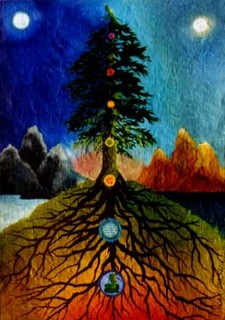
Here is a little poem I wrote about my own journey of healing ‘whiteness’ trauma:treechakras

Beneath the Roots

Ancestral trauma 
Has defined me
But I kept digging
Because I knew
My taproot was deeper
And drinking in peace
Somewhere down there

To heal from whiteness trauma, I have found many helpful approaches, including: honouring ancestors, grounding, re-defining tribe & belonging, bridging multiple identities, healing power dynamics, and healing existential wounds. The following quote is a humbling reminder of what our indigenous minds carry somewhere inside of us from an Australian Aboriginal culture more recently colonised:

“The first peoples of this land don’t need statues of our heroes, we have mountains that remind us of our people. We don’t need painted portraits, we have rivers that flow with the stories of our dreaming. Our songs are filled with culture, our language of the land. So we don’t need books. Our history, our connections, our hearts are true to this country.”–Baker, 2017, quoted in Koori Mail, Oct 23, 2019 p. 24

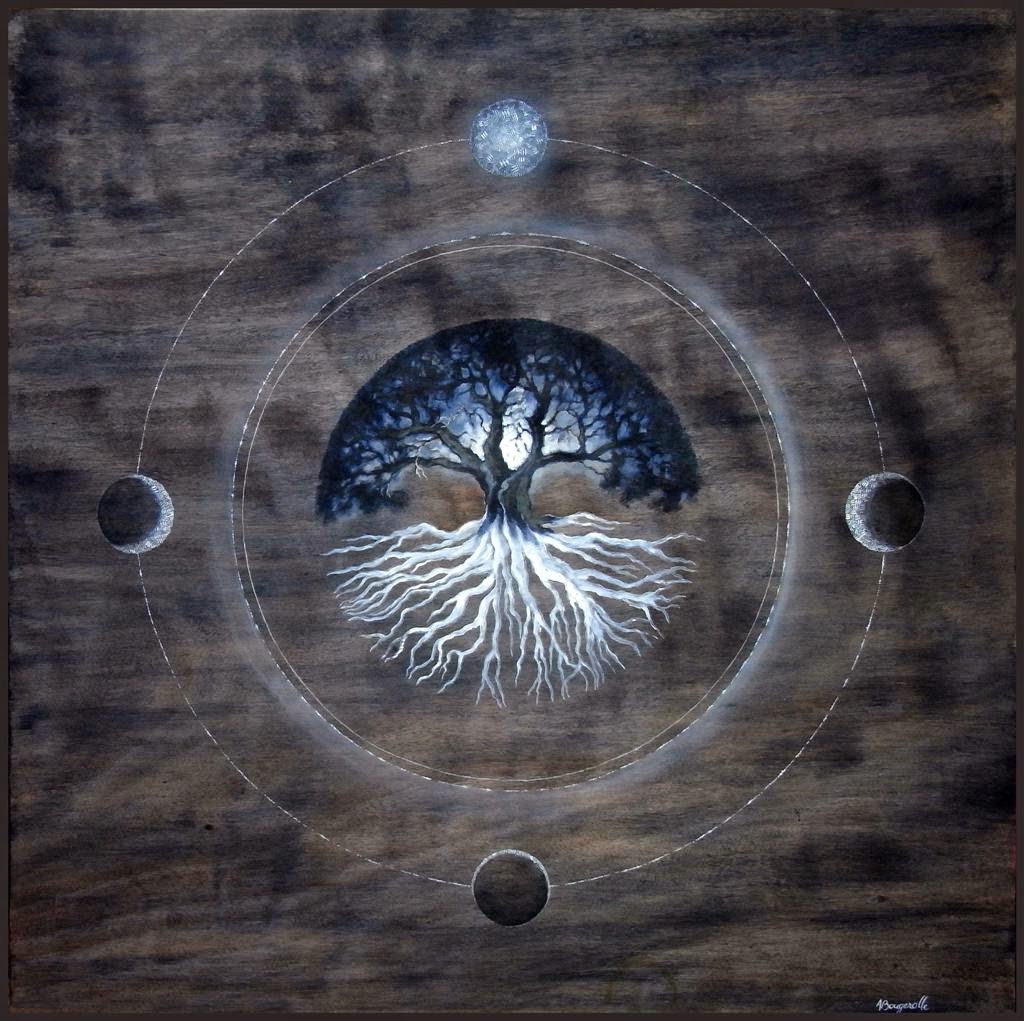
- Tree Annick Racines du Ciel

(Image from here, by artist Annick Bougerolle)

giveheartIf you value this content, please engage in reciprocity by living, sharing and giving.