Blog by Valerie
Lately some protracted conflicts have come to the surface in my life at a macro level in the world, and at a micro level in my daily life. I have been praying quite a lot since the war in Ukraine broke out, where my Jewish-Sumerian ancestors spent many generations living, and more recently about the war in the Middle East. It seems to me like there is existential war and rejection going on based in judgment, where one or more parties to a conflict feel they are fighting to exist in the minds and hearts of the other.
I find existential judgement incredibly dangerous and damaging and see it as the root of genocide. It feels to me like a hand rejecting its own finger. If we believe in a Creator with wisdom our human minds cannot comprehend, how can we put ourselves in the position of judging what the Creator brought into being? And to say another is allowed to exist elsewhere (NIMBY) is still judgmental, for if we force another to leave their home and live on different lands, we change their and our identities by disconnecting people from their earthly homes and playing the roles of victims and offenders.
On a micro level I’m seeing this thinking play out in some righteous social justice warrior crusades around me. I find the concept of ‘rights’ to be violent, though it has obvious practical value to create baseline standards for society. If we didn’t existentially judge certain struggles and behaviours as deeming people unworthy of housing or health care or food, then rights would simply represent social baselines we collectively agreed upon as minimum standards of care for all of us humans living here. But if a single mother can’t afford housing, or a man with mental illness isn’t at retirement age but can’t hold down a job, we don’t collectively agree how (or sometimes even if) to support their survival. Rights then get used in a forceful way to push a majority social group’s minimum standard of support onto the collective, and thus they often need to be en-forced. And when we are judged and caught up in the rights battles we feel, rightly so, like we are fighting for our survival. (See survival strategies blog)
I agree with Jungian scientist Fred Gustafson that the Western mind is “having a massive collective nervous breakdown” and is going to “war to determine whose anthropocentric [world]view is most valid [while] the earth and all its inhabitants [] suffer.”[1] I have not found sufficient solace for survival in the Western world alone.
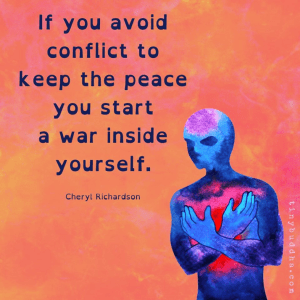
 For me it has been vital to live in two worlds: (1) a social reality that is based on a Western worldview, and (2) an earth-based reality based on an Indigenous worldview. When I’m caught up in a survival struggle in the Western world that’s terrifyingly real, and I’m feeling rejected and judged and shamed and angry, I can spiritually connect with the knowing from the Land and my ancestors that I’m not only allowed to exist but that I am wanted. This powerful medicine is all I have found that alleviates my existential wounds. Without it I feel like I would not still be here on this Earth, as my roots would have rotted and not been able to hold up the rest of my inner tree of life. (Image from here)
If you’re also feeling some pain and heaviness about existential judgement and its impact, here are a few things that help me keep my spirits strong:
- Grieving is a way I like to express angry energy to avoid getting overwhelmed by righteousness and gain clarity which fights, if any, feel right for me to engage in, and what that means practically. You may prefer to yell and scream or throw things or punch a bag instead, so however you express anger to avoid it overwhelming you is helpful.
- Connecting with the land and ancestors where I am offers me powerful healing. I may give offerings as simple as feeding a bird or picking up rubbish, or as profound as a placenta burial or smoking/smudging ceremony. I may also cultivate a sit spot on the land, walk barefoot, and tend a tree altar. There are so many more ways to connect with the land where you live, these are but a few. The reverence we bring to the action we choose matters more, I think, than exactly what we do.
- Letting go of black-and-white, objective, judgmental thinking is something I am very fierce with myself about. Humility is an important value to me, so I ensure that even when I feel certain or highly confident about something that I carry a little bit of doubt. For example, I feel highly confident that child sex abuse (link) is a damaging act that is wrong to do. Yet my intense journey of seeking to heal that wound has brought me so much wisdom and peace. Spiritual gifts often thrive in grey, paradoxical spaces.
 Altering my consciousness is another survival tool I use daily, primarily through embodied meditations and drum journeys. I do it to heal trauma, connect with ancestors and other spiritual guidance, and seek tools for every day survival such as deeper spaces of compassion or peace. However you are able to sink deeper than your everyday ‘known’ and familiar thought loops can bring you some healing. I do find, however, that embodied practices (such as using sound or dance or breath techniques) are more powerful than mind-based practices (such as meditating through your third eye or simply watching your thoughts).
Thank you for reading this, and may your life be enriched (and even saved) by living in both worlds, as mine is.
[1] Gustafson, F. (1997). Dancing between two worlds: Jung and the Native American soul. Mahwah, NJ: Paulist Press.
 If you value this content, please engage in reciprocity by living, sharing and giving.
 Earth Ethos
3 thoughts on “Navigating Existential Judgment”