Blog by Valerie
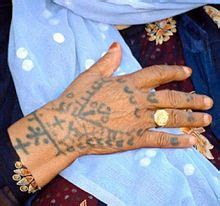 This blog idea came to me a while ago when I read an article about the revival of Deq, a traditional tattooing technique in Kurdish and some other Arabic and Northern African cultures. I had always been told you can’t be buried in a Jewish cemetery with a tattoo, and something about this tradition resonated as more ancient and true to my Sumerian roots. The article explained that Deq is a form of worship, with tattooing the skin believed to also engrave a person’s soul. It is a women’s tradition that uses breast milk and another substance (such as soot) to create the ink. (Image from Wikipedia)
Deq differs greatly from modern conceptions of tattooing. While today individuals often get tattoos for decoration or to memorialise events, people, or beliefs, deq is traditionally done to request abundance, protection, blessings, or fertility from God.
Spiritual protection is a common reason for tattooing in Indigenous science. According to Western scientist Lars Krutak of the Smithsonian, traditional cultural tattooing is done for the following reasons:
- Adornment
- Identity
- Social status
- Therapeutic/Health
- Spiritual protection/Animal mimicry
(Krutak, L. (2015). The cultural heritage of tattooing: a brief history. In Tattooed skin and health (Vol. 48, pp. 1-5). Karger Publishers.) Most of these we can relate to today, though you may be wondering what therapeutic or health tattoos are. Among our ancient ancestors are tattooed ceramic figures that are over 6000 years old found in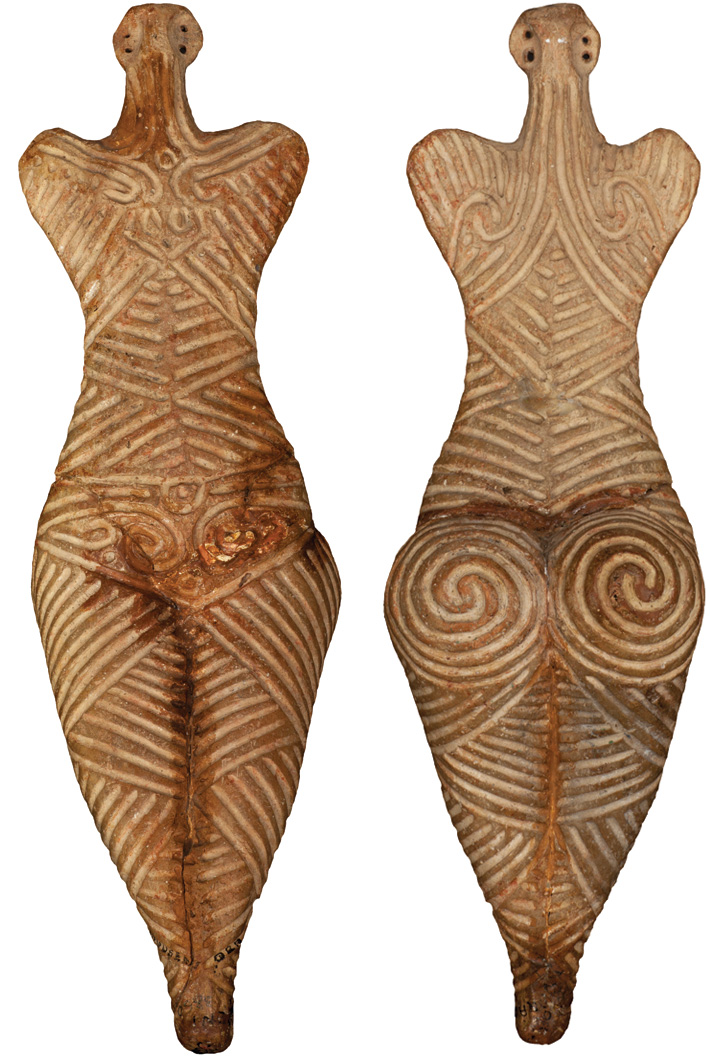 modern day Ukraine and Romania, and a 5000 year old mummy found preserved in ice in the Italian Alps who appears to have therapeutic tattoos in places on his body that look similar to a practice in traditional Asian cultural medicines. Such tattoos tend to be at joints and in the lower back. Tattooed mummies have also been found from Egypt to Siberia to Peru, and tattooed earthenwares of human or spirit figures have been found across the world from ancient Mississippi to Japan to the Philippines.
 The word ‘tattoo’ was brought into English from James Cook’s 1770s journey to New Zealand and Tahiti, and supposedly inspired Western sailors to start a tradition of tattooing themselves to remember where they had traveled and people they missed at home. (Image of a Ta`avaha (headdress) with tattoos, Marquesas Islands, 1800s, via Te Papa from here) Though modern Polynesian tattoos differ by island and culture, generally tattoos are seen as a form of spiritual protection, cultural status symbols displaying rites of passage, and signifiers of ancestral lineage. Where tattoos are on the body, and what symbols and motifs are used, are also important as they link people to their Creation story:
In Polynesian Mythology, the human body is linked to the two parents of humanity, Rangi (Heaven) and Papa (Earth). It was man’s quest to reunify these forces and one way was through tattooing. The body’s upper portion is often linked to Rangi, while the lower part is attached to Papa.
But tattoos have a long reputation as being lower class in Western culture due to their link with slavery and criminality, which can be traced back at least to ancient Greece and Rome, and likely to ancient Mesopotamia before then. As recently as in the 1800s in parts of Europe tattoos were being outlawed and seen as unChristian. And while the major world religions are not associated with traditional tattooing, there are exceptions, such as a Buddhist monastery in Thailand that “anchors” people into scripture with tattoos. (Image from here of Angelina Jolie). And while I can’t speak for how locals feel about Angelina’s tattoos (she was given Cambodian citizenship and adopted a child there, so she has come cultural connections), I feel uncomfortable about the amount of cultural appropriation that goes along with tattooing in
 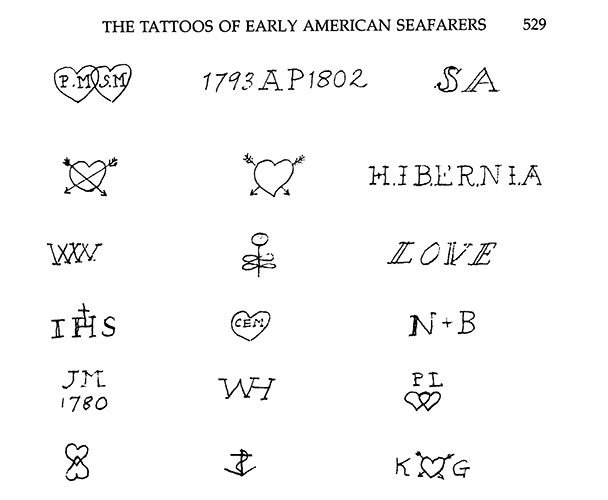 Western culture. I remember a trend some years ago of getting Chinese characters tattooed without many people even knowing or speaking the language. (I used to wonder how people weren’t scared they were lied to about what their tattoo said!) And many modern designs in Western culture have originated from those early sailors’ tattoos in the 1700s and 1800s. However, many have not, and where some celebrities like Dwayne “The Rock” Johnson express Samoan heritage through tattoos, others like Mike Tyson who is not of Maori descent has a ta moko design on his face (See this article on a history of tattooing in the U.S. by Sara Etherton). (Image from Visual log of tattoos seen on sailors in a survey done in 1809. (Ira Dye, “The Tattoos of Early American Seafarers, 1796-1818,” Proceedings of the American Philosophical Society 133, no. 4 [1989]: 520-554. accessed here).
I have two tattoos. The first commemorates a flower I have a cultural connection with as well as a number, a colour, and some simples values; the second commemorates an insect I have a cultural and personal connection with. I got them both with close friends at the time during important moments in my life to mark endings/beginnings. Their placement is interesting – one on my right hip, and one on my left foot. I trust the intuition of those choices. I don’t notice them much anymore, they just feel like part of the fabric of me, and I’m thankful that though I got them when I was young, I still appreciate their presence on my body, and I have no need to be buried in a Jewish cemetery anyway.
Exercise: Reflect on any tattoos you have (or have considered getting). How do you feel about them – their aesthetic, meaning, and history? Is there anywhere you would or would not get a tattoo? Do you resonate with the idea that they connect you with your Creator or that they imprint onto your soul?
 If you value this content, please engage in reciprocity by living, sharing and giving.
 The Timeless Land – Eleanor Dark: Work of incredible channeling by Eleanor Dark from the 1950s who tries to get into the mindspace of both colonists and Aboriginal people in the early days of the colony at Sydney Cove. Presents the crucial idea in Indigenous Science that how you treat others — for example convict flogging — is a reflection of oneselves because we are all interconnected.
 Earth Ethos