 If you value this content, please engage in reciprocity by living, sharing and giving.
All posts by Valerie Ringland
My initiation into adulthood was evil
Long Blog by Lukas
I suffered brutal bullying in high school. I also acted as a perpetrator. And a bystander. Sitting on all sides of this equation is perhaps the hardest role of all. There are many anecdotes I could tell but one stands out, because it was an encounter with traumatic evil, and perhaps more than any other moment in my adolescence, marked the loss of my childhood innocence.
***Trigger warning: bullying story. To skip the story, scroll below to the next *** for reflections.
It was school camp 1998. Year 8. I was 13. My bullying experience at the hands of my so-called circle of friends had been slowly gathering pace. But there’s only so much that can be done in the hours of a school day. School camp was going to be a different beast.
Sensitivity and my steely sense of fairness and justice are amongst my greatest gifts, but like many such things, are a source of great vulnerability. I used to liken myself to a ripe peach. Not only did I bruise easily, but it showed so very obviously. Yet I never got squashed entirely. At my core I have a rock hard seed that doesn’t break. This gave my tormenters a sense of sport. Even the most sociopathic of people seem to tire of picking on something completely broken and pathetic.
In the days leading up to camp, a number of boys within my ‘friendship’ group had begun to use the word “core” and “non core” to describe members of the group. Core members received privileges, and non-core members were made to feel lesser than and ostracised from certain activities. I was “non core,” and it got to me, and they could tell. By then I had a number of nicknames that I hated too, not because they were particularly harmful, just the condescension of it all. We were meant to be friends. There was also a very dark and (as I experienced it) deeply shameful (though in hindsight, completely innocent) rumour of a sexual nature that had followed me all the way from early primary school that lurked in the background. Such was the power of the shame over me that they only needed to threaten to use it to crush all resistance I might have offered. Call this the nuclear deterrent. (Image from here)
Even at 13 years old, I feel like I had some responsibility for not exiting this group earlier. But even to this day I have a tendency to let things run their course in social dynamics even when it’s clear they’re not healthy. I call this my “crash the plane into the mountain instead of jump out with a parachute” mentality. It’s something to work on. And run its course it did, a crash course with the mountain of school camp.
It didn’t take long. A long bus ride filled with put-downs and taunts was followed by the announcement that only “core” group members could keep their bags inside the tent. There was also the “core” clothes line. I’d had enough. With a barrage of insults fired back in their direction, I announced that I was done with them. I made a deal with another brutally bullied chap who wanted to be in this social group to swap tents. I had no sympathy for him.
It was well and truly on. I had challenged their power publicly. The “nuclear deterrent” was armed and readied for use. Sexually based taunts have a particular sting to them, perhaps because we are so apt to feel shame in that area, such are our deeply socialised taboos. I tried to show my face at the campfire – as one wants to do at a camping trip – but the put downs were unrelenting. I had no defense, no come back. I ran back to my tent, tears streaming down my face. Beaten. Broken.
But worse was to come.
I wrapped myself up tight in my sleeping back and sobbed. It was not performative in the slightest, and was to my knowledge, private. But no.
All of a sudden I felt a deep pain in my back. Someone or multiple someones had followed me back from the campfire and had kicked me, hard, through the tent. I let out a wail and some kind of “f*** you”. Insults given amongst sobs are not that intimidating though. A few seconds went by. I wondered if that indignity would be the end of it. But no. A second kick, even more painful.
This time I let out a guttural howl of rage, and emerged from the tent. I didn’t see my offenders so I ran over to their tent and jumped on it with all my weight. As one of those boys used to just love recounting in the weeks afterwards, it was one of those tents with the springy poles that as soon as I got back to my feet, just popped back into shape as though I was never there. Never there. That was about right.
My chief tormentor – the de facto head of the group – emerged from their tent. I don’t think he was one of my kick attackers, but I didn’t care. I punched him square in the face with all my might – just the thing to fix a bully according to my dad and just about all popular culture. He was briefly startled and began backing away. I shouted at him to fight me. I’ll never forget the way the expression changed on his face: from surprise, to alarm, to a brief flicker of readiness to fight and then..a smirk…and a headshake. He then turned his back on me and walked away. Clever.
With that gesture of profound condescension, he won. Did I proceed to keep beating him, to have my fight whether he was going to show up or not? No I did not. And this haunted me – perhaps I might even say crippled me, though in truth this incident was but one of many – for years. Decades. Perhaps it still does.
I spent the following days feeling and playing dead. There was more to the bullying even on that trip, much more, but I’ll leave it there.
I did not tell an adult, the teachers. But I looked them searchingly in the eye. Perhaps I was asking myself “could, or should, I tell them?”. But no. I got the feeling they didn’t like me. One of them – the Deputy Principal in fact – actually and literally told one of my bullies that he didn’t like me. I don’t remember how I found that out. Perhaps it was because the previous year I’d been in his office for reasons of bullying on the offender side, and thus deserved it? Little did he know how much our thoughts were aligned, and how damaging this was to me.
***
I was never, and could never be, the same person again after this and many other experiences like it around that time. Leaving childhood behind forever is of course a natural and desirable outcome of adolescence. But the vehicle for my passage, my initiation, my ordeal, was evil. This is so far from the intentional, ceremonial, sacred and mediated by responsible elders kind of initiation that is practiced by wise cultures. It was trauma without much meaning beyond developing an intimacy with evil. But it was an evil I could not name, such was my deep belief that it was my deep personal failings that brought it upon myself. (Image from here)
In writing this, my ordeal sounds very alike the relationship between the Church and the people in medieval Europe. Don’t focus on the wrong of having your Indigenous culture genocided, pray for your forgiveness for your innate sinfulness.
Our deep patterns reverberate until something more powerful intervenes. For me, it has been having my adult life and the whole identity I was raised with fall apart. It’s like I’ve had to do my right of passage over again, but scarred, burdened and traumatised by the experience of the first, and, weighted down by the intergenerational trauma of my ancestors that I not only carry personally, but that which is literally built into the social and systemic structure of the society in which I was raised and still live.
Evil is a rather heavy hitting word. So much so that many modern social theorists reject it entirely, instead wanting to focus on pathological or environmental causes of harmful human behaviour. These perspectives are valuable, but to strip evil from our cultural lexicon is to reduce our ability to describe an experience of profound malevolence. (Image from here)
I think the aversion to ‘evil’ has more to do with a modern desire to have a common moral and ethical understanding of the world devoid of the spiritual. This is one of the many bad marriages between Western pluralistic liberalism and logical positivism. This is to say firstly, the belief that single sovereign entities (as opposed to confederations of sovereign entities) can hold and treat equally people with a diversity of spiritual beliefs, and that secondly, the rules and practices that govern such a culture can and should be based in concretely knowable moral and ethical truths that everyone can agree on.
In fairness to this way of thinking, much harm has been done under the guise of eliminating evil. Top down, coercive and dominating control of spiritual knowledge and life from religious institutions deeply abused the idea that there is an existential evil in the universe that should be eliminated at all costs. Attaching ‘existential’ to evil is deeply problematic (more on this later), and obviously even more so when wielded by those deeply beset by Wetiko.
But regardless, in my view, to live fully as humans I believe it essential to experience life at the level of the spiritual. In this I’m talking about that which is experienced outside of rationally expressed conceptual reason; that which gives life a lot of its meaning.
A sense of spiritual awe is never more important than when looking for ways to deal constructively with and making sense of profound suffering, pain and trauma. We need to be able to distinguish between the deeply painful in raw form, the tragic, and evil. I think this is why so many cultures “get out in front of it” so to speak, and intentionally inflict pain and ordeal upon people in the form of initiation. People need discernment in this area of life perhaps as much or more than any other. We need to see and be able to hold and make sense of the light, the dark and everything in between. (Image from here)
So like many, many things that have occurred as societies move on from Judeo-Christianity, the notion of evil is absolutely one of the babies that should not be tossed out with that bathwater.
Most people understand that suffering, pain and trauma are not synonymous with darkness and the shadow (though abusing our almost primal propensity to want to avoid it is a tremendously effective way to enslave people without their knowing it). They have a shadow, and can exist in shadow, but they are not intrinsically so. We experience them, and it is the quality of this experience that gives them their character. So they are definitely not evil, but they certainly can be expressed and experienced as so.
So what is evil?
Controversial Western psychologist Jordan Peterson has written and spoken a lot on the topic, and whatever you may think of his politics, I think what he has to say on this topic is valuable. He draws a very sharp distinction (perhaps overly so) between evil and tragedy.
The truly evil, he says, possesses a “demonically warped aesthetic”. After thinking about this for a while, I came up with my own version: “volitionally malevolent aesthetic”. I had to ruminate on what he means by “aesthetic” here, and I think he’s saying that part of a human action that comes from expression and taste, largely disconnected from practical necessity. When this expression is designed to cause extra suffering, that’s evil. Like a desire to manifest with free will and volition the polar opposite of beauty. It’s like he’s saying evil is almost like a kind of dark artistry.
Some of his examples are very very dark, such as the “work sets you free” sign on the gates of Auschwitz. This was not a work camp, but an expressly designed death camp. It was a deliberate torment. Evil upon evil. Something dark for the tormentors to enjoy.
When I think about my bullies, I think about the choice of things that they could have done to me. They chose things for maximum hurt, yes, a practical wielding of power. But the decision to kick me in the back whilst I lay sobbing in my tent, was an expression of some kind of dark…aesthetic. It was mostly unnecessary in a practical hierarchical sense. I was already beaten. It was about giving the whole affair a certain sadistic panache; an evil cherry on top.
The use of the word “demon” is interesting. Within Christianity it is used existentially. The devil is evil, and will always be thus, as a more or less cosmological fact. And so given his Christian sympathies, I am suspicious of Peterson here. So to me it proved interesting to look up the etymology of demon. (Image of Pazuzu, a Mesopotamian demon Valerie has seen in a number of visions and found to be helpful)
In its earlier usage, Demons were seemingly not originally nor wholly, existentially bad or dark. It was behaviour that was so. In most indigenous cultures, their darker characters or malevolent spirits are more teaching tools that everyone can learn from. Collections of energies that serve to remind all of us of the darker tendencies that we need to watch out for in our own selves. As spirit beings and helpers, there are more shades of gray, and less taboo. Perhaps this is what modern social theorists want to achieve when they focus on the environmental and social factors behind dark acts, rather than the physical or spiritual pathology. But I do believe we need to work with evil as a teaching tool, to help us see what we’re capable of, learn to avoid it, and process its meaning constructively. Because it does exist, like it or not, and if we pretend it doesn’t, I’m with the Christian perspective that “the greatest trick the devil ever pulled was convincing the world he didn’t exist”. I think denying evil’s existence will be to our severe detriment.
For me, deriving constructive meaning from my experience of evil has been largely about breaking my attachment to a culture that fostered and tolerated the behaviour on the one hand, and in other circumstances, punishes those who do evil with more evil. This, I think, was the mentality of the Deputy Principal who thought I “deserved” to be abused. Like jail in most countries, which makes an almost science out of doing evil onto those accused of doing evil (though I suspect jails contain more people whose crimes are better described as more tragic than evil).
With more space from modern Western society, I feel more free to access and develop healthier understandings of myself and the universe that situates evil in a more balanced perspective and context.
Exercise: Reflect when and where you feel you have encountered evil. Have you been able to process it in a way that felt constructive? Consider re-visiting one such encounter using an altered state tool such as meditation with the intention of reframing the meaning of your experience.
If you value this content, please engage in reciprocity by living, sharing and giving.
Living Systems Dialogue
If you value this content, please engage in reciprocity by living, sharing and giving.
Big news!
Vlog by Lukas
If you value this content, please engage in reciprocity by living, sharing and giving.
On Gossip
Blog by Valerie
When you hear the word gossip do mostly negative images of talking about people when they’re not there come to mind? Does it make you feel uncomfortable? Like everything, there’s a dark and a light side to gossip, and it’s something I’ve been reflecting on lately.
I remember years ago reading a story about gossip in an African community being vital to controlling the spread of HIV; a few men were denying they had the virus but their former partners knew otherwise and spread information through women’s gatherings. Gossip, when used with care, can be used to warn and protect and to build trust.
If it were a hot piece of metal, she’d have told me ‘don’t touch it, it’ll burn you’. But for many, if the concern is about a person, it’s silence and watching and only sharing experiences after the other person has been hurt too. I would much rather someone warn me, and not just watch me learn the hard way, whether it’s about a concerning person or object!
 I tend to err on the side of sharing things that feel like warnings about concerning behaviours or values conflicts. I also share things I find especially hard to witness and want help with when I feel that others might be able to hold the story with compassion or offer me insight. I see many people who are averse to gossip both titillated with taboo interest in it as well as acting nervous. Interestingly, people who lean into caring gossip sharing I find tend to be less judgemental than those who shy away. It’s as if those who avoid it are scared of being judged so they want to protect themselves and others from that, even at the expense of improving protection. (I say caring gossip sharing because intention matters, and it feels different than spreading rumours or not letting someone live down one poor decision.) (Image from here)
I feel a sense of responsibility to share some personal experiences. And for behaviour that’s dangerous, I may also share a story from someone I trust. Some years ago I attended a spiritual group, and after a while brought a friend along. After some months I started seeing the leader misuse power, and by then my friend was a regular. I talked to her about concerns it was starting to feel cult-like to explain why I left. I still felt a bit guilty I had brought her into it, but at least I had shared my process so she could make up her own mind. (She did leave eventually.) But I found it hard to talk it through and reconnect with her afterwards though we tried.
Avoiding talking through things is really hard for me as I struggle to rebuild trust, but it’s common in some cultures to practice forgetting or face saving. When I worked in clergy abuse healing, I met a number of families who had gossiped enough to know which priest was an abuser and who in the family had been abused, but had not yet talked to each other directly. To me that is a dark side of gossip – there needs to be some direct follow through if something concerning comes to light, not just gossip.
I once lost a close friend of eight years when I told her I was concerned she was in a domestic violence relationship with her husband, and that she was feeding that dynamic out of guilt that she had cheated by putting him in a position to punish her as she kept the secret. She did not speak to me for five years after I really that, and when she got back in touch she said she heard others say something similar a few years after I did when they didn’t think she was listening, and that she had recently divorced. She said what I did was really dangerous and risky. I told her I felt that as a friend I needed to be willing to risk ending the relationship to speak loving truth. The next step after gossip can make all the difference in demonstrating our values of protection, care, and believing in each other’s strength. As is discerning when it’s appropriate to gossip and with whom. Some secrets are meant to be kept, others are not. (That’s a dark side of loyalty, a subject for a future blog maybe!)
If you value this content, please engage in reciprocity by living, sharing and giving.Sacred Communication Dialogue
If you value this content, please engage in reciprocity by living, sharing and giving.
Vlog 1 – Winter Solstice
If you value this content, please engage in reciprocity by living, sharing and giving.
Book Announcement
Valerie’s book-baby is about to be published/born, on July 24 (Australia & New Zealand) & August 24 (US, Europe, Canada, Singapore, & other English-speaking countries).
The front & back cover from the official Rockpool & Simon & Schuster pages:

Available in many bookstores, hopefully your favourite one! A big thank you for pre-ordering & spreading the word to others who may be interested.
Honouring lack
Blog by Valerie
It is autumn here, and at the recent equinox we did a ceremony of thanksgiving. I like to read the Thanksgiving Address of the Haudenosaunee peoples. I find it really beautiful. We also asked for a few things, which later felt wrong to me, like it was the season of giving thanks for what we had, not to plant seeds and ask that they grow; so we did another ceremony expressing gratitude for what is working for us related to the area of life where we asked for change. That felt more balanced.
There are some areas of my life where I feel so deeply in lack that I feel pain and impatience even as I experience them healing. It is as if I’m coming from so far behind what I need that I can’t yet relax and feel at ease that it’ll keep going in a healthy direction. I need to keep it on my radar to pray about and act to improve within my power.
So I have decided that I no longer believe that I always have everything I need. It feels untrue and unkind to carry that belief. I believe my responsibility is to discern my needs as best I can and act within my power to meet them; and that dignity requires me to honour Life by allowing all energies that arise within me to be celebrated. At the moment, that means honouring lack, and so here’s my blog celebrating that. I hope you find value in it.
If you value this content, please engage in reciprocity by living, sharing and giving.Is it worth decolonizing my Filipino spirituality and mentality?
Blog by Ellis Bien Ilas
“The Filipinos of today are the happiest people I know. Why revisit the past and why does it matter now?” She told me with an unsure smile. I only just met her for the first time five minutes ago and somehow, our conversation took an unexpected dip into the stories rarely told territory.
When two strangers realise they’re both Pinoys because curiosity has prompted either of them to ask “Are you Filipino?”, there’s typically a surge of excitement when it’s a match. Usually, I reply by either talking about how long since I’ve been back in the Philippines or how much fun I had in my most recent trip. In this case, I had just returned from a trip to my homeland after a 5 year drought.
I casually recounted that while my trip was short and sweet, I was also on a mission to discover some local books on Filipino History. A quest that took me at least 9 book stores until a kind soul directed me to a shelf filled of said books on the second last day of my trip. It was a welcome relief after being repeatedly directed to the Filipino cookbooks section in my prior search.
Back to our unplanned discourse, I couldn’t possibly not share a tidbit or two about how aghast I was at what I’ve learned so far. Especially how our distant relatives have been wrecklessly jostled about from the Spanish to the Americans in deeply degrading (and staged) circumstances.
“…why does it matter now?” she recoiled back.

The sound of my name being called broke my reverie as I mulled her question. I was in an animal shelter and fortunately, it was my time in the queue to be attended to.
Being a Filipino-Australian who has been living in Australia since I was eight years old, I have also felt a gnawing inkling that now would be a great time in my life to rediscover my Filipino roots.
How does one start though? Scholarly articles and the very limited Filipino history ebooks on Amazon points to the fact that the colonial legacy of the Philippine’s past has left deep scars in the Filipino psyche, including “internalised oppression, self-hatred and colonial mentality” (David & Okazaki, 2006).
Hang on. Colonial Mentality? What does that actually mean?
Colonial Mentality
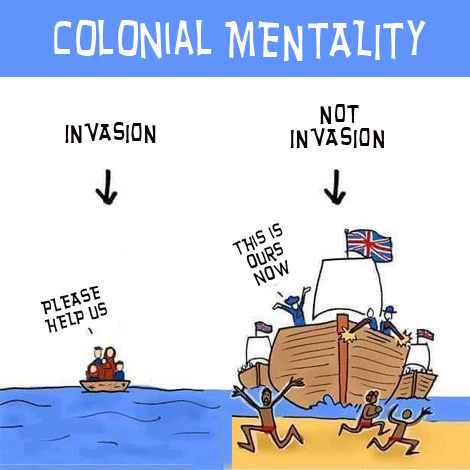 According to Nadal et al. (2016), colonial mentality refers to the internalisation of colonial values, beliefs and practices that devalue Filipino culture, language and identity. This can manifest as embarassment or feelings of inferiority over Filipino tradition and practices.
I recall when I first moved here in Sydney, Australia on several occassions, how several of my Filipino peers more often than not, proclaimed they were Fillipino-Spanish (even if that was 1/32th in bloodline). (Image from here)
“It just makes me sound more interesting you know. I’m not just another flip (Inner West Sydney slang for Filipino back in that time) who’s also a fob (fresh off the boat)”, I vividly recall an acquaintance disclosing.
David and Okazaki (2006, p.335) defines colonial mentality as “the conscious or unconscious acceptance of the belief that traits, values and practices associated with the coloniser are inherently superior to those associated with the colonised”.
To dive a little deeper, the authors developed the Colonial Mentality Scale to measure colonial mentality, which includes the following dimensions:
1. Belief in the superiority of Western physical features (e.g., light skin, straight hair)
2. Belief in the superiority of Western cultural values (e.g., individualism, direct communication)
3. Belief in the superiority of Western education and credentials
4. Belief in the superiority of Western technology and innovation
5. Belief in the superiority of Western religion and morality
The authors found that colonial mentality was significantly associated with lower self-esteem, higher acculturative stress, and lower levels of Filipino cultural values and practices among Filipino Americans.
So basically, colonial mentality has negative consequences for our mental health and well-being.
Decolonizing the Filipino Spirituality
Mention the word spirit or espiritu to a Filipino and you’ll either be discussing about perceived ghost sightings/apparitions (which stems from one of the Philippines’ pre-colonial belief systems referred to as animism — the belief that objects, places or creatures all possess a distinct spiritual essence) or, you’d be discussing the divine power of the Holy Spirit (through the lens of the Romantic Catholic faith).
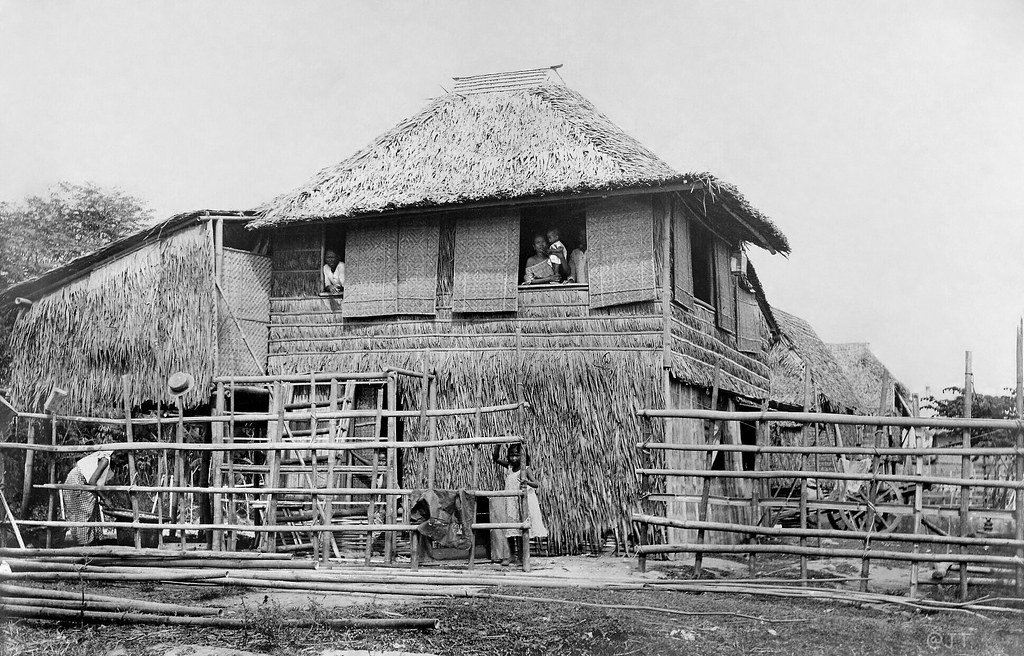 Constantino (1975) argued that Spanish colonialism and Catholicism had a profound impact on the Philippines, including the suppression of indigenous spirituality and cultural practices (which were largely based on animism), leading to the creation of a colonial and clerical elite. It also strongly impacted Filipino values and beliefs, how Filipino society is organised and the perpetuation of patriarchal and authoritarian structures of power, gender inequality and resistance to social and political change. (Image of pre-colonial Philippines house from here)
Let’s look at the typical Filipino family unit. Respecting and obeying Filipino parents and elders are deeply ingrained value and practice that is often associated with the way Catholicism has spread in the Philippines. These values and practices are based on the belief that Filipino parents and elders have the ultimate authority and control over their children and younger family members, and that their decisions and actions should not be questioned or challenged.
However, this value and practice can also perpetuate toxic and abusive dynamics in the Filipino family unit, particularly in relation to the reinforcement of authoritarian structures of power. For example, Filipino parents and elders may use their authority and control to enforce strict and oppressive rules and expectations, such as the control of their children’s education, career, and relationships; the restriction of their freedom and autonomy and the perpetuation of gender stereotypes and roles.
These dynamics can lead to unknowingly abusing that power, such as the emotional, physical, and sexual abuse of children and younger family members; the neglect and marginalization of their needs and rights, and the undermining of their agency and participation.
In light of the above, I’m not saying that Catholicism was all doom and gloom. I acknowledge that it also helped develop the Philippines through education and healthcare, as well as a sense of community and solidarity (which appears to still hold strongly today). However, it has caused issues still pervasive today. Problems that manifest in everyday life and I would imagine, most Filipino family units. Problems that I’ve seen myself and maybe, you have too. It’s possible that you have also considered, in the grand scheme of things, how did we get here and what can I do about it?
So… is it worth decolonizing my Filipino spirituality and mentality?
Considering the complex, multifaceted and evolving nature of the process of decolonisation, I don’t think I can reach a point and say, yeah, I’ve become decolonized now. Far from it.
But I am interested in improving my mental health and well-being, and this aspect of decolinization is a part of that process.
Despite this being in the making in the past few years, I’ve really only just taken my first few steps. My goal is to share this ever-evolving journey with others who may have had this spark lit within them. I’m curious to hear from you.
References
Constantino, R., & Constantino, L. R. (1975). The Philippines: A past revisited (Vol. 1). Quezon City: Renato Constantino.
David, E. J. R., & Okazaki, S. (2006). Colonial mentality: a review and recommendation for Filipino American psychology. Cultural Diversity and Ethnic Minority Psychology, 12(1), 1.
Nadal, K. L. (2020). Filipino American psychology: A handbook of theory, research, and clinical practice. John Wiley & Sons.
If you value this content, please engage in reciprocity by living, sharing and giving.
 Earth Ethos