Category Archives: Indigenous Science

Honouring lack

Blog by Valerie
It is autumn here, and at the recent equinox we did a ceremony of thanksgiving. I like to read the Thanksgiving Address of the Haudenosaunee peoples. I find it really beautiful. We also asked for a few things, which later felt wrong to me, like it was the season of giving thanks for what we had, not to plant seeds and ask that they grow; so we did another ceremony expressing gratitude for what is working for us related to the area of life where we asked for change. That felt more balanced.
Lack of Support and Destruction of Health and Life - Symbolized by Word ...As much as I have and am truly grateful for, this experience highlighted how much lack is in my life at the moment. I started to reflect on that. I realised that I have had a belief that ‘I always have what I need’, and so if something isn’t present in my life, then I must not need it. But that belief doesn’t feel like it is honouring my life. It feels like trying to reject or mentally trick myself out of being in lack. In new age-y and positive psychology thinking, ‘light’-ness is privileged, and we are pushed to look at the bright side. There is value to that, but not, in my opinion, if it feels forced or rejects our lived experiences. Sometimes life feels heavy and dark, and it’s important to make space for that. (Image from here)
Dams and water supply schemes suffer due to lack of rain | Utility MagazineOn the planet right now, so many plants, human and non-human animals are lacking safety, security, healthy food, clean water, shelter, etc. Why would I be any different? I would expect there to be some lack in my life given our collective environment. Lack teaches me to appreciate what I have, and to cherish what comes into my life when lacks are transformed. (Image from here)
There are some areas of my life where I feel so deeply in lack that I feel pain and impatience even as I experience them healing. It is as if I’m coming from so far behind what I need that I can’t yet relax and feel at ease that it’ll keep going in a healthy direction. I need to keep it on my radar to pray about and act to improve within my power.
lack-of-motivation | Born RealistAs I am still breast-feeding and being a full time carer, Lukas has been looking for employment for a few months. That struggle has brought stress, fear, and lack for both of us, along with moments of finding deeper faith and trust, as well as gratitude and joy for extra family time. Another example: the more I parent my toddler, the mirror of my own childhood continually brings up grief and lack for me to be with, along with the joy and relief of breaking patterns as best I can by giving my child what I didn’t receive. (Image from here)
The love of money. stock image. Image of crumpled, quarter - 76482929In the Jewish family and the secular capitalist culture I was raised in, people believed not in reciprocity and gift economy, but in transactions. As a non-Zionist Jew, my understanding from my family was to place faith and trust in accumulating gold, jewelry and money for survival, not land, because we could carry those things with us if we were forced to move. They saw me as a commodity too, which felt incredibly de-humanising. It confused me for a long time, how I could feel so much love and pain at the same time. It also existentially denied my spiritual gifts and strengths. But that’s how they saw the world and what they believed in. And I’m not in the business of trying to change anyone’s beliefs but my own. Beliefs are very personal things. (Image from here)
So I have decided that I no longer believe that I always have everything I need. It feels untrue and unkind to carry that belief. I believe my responsibility is to discern my needs as best I can and act within my power to meet them; and that dignity requires me to honour Life by allowing all energies that arise within me to be celebrated. At the moment, that means honouring lack, and so here’s my blog celebrating that. I hope you find value in it.
giveheart If you value this content, please engage in reciprocity by living, sharing and giving.

Navigating Existential Judgment

Blog by Valerie

Lately some protracted conflicts have come to the surface in my life at a macro level in the world, and at a micro level in my daily life. I have been praying quite a lot since the war in Ukraine broke out, where my Jewish-Sumerian ancestors spent many generations living, and more recently about the war in the Middle East. It seems to me like there is existential war and rejection going on based in judgment, where one or more parties to a conflict feel they are fighting to exist in the minds and hearts of the other. Difference Between Perception and Judgement | Compare the Difference ...

I find existential judgement incredibly dangerous and damaging and see it as the root of genocide. It feels to me like a hand rejecting its own finger. If we believe in a Creator with wisdom our human minds cannot comprehend, how can we put ourselves in the position of judging what the Creator brought into being? And to say another is allowed to exist elsewhere (NIMBY) is still judgmental, for if we force another to leave their home and live on different lands, we change their and our identities by disconnecting people from their earthly homes and playing the roles of victims and offenders.

On a micro level I’m seeing this thinking play out in some righteous social justice warrior crusades around me. I find the concept of ‘rights’ to be violent, though it has obvious practical value to create baseline standards for society. If we didn’t existentially judge certain struggles and behaviours as deeming people unworthy of housing or health care or food, then rights would simply represent social baselines we collectively agreed upon as minimum standards of care for all of us humans living here. But if a single mother can’t afford housing, or a man with mental illness isn’t at retirement age but can’t hold down a job, we don’t collectively agree how (or sometimes even if) to support their survival. Rights then get used in a forceful way to push a majority social group’s minimum standard of support onto the collective, and thus they often need to be en-forced. And when we are judged and caught up in the rights battles we feel, rightly so, like we are fighting for our survival. (See survival strategies blog)

I agree with Jungian scientist Fred Gustafson that the Western mind is “having a massive collective nervous breakdown” and is going to “war to determine whose anthropocentric [world]view is most valid [while] the earth and all its inhabitants [] suffer.”[1] I have not found sufficient solace for survival in the Western world alone.
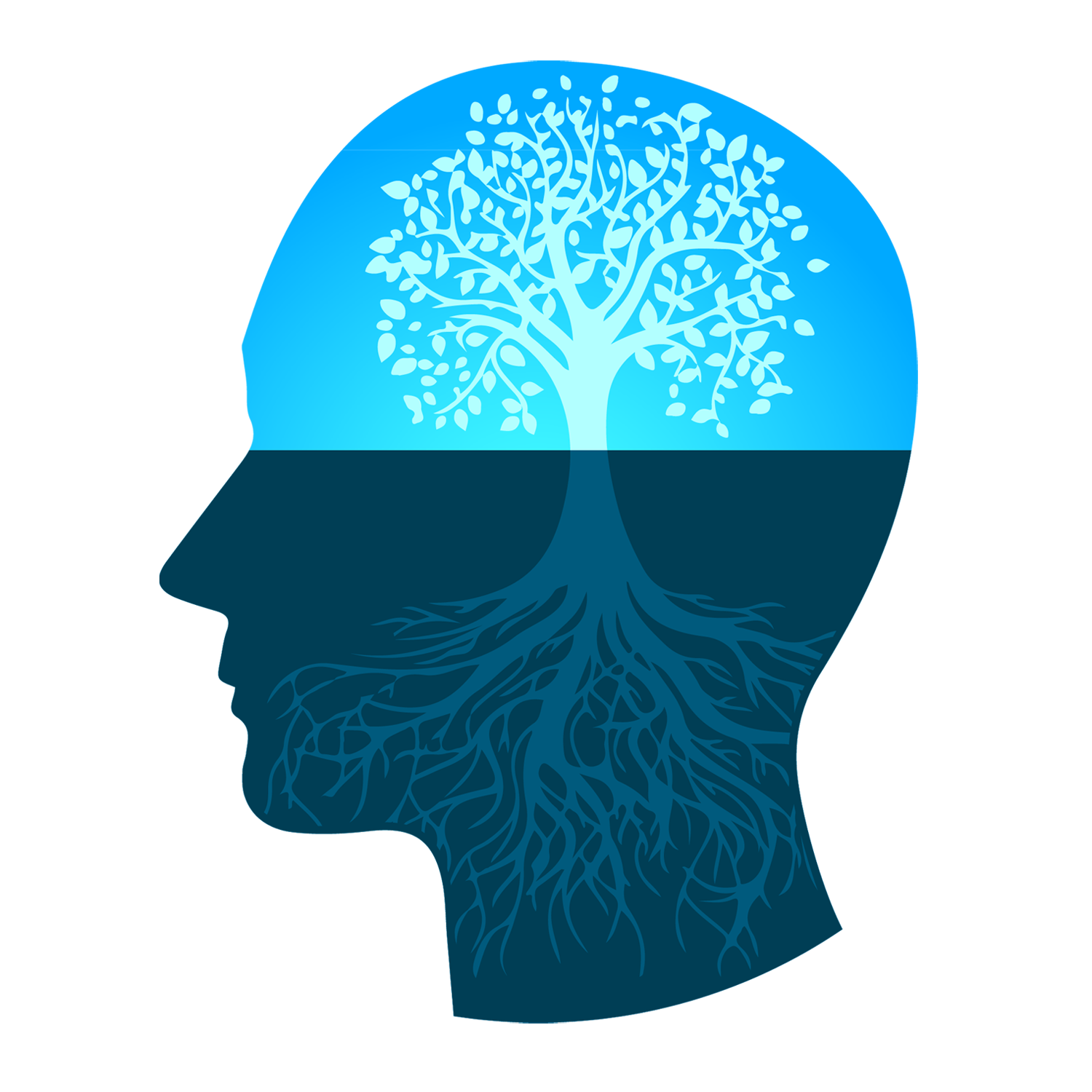
Mind PNG Images - PNG All | PNG AllFor me it has been vital to live in two worlds: (1) a social reality that is based on a Western worldview, and (2) an earth-based reality based on an Indigenous worldview. When I’m caught up in a survival struggle in the Western world that’s terrifyingly real, and I’m feeling rejected and judged and shamed and angry, I can spiritually connect with the knowing from the Land and my ancestors that I’m not only allowed to exist but that I am wanted. This powerful medicine is all I have found that alleviates my existential wounds. Without it I feel like I would not still be here on this Earth, as my roots would have rotted and not been able to hold up the rest of my inner tree of life. (Image from here)
conflict

If you’re also feeling some pain and heaviness about existential judgement and its impact, here are a few things that help me keep my spirits strong:

  1. Grieving is a way I like to express angry energy to avoid getting overwhelmed by righteousness and gain clarity which fights, if any, feel right for me to engage in, and what that means practically. You may prefer to yell and scream or throw things or punch a bag instead, so however you express anger to avoid it overwhelming you is helpful.
  2. Connecting with the land and ancestors where I am offers me powerful healing. I may give offerings as simple as feeding a bird or picking up rubbish, or as profound as a placenta burial or smoking/smudging ceremony. I may also cultivate a sit spot on the land, walk barefoot, and tend a tree altar. There are so many more ways to connect with the land where you live, these are but a few. The reverence we bring to the action we choose matters more, I think, than exactly what we do.
  3. Letting go of black-and-white, objective, judgmental thinking is something I am very fierce with myself about. Humility is an important value to me, so I ensure that even when I feel certain or highly confident about something that I carry a little bit of doubt. For example, I feel highly confident that child sex abuse (link) is a damaging act that is wrong to do. Yet my intense journey of seeking to heal that wound has brought me so much wisdom and peace. Spiritual gifts often thrive in grey, paradoxical spaces.
  4. earth ethos drum journeyAltering my consciousness is another survival tool I use daily, primarily through embodied meditations and drum journeys. I do it to heal trauma, connect with ancestors and other spiritual guidance, and seek tools for every day survival such as deeper spaces of compassion or peace. However you are able to sink deeper than your everyday ‘known’ and familiar thought loops can bring you some healing. I do find, however, that embodied practices (such as using sound or dance or breath techniques) are more powerful than mind-based practices (such as meditating through your third eye or simply watching your thoughts).

Thank you for reading this, and may your life be enriched (and even saved) by living in both worlds, as mine is.

[1] Gustafson, F. (1997). Dancing between two worlds: Jung and the Native American soul. Mahwah, NJ: Paulist Press.

giveheart If you value this content, please engage in reciprocity by living, sharing and giving.

Tattoos & Tradition

Blog by Valerie

Deq (tattoo) - WikipediaThis blog idea came to me a while ago when I read an article about the revival of Deq, a traditional tattooing technique in Kurdish and some other Arabic and Northern African cultures. I had always been told you can’t be buried in a Jewish cemetery with a tattoo, and something about this tradition resonated as more ancient and true to my Sumerian roots. The article explained that Deq is a form of worship, with tattooing the skin believed to also engrave a person’s soul. It is a women’s tradition that uses breast milk and another substance (such as soot) to create the ink. (Image from Wikipedia)

Deq differs greatly from modern conceptions of tattooing. While today individuals often get tattoos for decoration or to memorialise events, people, or beliefs, deq is traditionally done to request abundance, protection, blessings, or fertility from God.

Spiritual protection is a common reason for tattooing in Indigenous science. According to Western scientist Lars Krutak of the Smithsonian, traditional cultural tattooing is done for the following reasons:

  1. Adornment
  2. Identity
  3. Social status
  4. Therapeutic/Health
  5. Spiritual protection/Animal mimicry

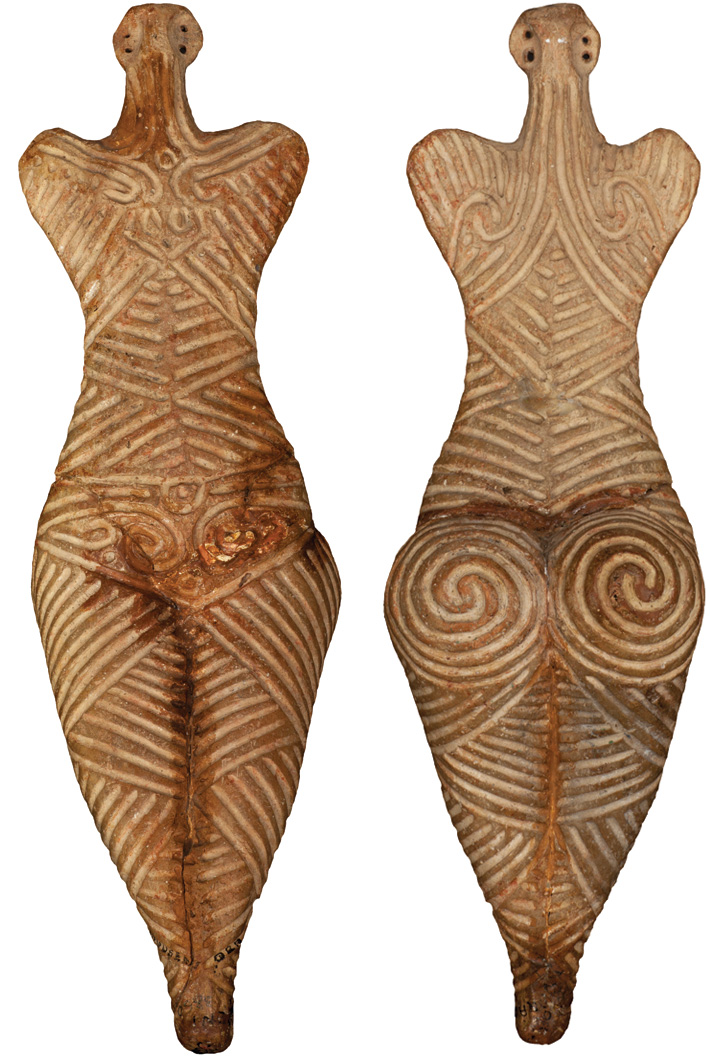
(Krutak, L. (2015). The cultural heritage of tattooing: a brief history. In Tattooed skin and health (Vol. 48, pp. 1-5). Karger Publishers.) Most of these we can relate to today, though you may be wondering what therapeutic or health tattoos are. Among our ancient ancestors are tattooed ceramic figures that are over 6000 years old found incucuteni-tattoos modern day Ukraine and Romania, and a 5000 year old mummy found preserved in ice in the Italian Alps who appears to have therapeutic tattoos in places on his body that look similar to a practice in traditional Asian cultural medicines. Such tattoos tend to be at joints and in the lower back. Tattooed mummies have also been found from Egypt to Siberia to Peru, and tattooed earthenwares of human or spirit figures have been found across the world from ancient Mississippi to Japan to the Philippines. 
taavaha headdress polynesian tattoo manThe word ‘tattoo’ was brought into English from James Cook’s 1770s journey to New Zealand and Tahiti, and supposedly inspired Western sailors to start a tradition of tattooing themselves to remember where they had traveled and people they missed at home. (Image of a Ta`avaha (headdress) with tattoos, Marquesas Islands, 1800s, via Te Papa from here) Though modern Polynesian tattoos differ by island and culture, generally tattoos are seen as a form of spiritual protection, cultural status symbols displaying rites of passage, and signifiers of ancestral lineage. Where tattoos are on the body, and what symbols and motifs are used, are also important as they link people to their Creation story: 

In Polynesian Mythology, the human body is linked to the two parents of humanity, Rangi (Heaven) and Papa (Earth). It was man’s quest to reunify these forces and one way was through tattooing. The body’s upper portion is often linked to Rangi, while the lower part is attached to Papa.

But tattoos have a long reputation as being lower class in Western culture due to their link with slavery and criminality, which can be traced back at least to ancient Greece and Rome, and likely to ancient Mesopotamia before then. As recently as in the 1800s in parts of Europe tattoos were being outlawed and seen as unChristian. And while the major world religions are not associated with traditional tattooing, there are exceptions, such as a Buddhist monastery in Thailand that “anchors” people into scripture with tattoos. (Image from here of Angelina Jolie).Angelina Jolie Sak Yant Tattoo's MeaningAnd while I can’t speak for how locals feel about Angelina’s tattoos (she was given Cambodian citizenship and adopted a child there, so she has come cultural connections), I feel uncomfortable about the amount of cultural appropriation that goes along with tattooing in Western culture. I remember a trend some years ago of getting Chinese characters tattooed without many people even knowing or speaking the language. (I used to wonder how people weren’t scared they were lied to about what their tattoo said!) And many modern designs in Western culture have originated from those early sailors’ tattoos in the 1700s and 1800s. However, many have not, and where some celebrities like Dwayne “The Rock” Johnson express Samoan heritage through tattoos, others like Mike Tyson who is not of Maori descent has a ta moko design on his face (See this article on a history of tattooing in the U.S. by Sara Etherton). (Image from Visual log of tattoos seen on sailors in a survey done in 1809. (Ira Dye, “The Tattoos of Early American Seafarers, 1796-1818,” Proceedings of the American Philosophical Society 133, no. 4 [1989]: 520-554. accessed here).
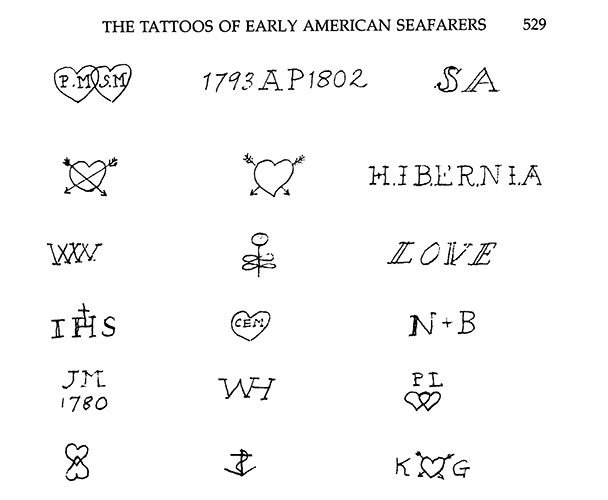
I have two tattoos. The first commemorates a flower I have a cultural connection with as well as a number, a colour, and some simples values; the second commemorates an insect I have a cultural and personal connection with. I got them both with close friends at the time during important moments in my life to mark endings/beginnings. Their placement is interesting – one on my right hip, and one on my left foot. I trust the intuition of those choices. I don’t notice them much anymore, they just feel like part of the fabric of me, and I’m thankful that though I got them when I was young, I still appreciate their presence on my body, and I have no need to be buried in a Jewish cemetery anyway.

Exercise: Reflect on any tattoos you have (or have considered getting). How do you feel about them – their aesthetic, meaning, and history? Is there anywhere you would or would not get a tattoo? Do you resonate with the idea that they connect you with your Creator or that they imprint onto your soul?

giveheart If you value this content, please engage in reciprocity by living, sharing and giving.

Birth as Ceremony

Blog by Valerie, following recent presentations with breastfeeding and pregnancy groups

We do ceremonies at important moments in our lives, such as weddings, graduations, and funerals. Ceremonies support us to gain knowledge, purify our spirits, and honour life. They can be as simple as a small act done with sacred intention, or as elaborate as a religious confirmation.

“In traditional practices and rituals, birthing involved more than the physical health of the mother and baby. Giving birth was a process of initiation and belonging to the culture that created spiritual links to the land and the ancestral Dreaming.”—Best, O., & Fredericks, B. (Eds.). (2021). Yatdjuligin: Aboriginal and Torres Strait Islander nursing and midwifery care. Cambridge University Press.

The birthing journey, from pregnancy to postpartum it is seen in Indigenous science as a time of spiritual initiation for the new mother. Initiations are transitional ceremonies that lead us through Earth’s cycle from life to death and rebirth into a new identity. For first time mothers, this journey is a profound shift from being a maiden into be-coming a mother, and for all mothers it is a journey of be-coming a mother within a new relationship.

Initiation ceremonies have three phases:

  1. Separation from daily reality;
  2. Ordeal or trauma; and
  3. Return or rebirth.

the tree of life ( our roots in life) | Creative Projects | Arte da ...In an Indigenous worldview, the mother is seen as a conduit between the spiritual and physical worlds, and birthing trauma as a meaningful initiation into spiritual adulthood. In fact, many Indigenous cultures have initiation rites only for young men, because childbirth (as a birthing mother, through miscarriage, and/or through supporting birthing women) is considered to be the initiation process naturally built into women’s bodies. (Image: Natural Birth Art Print by Sean Frosali, Society6)

Phase 1: Separation from daily reality – being pregnant

The moment a woman is pregnant, she and everyone she meets is in ceremony…The womb is our first orientation on Earth.–Patricia Gonzalez, Red Medicine: Traditional Indigenous rites of birthing and healing

During pregnancy, traditional ceremonies are based on:

    • Mothers and elders sharing wisdom about birthing, breastfeeding and childrearing;
    • Cleansing the mother’s space, including her body and home (i.e. massage, smudging);
    • Community support with certain tasks around the house for the mother;
    • Taboos and norms about foods, drinks, and activities a mother ought to do or avoid;
    • Honouring the babies’ soul entering the womb and protecting the mother and baby (i.e. with amulets, prayers, and rituals, and avoiding aspects of life such as funerals);
    • Helping to welcome and support a new baby (i.e. to ease a first time mother’s anxiety, baby showers).

Why we need to support Aboriginal women’s choice to give birth on countryThere are of course many cultural variations on such ceremonies. One example is in parts of India where there is a sort of baby shower called a Valaikaapu in which the mother-to-be is sung to by other women, adorned with bangles, soothed from anxiety with herbal treatment on her hands and feet, and fed traditional nourishing foods. After this ceremony in the third trimester, the mother-to-be traditionally stays at her parents’ house until the baby is born. Another example occurs in parts of Indonesia also begins in the third trimester with the mothers’ parents bringing food to their son-in-law’s family, and the mother ceremonially feeding her pregnant daughter before everyone else eats. The parents-to-be are then given blessings and encouragement by both the whole family, including being wrapped in traditional fabric as a symbol of strength for their union through the birthing journey (Silaban, I., & Sibarani, R. (2021). The tradition of Mambosuri Toba Batak traditional ceremony for a pregnant woman with seven months gestational age for women’s physical and mental health. Gaceta Sanitaria, 35, S558-S560.). (Image from here)

Phase 2: Trauma/ordeal – birthing

In the Mohawk language, one word for midwife…describes that “she’s pulling the baby out of the Earth,” out of the water, or a dark wet place. It is full of ecological context. We know from our traditional teachings that the waters of the earth and the waters of our bodies are the same.
—Rachel Olson, Indigenous Birth as Ceremony and a Human Right

During and immediately following birth, traditional ceremonies are based on:

    • Birthing sites in sacred spaces indoors (e.g. sweat lodges) and outdoors (e.g. natural pools);
    • Taboos about labour being quiet or loud, and women’s positions (e.g. squatting);
    • Norms about partners being present at birth, or having their own tasks to do for the baby;
    • Use of traditional herbal steams and poultices to cleanse the womb, stop bleeding, and help milk start flowing following the birth;
    • Protecting the baby and mother;
    • Umbilical cord ceremonial clamping and/or saving, or lotus birthing;
    • Sensual imprinting for the newborn through wrapping them in traditional clothing, jewellery, fur, and/or blankets; and
    • Body wrapping and womb re-warming practices for the mother after birth.

How Natural Birth Became Inaccessible to the Poor | by SAPIENS ...There are also many cultural variations for these ceremonies. For example, in Japan umbilical cords are saved and presented to new mothers in keepsake wooden boxes at hospitals. This tradition is meant to keep a good relationship between the mother and baby, and sometimes the box is given to the adult child when they leave home or marry to symbolise a separation in an adult-to-adult relationship. In Australian Aboriginal cultures, cultural birthing areas utilised natural depressions and sacred spaces such as rock formations, caves and water holes, to spiritually connect the child to their Country and their ancestors. Women followed ‘Grandmother’s Law’ which often included practices such as squatting over the steam of traditional medicinal plants after birth to prevent infection, how to name the child, and when the child would meet their father (Adams, K., Faulkhead, S., Standfield, R., & Atkinson, P. (2018). Challenging the colonisation of birth: Koori women’s birthing knowledge and practice. Women and Birth, 31(2), 81-88). (Image from here)

Phase 3: Return/rebirth – becoming a mother

We believe in waiting until 30 days after the birth for any celebrations. In our tradition, we believe that the unborn child has a guardian angel, who is the previous mother of the child. If we celebrate the pregnancy publicly, the spirit of the previous parent might come and reclaim her child — so that the new mother loses her baby!—Vietnamese grandmother quoted in Cusk, R. (2014). A Life’s Work. Faber & Faber.

In the postnatal months, traditional ceremonies are based on:

    • Protecting the baby and mother;
    • Naming and welcoming the baby to the land and family;
    • Building the newborn’s resilience with elements and weather;
    • “Firsts” (i.e. baths, foods, laughs, rolling over, walking, etc.);
    • Mother’s rest and recovery from birth (often 40 days); and
    • Placenta ceremonies.

Pin on PinturaA sweet example of such a ceremony comes from the Navajo/Diné people of North America have a ceremony to honour the babies’ first laugh, and the person who gets the baby to laugh throws a party where guests are given salt on the baby’s behalf as a symbol of generosity since it was traditionally valuable and hard to get (Brown, Shane. (2021). Why Navajos Celebrate the First Laugh of a Baby. https://navajotraditionalteachings.com/blogs/news/why-navajos-celebrate-the-first-laugh-of-a-baby). Across the world in Egypt, on the child’s seventh day after birth, a Sebou’ ceremony welcomes the baby with a number of traditions related to the cultural meaning of the number seven, such as placing the baby in a sieve and shaking them to symbolise life becoming more dynamic outside the womb, then stepping over them seven times saying prayers for protection and obedience to their parents; a candlelit procession of smudging the house; and a drink to increase breast milk production (Gamal, A. (2015).  The Sebou‘: An Egyptian Baby Shower, https://www.madamasr.com/en/2015/11/02/panorama/u/the-sebou-an-egyptian-baby-shower/). And in Nordic countries, babies are traditionally left to nap outside no matter the weather to build their resilience to the earthly elements. Called friluftsliv it translates to ‘open-air life’ and represents cultural importance of enjoying nature and the outdoors all year round (McGurk, L. (2023). Creating a stronger family culture through ‘friluftsliv’, Children’s Nature Network, https://www.childrenandnature.org/resources/creating-a-stronger-family-culture-through-friluftsliv/). (Image by Joey Nash)

Sponged placenta print to celebrate the tree of life. www ...Placental ceremonies are based on traditional understandings of the placenta as a spiritual twin, a baby’s guardian angel, a ‘death’ gift offered to the Earth to give thanks for a healthy baby, and a carrier of a holographic imprint for the baby’s life on Earth. Most cultures bury the placenta (a few even give it funeral rites), some burn or eat it, and a few do lotus births (where the placenta stays attached to the baby until it dries out and falls off). The Hmong people in Laos believe a person’s spirit will wander the Earth and not be able to join their ancestors in the spirit world without returning to the place their placenta was buried and collecting it, and the word for placenta in their language translates as ‘jacket’ (https://en.wikipedia.org/wiki/Hmong_women_and_childbirth_practices). In Maori language in New Zealand, ‘whenua’ is the word for both ‘land’ and ‘placenta’, and after childbirth the placenta is buried on ancestral lands to strengthen a child’s connection to culture, often beneath a tree (Soteria. (2020). Māoritanga: Pregnancy, Labour and Birth. https://soteria.co.nz/birth-preparation/maori-birthing-tikanga/). Placentas are dried and eaten to support the mothers’ or baby’s strength in many places, from China to Jamaica to Argentina (https://en.wikipedia.org/wiki/Human_placentophagy).

Today, it might be hard to decide what to do if you don’t know your Indigenous roots and their cultural traditions, and when because many of us birth in hospitals. I suggest relying on your intuition, and what resonates with you. Some ceremonies common across cultures that you may wish to do for yourself and your baby may relate to:

    • Prenatal blessings to keep the mother and baby safe;
    • Connecting the baby to the land and elements (earth, air, fire, water);
    • Postnatal rituals to keep the mother and baby safe;
    • Placenta burial; and/or a
    • Naming ritual.

Keep in mind that you can’t do a ceremony wrong if your heart and intention are in it. The way you feel during and after the ceremony will show you how it went. For my child, we did a prenatal baby shower/blessing with friends and family in person and on Zoom, and we printed out the blessings for our home-birthing space, then ultimately buried them with the placenta a few months after the birth. We chose our baby’s first sensual experiences – sight, smell, touch, and hearing, as her first taste was breastmilk! We brought earth inside to touch to her feet to connect her to the land as she was born in winter, and her placenta burial ceremony was on land where her great-great-great grandmother was buried.

I hope this has given you some things to reflect on and ideas for celebrating your journey into be-coming a mother in a way that feels sacred and special to you and your family. (Two other blogs you may find interesting about my birth and early mothering experiences are: about spirit babies, and mothering amidst intergenerational trauma).

giveheart If you value this content, please engage in reciprocity by living, sharing and giving.

On “The Voice to Parliament”

Blog by Lukas

(For non-Australian readers, there will be a national referendum later this year on changing the Constitution to add a First Nations ‘Voice to Parliament’ as an advisory body to the federal government, without official powers. “This is part of a reconciliation process that’s been running for decades. A key moment came at a historic meeting of First Nations people from across the country at the First Nations’ National Constitutional Convention in 2017. As many as 250 Indigenous delegates met at Uluru and, after days of discussions, reached a consensus on a 440-word statement, now known at the Uluru Statement from the Heart. It has three key objectives:

1.Voice to Parliament
2.Treaty
3.Truth-telling” (quoted from this article)

The Constitutional amendment proposed would read:

“In recognition of Aboriginal and Torres Strait Islander peoples as the First Peoples of Australia:

1.There shall be a body, to be called the Aboriginal and Torres Strait Islander Voice;
2.The Aboriginal and Torres Strait Islander Voice may make representations to the Parliament and the Executive Government of the Commonwealth on matters relating to Aboriginal and Torres Strait Islander peoples;
3.The Parliament shall, subject to this Constitution, have power to make laws with respect to matters relating to the Aboriginal and Torres Strait Islander Voice, including its composition, functions, powers and procedures.” (quoted from this article)

Lukas’s take on the issue is below. Enjoy!)

Why I’m voting Yes in three points

Whatever we think of the practicalities and politics of The Voice referendum, we can’t afford to ignore it. If nothing else, something important and volatile is brewing at the energetic and psychic level. This goes for all Aussies, but in particularly for Aboriginal people and Anglo-Celtic Australians, the two main protagonists in the often dark recent history of this land. (Image from here)

Voice to Parliament concept is ‘racist’ and ‘divisive’ | Sky News Australia

We can’t know whether this volatility will lead us down a healing or an even darker path, or both. But as with most things, I believe a ‘sunlight’ attitude will help. We need to bring our deepest thoughts and feelings to the surface and into the cleansing light of the sun. This process may well take the form of great explosions of suffering that scatter our former selves across the land like rubble. But I can’t help but envision a gentler path even if sometimes this destruction feels inevitable and necessary.

1. The Uluru Statement

Of course it doesn’t represent every Aboriginal and Torres Strait Islander person. But the Uluru Statement feels like a truer reflection of Indigenous governance, both practically and energetically, than anything that has come before. It is clear in asking for the Voice. I feel a responsibility to respect this request with humility for what I don’t know or understand.

2. We need more forums for intimate relationship building, community dialogue, and consensus.

A Voice for Aboriginal people doesn’t have to be an outlier that further cleaves this nation’s people in two. It can be the first step on the road to more direct democracy, representation and community dialogue for lots of different groups and topics.

We should never accept our imperfect representative democracy as the best we can do.

Democracy Is The Best Form Of Government: Arguments For And Against ...

We should never put efficiency of decision making above our deepest human need for connection and meaning.

We should do our best to avoid reducing groups of people to abstract and remote objects, whether we’re talking about “Aboriginal people”, the “homeless” or anyone else. (Image from here)

Even with the best of intentions, it is very hard to do justice to the complexity of a whole person when working from a distance. Think about how many people a local Federal member is supposed to represent and what that means both practically and spiritually. Now compare that to the complex, intimate and place-based (grounded) kinship structures, law and lore of pre-colonial Australia and how they created one of the most peaceful societies in human history. We need to start the process of going back in this direction. For all of us.

3. Incremental change and visions of radical change must coexist without always knowing how they will meet.

On a deep existential level I don’t believe in this nation state called Australia. However pure the intentions of its notions of liberal justice and freedom, I see these as ideas grafted onto a spiritual and physical superstructure that was and is hierarchical, controlling and exploitative. It is still a colony. See my dialogue with Valerie on settler trauma for more detailed thoughts on this.

I see most people, especially wealthy Anglo-“white”-Australians, living in ignorance of these truths. A bribe of material prosperity and a degree of self-determination most embodied by the illusion of land “ownership” serves to anaesthetise and hide deeper longings and knowings, and the sense that we’re exploited and controlled. It’s like the matrix.

The higher up the hierarchy you are, the more physical comforts (on deeper levels there’s nothing comfortable about this way of being), with those below serving as a warning as to what will happen to you if you stray off script. There is a strong argument to be made that the very idea of “race” was created with this in mind. (See Roots Deeper than Whiteness, Seeing White podcast, Healing whiteness trauma blog).

Bribery Case: Military Engineering Services officer, 5 others held by CBIFor much of the history of colonial Australia, Aboriginal Australians weren’t even offered the bribe. This is slowly changing, but for most part the structures and systems are still too racist, controlling, individualistic and devoid of spirit. They insist that Aboriginal people forgo their communal rights to land, their sovereignty. The bribe doesn’t work. The conservative “no” campaign might as well say: “Don’t worry, give it time, we can eventually bribe most of them and the rest we can safely oppress. As a society we’re experts at this.” (Image from here)

Having said all this, one might ask why should we keep investing in these toxic structures and systems, most embodied by the Australian nation state? Shouldn’t we just boycott and undermine them, and settle for nothing less than radical change? For some Aboriginal Australians, Lidia Thorpe for example, this might mean settling for nothing less than treaty and restoration of full sovereignty. Good luck to her I suppose.

But I don’t think many of us are ready for statelessness, me included. We’re all too traumatised by hierarchy, top-down power and control, and our severance from Country, both practically and spiritually.

Debunking the 'Pull Yourself Up By Your Bootstraps' Myth - Everyday ...Given what we’ve lost as far as knowledge of more intimate and communal governance structures, relationship to Country and self-sufficiency, I believe we need to work on growing and healing these aspects of ourselves whilst chipping away at rather than attempting wholesale revolution and rebellion from the structures and systems of the state. We must keep pushing the boot off our throats whilst never losing sight of a radical vision of change. (Image from here)

For people down the bottom of the hierarchy, this might mean very physically focused work concentrating on the way the system denies them basic care and sustenance. For those of us higher up the power hierarchy, it might mean more work in the mental and spiritual realms, and as much renunciation from numbing comforts as we can handle without egocentric martyrdom.

In other words, we must manipulate the system into letting us sow the seeds of something better.

On a daily level I try to do this for my social work clients and community, as well as for myself. An increase in Job Seeker (welfare payments), or more public housing, or a grant for a new men’s shed, despite coming from an oppressive system, has the potential to increase our short-term wellbeing and give us space to consider what we really want and vision something more. This is even if, or perhaps even ESPECIALLY if, we don’t know how the here and now and our greater vision will connect.

To be flippant about incremental improvement in all its forms risks condescending to a lot of hard work, whether your own or the work of others.

Embodied in The Voice, I see a generational moment. For many of the Elders who authored the Uluru Statement, I suspect their relationship with the Australian state has been so dire as to make incremental change all they could hope for. Perhaps they didn’t even dare dream. And now there may well be light at the end of the tunnel, and maybe the Aboriginal community and all of us can have bigger dreams. But in many ways, I think it is built on the opportunity that all of this incremental improvement has afforded, paltry as it may seem when viewed through the prism of matrices like the Closing the Gap indicators or revolution. Perhaps this request is a big part of the legacy of the hard work and resilience of these Elders?

Yes or No: the organisations taking a public position…

The space between our immediate day to day struggles and our bigger dreams and visions is perhaps the most dangerous for a human mind. It is where we trick ourselves the most, it’s where we obsess and grind, and lose our faith.

Will a new way of making representations to the Australian government really improve things for Aboriginal people? We can’t know. But it feels like a step, a step made positive the more we get behind it. (Image from here)

giveheart If you value this content, please engage in reciprocity by living, sharing and giving.