Blog by Valerie
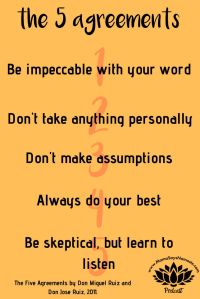
Many of us are familiar with the four (or five) agreements concept of spiritual teachings Miguel Ruiz wrote about based on ancient Toltec wisdom. The first is: Be impeccable with your word. It is much easier to be tricky with our words than our actions. Actions require lack of awareness, sneakiness or even betrayal at times to follow through on a trick, whereas being tricky with our words seems to have become so common that it’s often forgotten a few minutes after we’ve done it.
Unless you are in intimate relationship with someone like me who has an elephant’s memory for words. Growing up, watching how well someone’s words were aligned with their actions helped me judge how safe I was with them, because my home environment was so dangerous and my nervous system so often triggered that I couldn’t rely on feeling safe in my body to discern which people were safe to be around. Even now in my forties after years of estrangement from my family of origin and many healing experiences, I am still uncovering layers of feelings of unsafety and relational dynamics where I was tricked because I loved someone and gave too much benefit of doubt when they told me something I wanted to hear and their actions didn’t quite align…
I had a conversation with a friend about colonisation a few years ago, and she said an elder told her that the British didn’t have superior manpower or military strength when they invaded; they overpowered the people with their words. I have written before about unconscious sorcery, and it continues to be something I experience and witness regularly. But this blog is about the way we use our words, and the tricks our minds play on us and those we love when we believe what we say (at least in the moment).
I have had experiences with people who are in their hearts in a moment, but then dis-ease such as Wetiko takes over and their minds get to work changing the story and tricking them. How many of us say something and mean it in a moment, then think about it later and realise we don’t still feel that way, then go back and correct it with the person? It’s hard to do that. And yet those words sit there, and we may not realise how much of our relationship is built on them and the emotional power they possess.
 I see this as one of the greatest tricks playing out right now in the world; on a big scale, there are people saying things like: “[Y]ou always want to go with what’s come out of his mouth rather than look at what’s in his heart” about Donald Trump’s incongruent words and actions. On a small scale how many of us say “I’m good” when asked how we are, when in fact we do not feel good, or at least not wholly so. It took me a few years to work out ways of navigating these interactions gracefully in shops and places where people are meaning to make small talk but I don’t want to smile and lie and build that energy into my day. I find saying something I like tends to work, e.g.: “How are you today?” “I’m appreciating the sunshine outside.” “Oh yes, it’s a hot one.” (Image from here)
Some friends have told me I expect too much from people. That bums me out, because I don’t expect more than I ask of myself. Others say, just take people at their word and decide if they’re safe or not based on actions, but it feels too harshly black-and-white to me to put people into categories labelled ‘safe’ or ‘unsafe’.
I had a conflict with a friend many years ago, and we talked about it and made up, but I felt insecure with her for years afterwards. When I brought that feeling up a few times she told me I was being crazy; then when another conflict arose and I said I felt hurt by some of her behaviour, she immediately brought up our conflict from five years prior and said she had forgiven me for that so I had no right to bring up something else, I had to just forgive her as  well. I certainly didn’t feel forgiven! I felt like my insecure feelings had unfortunately been vindicated. A few months later when she wanted to meet and put everything behind us, I felt like I couldn’t trust her anymore, so there was no point. Without the potential for building trust, I can’t feel safe in a relationship. So even thought it really hurt, I had to let it go.
I do believe that she believed she had forgiven me. And I don’t know if she didn’t know how to or what the block was, but when it became clear she was still upset about the first conflict and was denying it, I lost hope for healing together. And that friend who talked about colonisation being a conquering of words, well, she conquered the doors to my heart with some powerful words that it turns out were not impeccably used. I can accept that we both were tricked in good faith, and I can rebuild trust by talking about it, so the words between us change and we can do our best to be more impeccable this time around. The responsibility of using our word belongs to each of us to co-create a healthy world together! (Image from here)
 If you value this content, please engage in reciprocity by living, sharing and giving.
 I have heard people of many cultures say the world we’re living in was created by trickster. Some cultural creation stories are explicit about this, such as
  My view is that we’re all somewhat tricked into thinking that the collective ways we’re living are working, when deep down we feel pain, grief, conflict, helplessness, etc. about changing. We may be aware that current systems and ways of being and acting are unsustainable, and we may already be taking active steps to change ourselves and to advocate for bigger visions of change. Individual action does matter, miracles do occur, and self discipline and personal perseverance only takes us so far. As Isaac Murdoch, an Anishinaabeg elder (Canada)
 If you value this content, please engage in reciprocity by
  Earth Ethos