Blog by Valerie
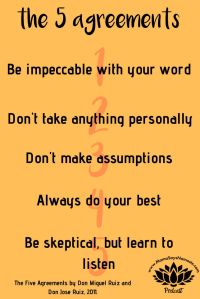
Many of us are familiar with the four (or five) agreements concept of spiritual teachings Miguel Ruiz wrote about based on ancient Toltec wisdom. The first is: Be impeccable with your word. It is much easier to be tricky with our words than our actions. Actions require lack of awareness, sneakiness or even betrayal at times to follow through on a trick, whereas being tricky with our words seems to have become so common that it’s often forgotten a few minutes after we’ve done it.
Unless you are in intimate relationship with someone like me who has an elephant’s memory for words. Growing up, watching how well someone’s words were aligned with their actions helped me judge how safe I was with them, because my home environment was so dangerous and my nervous system so often triggered that I couldn’t rely on feeling safe in my body to discern which people were safe to be around. Even now in my forties after years of estrangement from my family of origin and many healing experiences, I am still uncovering layers of feelings of unsafety and relational dynamics where I was tricked because I loved someone and gave too much benefit of doubt when they told me something I wanted to hear and their actions didn’t quite align…
I had a conversation with a friend about colonisation a few years ago, and she said an elder told her that the British didn’t have superior manpower or military strength when they invaded; they overpowered the people with their words. I have written before about unconscious sorcery, and it continues to be something I experience and witness regularly. But this blog is about the way we use our words, and the tricks our minds play on us and those we love when we believe what we say (at least in the moment).
I have had experiences with people who are in their hearts in a moment, but then dis-ease such as Wetiko takes over and their minds get to work changing the story and tricking them. How many of us say something and mean it in a moment, then think about it later and realise we don’t still feel that way, then go back and correct it with the person? It’s hard to do that. And yet those words sit there, and we may not realise how much of our relationship is built on them and the emotional power they possess.
 I see this as one of the greatest tricks playing out right now in the world; on a big scale, there are people saying things like: “[Y]ou always want to go with what’s come out of his mouth rather than look at what’s in his heart” about Donald Trump’s incongruent words and actions. On a small scale how many of us say “I’m good” when asked how we are, when in fact we do not feel good, or at least not wholly so. It took me a few years to work out ways of navigating these interactions gracefully in shops and places where people are meaning to make small talk but I don’t want to smile and lie and build that energy into my day. I find saying something I like tends to work, e.g.: “How are you today?” “I’m appreciating the sunshine outside.” “Oh yes, it’s a hot one.” (Image from here)
Some friends have told me I expect too much from people. That bums me out, because I don’t expect more than I ask of myself. Others say, just take people at their word and decide if they’re safe or not based on actions, but it feels too harshly black-and-white to me to put people into categories labelled ‘safe’ or ‘unsafe’.
I had a conflict with a friend many years ago, and we talked about it and made up, but I felt insecure with her for years afterwards. When I brought that feeling up a few times she told me I was being crazy; then when another conflict arose and I said I felt hurt by some of her behaviour, she immediately brought up our conflict from five years prior and said she had forgiven me for that so I had no right to bring up something else, I had to just forgive her as  well. I certainly didn’t feel forgiven! I felt like my insecure feelings had unfortunately been vindicated. A few months later when she wanted to meet and put everything behind us, I felt like I couldn’t trust her anymore, so there was no point. Without the potential for building trust, I can’t feel safe in a relationship. So even thought it really hurt, I had to let it go.
I do believe that she believed she had forgiven me. And I don’t know if she didn’t know how to or what the block was, but when it became clear she was still upset about the first conflict and was denying it, I lost hope for healing together. And that friend who talked about colonisation being a conquering of words, well, she conquered the doors to my heart with some powerful words that it turns out were not impeccably used. I can accept that we both were tricked in good faith, and I can rebuild trust by talking about it, so the words between us change and we can do our best to be more impeccable this time around. The responsibility of using our word belongs to each of us to co-create a healthy world together! (Image from here)
 If you value this content, please engage in reciprocity by living, sharing and giving.
 Some years ago while working with practicing Jews and Christians, I realised the underlying process many of them were continually going through: judge an act as righteously right or wrong, confront moral failings within oneself and others, then forgive and let go by giving anger to God or Jesus. The depth of potential existential judgment is so intense (e.g. eternal damnation and social ostracisation), that it can be very hard for people to acknowledge ‘wrong’ behaviours. I have experienced numerous instances of trickery of someone intending to forgive and let go (or deciding to avoid an issue), resulting in hurtful and confusing passive-aggressive behaviours. Often the underlying issue emerges years later after so much resentment has built up and trust eroded that the relationship becomes very hard to repair. (Image from
  Though it may at times seem more painful in the moment, I find loving acceptance brings me immeasurably more ease and peace than judging. I then discern what, if anything, I need to say or do when I experience hurt or realise I have caused hurt in another being. I remember Tom saying to me once that even when he doesn’t think he’s done anything wrong, if someone tells him that his actions have hurt them, he chooses to apologise because it is not his intention to hurt anyone. I appreciate the humility in that, and that it also helps hurting hearts to remain open to an ongoing relationship. (Image from
 _-_Bette_and_Joan.png/250px-Feud_(Season_1)_-_Bette_and_Joan.png) Now that the Western justice system has criminalised the payback ceremony, many Aboriginal people in the Northern Territory struggle to reach forgiveness with their Indigenous science of justice. I heard about someone who had been in prison for years as ‘Western justice’ who was released and immediately had to face spearing if he wanted to see his family and community again. I heard about family members of an offender being beaten up until someone agreed to be speared in place of the offender in prison. I heard about decades-long violent feuds involving multiple generations where many people didn’t even know how the feud had started, but no one felt justice had been satisfied. I even heard about someone trying to sue someone else for using sorcery against their family as payback instead of spearing. It’s a mess. (Image from
Now that the Western justice system has criminalised the payback ceremony, many Aboriginal people in the Northern Territory struggle to reach forgiveness with their Indigenous science of justice. I heard about someone who had been in prison for years as ‘Western justice’ who was released and immediately had to face spearing if he wanted to see his family and community again. I heard about family members of an offender being beaten up until someone agreed to be speared in place of the offender in prison. I heard about decades-long violent feuds involving multiple generations where many people didn’t even know how the feud had started, but no one felt justice had been satisfied. I even heard about someone trying to sue someone else for using sorcery against their family as payback instead of spearing. It’s a mess. (Image from  Though we may not be able to ceremonially heal with the people who hurt us or people we have hurt, we can do spiritual ceremonies on our own to change the way we hold people and what we project. Shifting our perspective requires us to hold paradox and avoid binary and judgmental thinking. In traditional Hawaiian culture, people use “Ho’oponopono, the traditional conflict resolution process…[to] create a network between opposing viewpoints…that allows dualistic consciousness to stand while becoming fully embodied by the ecstatic love of Aloha”
 Earth Ethos