Blog by Valerie
One of the basic premises of an Earth Ethos, and of indigenous teachings generally, is an innate worthiness of being. It does not depend on behaviour or social status or species; all beings on Earth are of worth. This is the foundation of dignity, whose root comes from Latin for “to accept, to take.” In the previous post I wrote about how acceptance keeps us in the present moment. And when we’re in the present moment in a state of worthiness, we are strong and we are dignified, even if behaviour of another person is not. Privilege, on the other
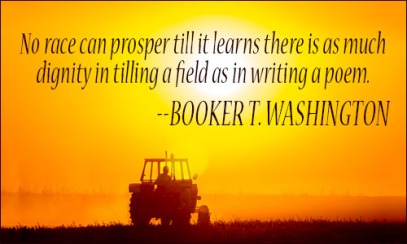
hand, comes from the Latin words for “private” and “law,” indicating an advantage, right or priority over another person, group, or even species. In social justice circles there has been a lot of discussion in recent years of privilege related to race/ethnicity, gender, sexual orientation, religion, class, age, citizenship, and disability. I know there are real life impacts for many of us because of social privileges, but our focus on these inequities distracts us from the important work of ensuring that we stand in dignity and see others that way regardless of their behaviour or beliefs. It’s our responsibility to remember that regardless of the domination of certain social stories and world views, there is innate dignity in all ways of being. Stories are powerful because we feed them, even if we do so by fighting.
It does not matter if a person has a million dollar home or a high social status job, being in denial and numb to painful feelings is not a privilege, is it disembodiment, disconnection with self, others, and the present moment. It is a disabled and difficult way to navigate the world. I know this because after numerous efforts to ask for help and protect myself from sexual abuse as a child failed, I dissociated, and did not re-member those experiences until my mid-twenties. My life before that was really hard and confusing. It has taken many years and hard work to build a trusting relationship with myself. I have had to let go of and reform numerous unhealthy relationships including my entire family of origin; I have had to ride out decisions based on that denial and numbness and give myself grace in the process; and I have had to dig deep into my psyche to question foundational stories and beliefs that guided me for over 20 years, and replace them with ones that feel and work better. (Image from here. And like skill, you could rank by social privilege as well.)
Sometimes it feels like we have no choice, because everyone around us is on board; we feel forced to accept global stories like, for instance, capitalism, or countries and borders, or languages we communicate with. These big stories do privilege certain values and world-views. This is Christmas season. How many of us know that Jesus was not born on this day, and that the Catholic Church repurposed indigenous European celebrations for winter solstice over 400 years after Jesus’s death? (Even a Christian site called www.allaboutgod.com knows this. In fact, many of the so-called Christmas traditions have strange histories. It’s okay to celebrate something on another day, like when it’s your birthday on a Tuesday and you have a party the Saturday before, but it’s less powerful than if you celebrated the actual date. It’s the same with solstice. It would be a lot more powerful if we celebrated winter/summer solstice on the actual celestial days instead of the days chosen for Easter/Christmas depending which hemisphere you’re in.Consider connecting with the powerful celestial energy this solstice and doing something to celebrate our planet regardless of what else you celebrate. In the southern hemisphere, Christmas celebrations with fake snowmen, fake pine trees, fake garlands, and sweaty Santas in summer are farcical. (Image from here.)

It is of course possible to be dignified in celebrating Christmas; it is meaningful to many people. It is also important to recognise, whether you celebrate it or not, that in society right now Christmas is privileged, and to consciously decide how you want to behave given that social reality. Most of us get time off of work for Christmas, and some of us have to use our vacation to celebrate days that are meaningful to us which are not socially privileged. If you have not taken the time to reflect on what the elements of the modern Christmas celebration mean to you and whether your participation aligns with your values and world view, I encourage you to. How could I get out of this if I wanted to?you might ask. Everyone buys presents, decorates houses and offices, makes certain foods, plays certain music, and expects me to join in. Didn’t anyone ever ask you as a kid if everyone was jumping off a cliff if you would too when you used that sort of logic? Christmas celebrations started to feel empty to me as my sex abuse memories were integrating. Christmas memories from childhood were joyful because my dad spent time doing creative things with me, not because there was deep meaning in the specific activities. I didn’t know why I was busily making and buying things, as I am not a  materialist or a Christian, so I told people close to me I would focus on birthdays and important life events, and I stopped. I don’t want to deprive anyone of the joy of giving, but I don’t want to feel burdened receiving what is intended as a gift, so I told people close to me if they want to give me something, I prefer personal notes, meals, time together, and handmade art. I dislike expectations to behave a certain way on a day that is not especially meaningful to me, so Luke and I take short trips just the two of us over Christmas to enjoy Mother Nature instead. This all make it easier for me to stand in dignity because I am accepting me and not playing a victim by gracefully navigating a situation where my way of being is not socially privileged. Cultivating the discipline to deny ourselves that which brings us pain and suffering helps us stand in dignity and experience more joyful abundance.
From a pagan friend: 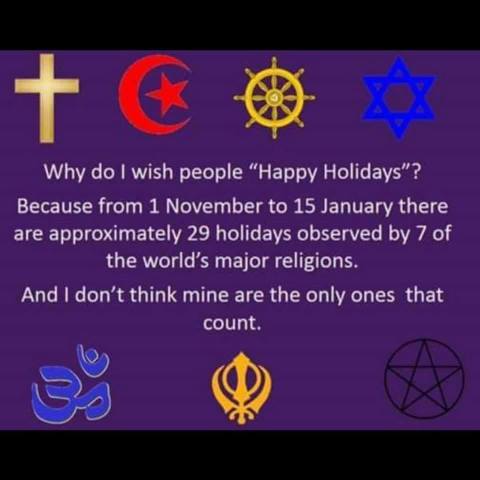
 If you value this content, please engage in reciprocity by living, sharing and giving.





 If you value this content, please engage in reciprocity by
  I have witnessed many people experiencing a shaman’s illness. When people reject or resist it, they usually end up dissociating the destructive energy and becoming very challenging externalising personalities (like narcissists or sociopaths), or internalising the destructive energy and creating diseases such as quickly metastasising cancers. I have witnessed multiple people do both of these things. When people accept the calling of the illness, there are different speeds of doing so, which impacts the way the illness plays out in a person’s life. I have seen some people slowly accept that they are experiencing shaman’s illness over many years and bit by bit change their paths so that over time more aspects of their lives are working. Some (including myself) dive directly into the fire and allow our lives to become incredibly chaotic as our identities are re-forged and often become overwhelmed at the amount of emotion that needs to be processed and the whirlwind pace of life changes that occur. (Image from
  It is helpful, but not necessary, to seek support from someone who has been through similar things. Such people can give you compassion and empathy, guiding wisdom, and tools to process wounds and express energy. But it’s vitally important not to delude yourself that any human is a fully healed Jedi-master, all-knowing figure. If someone says they are, then RUN AWAY FROM THEM, because that person is dangerous and delusional and is on a path of becoming a cult leader or something else you don’t want to be involved with. It is important to think of illness and healing as processes, not finite endpoints. When someone says they have “healed” a wound as intense as sexual abuse or parental abandonment, I am suspicious; and when someone plays power games, disrespects, or in any way puts me down, then I know that person is ill and cannot support my healing anymore. I have no tolerance for these behaviours, even when people are unaware. I either change my boundary and create space or make someone aware of their transgression, and if they then don’t own it and work through it, I’m done with the relationship. (Image below from
 If you value this content, please engage in reciprocity by
  A Druid
 Second, “if you don’t have an ancestor altar,
  If you value this content, please engage in reciprocity by
 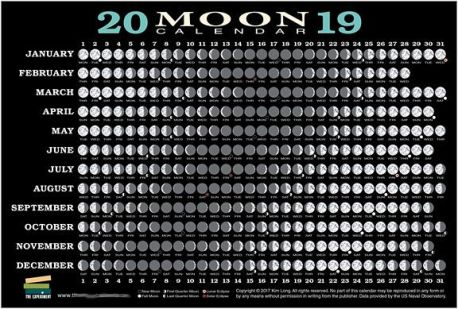 A lunar calendar follows the cycle of the moon only and may have 12 or 13 months in honour of the number of moons in a year. (e.g. Islam, Igbo & Yoruba of Nigeria)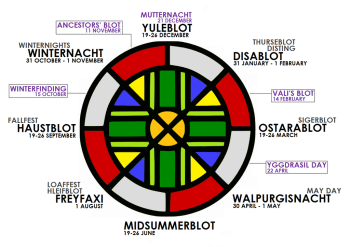

 In the template, cross-quarter days are marked as circles and lines mark equinoxes and solstices. Aspects of your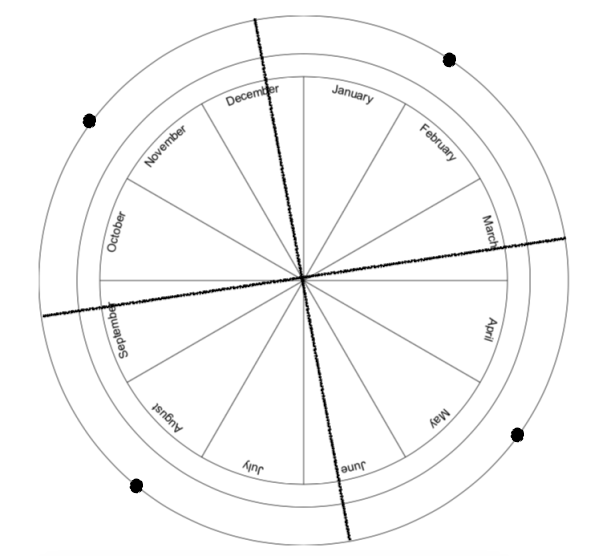
 If you value this content, please engage in reciprocity by
 (Image from
  If you value this content, please engage in reciprocity by
  Blog by Valerie
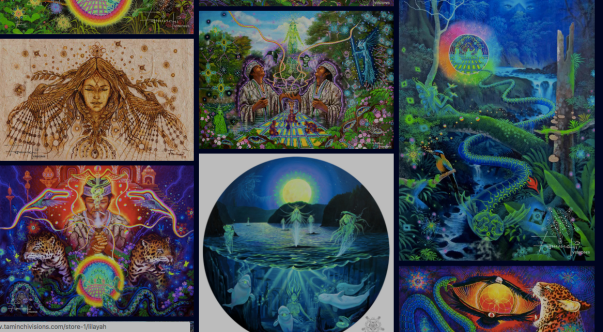 The depth of relationships, and the experiences, feel quite different to participants. Similarly, instead of peace circles as a tool to help control behaviour or improve the way people speak and listen to each other as is common in westernised restorative justice practices based on a Judeo-Christian worldview, an Earth Ethos peace circle is an opportunity for a communal spiritual experience based on an indigenous cultural cosmology. Because of the intentional use of metaphor, it ought to feel different to participants (and certainly does to me) than simply sitting in a circle (or around a table where we are blocked from connecting with each other physically) and passing around a talking piece. Many indigenous peoples use oral traditions to preserve cultural wisdom. Verbal repetition and physical embodiment of teachings keeps them pure (
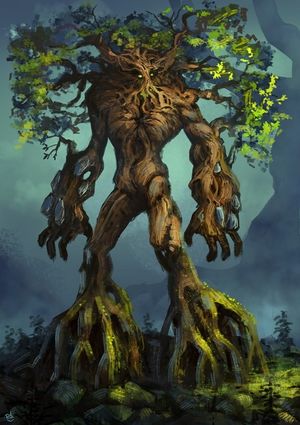 Healing of, and prevention of, dis-ease requires ceremony. Ceremony is an important human practice connecting the visible material/physical world with the invisible, spiritual world. Life feels empty and unsatisfying when we do not do enough ceremony, and ceremonies are most powerful done regularly and intentionally in community (
 If you value this content, please engage in reciprocity by
 In his
  When we are miserable we are rejecting or rebelling against reality, which is destructive and results in existential crisis. When we are accepting we remain in the present moment, however painful. Many of us understandably feel overwhelmed by the depth of pain on the planet right now, so we numb ourselves with substances such as sugar, caffeine or alcohol; run away to our heads to avoid certain feelings; and seek out “light work” or “positive psychology” to create bubbles of security around ourselves. This is so common that a famous social psychology
  Earth Ethos