If you would like to listen to an interview with Valerie about the inspiration behind the Healing through Indigenous Wisdom book, here is the link. =)
There’s also a short article about both Lukas & Valerie on p. 26 of our local paper The Triangle, with three corrections: Lukas was born in Sydney, Valerie was born in Ohio, and William Ringland is buried in Bermagui.
Years ago when I was practicing restorative justice/discipline in schools, what consistently came up as the toughest aspect of change were periods of transition. Teachers said, when the kids are in class we can get into a good space together, then the bell rings and they transition into the hall and it’s instant mayhem and reverting to old patterns. They reported a similar struggle with teacher staff meetings getting into a good space, but interactions in the break room not feeling great. Transition spaces were the last to be impacted by efforts to change the school culture and embed restorative values. (Image from here)
We’re in a period of transition at the moment of shifting boundaries with people, some we have known a long time and connected with deeply; shifting visions of how we’re spending our time day to day getting ready to facilitate retreats on the land here; and recently shifting our last connection with commercial or Christian Christmas to a simple seasonal solstice celebration. The past month has brought up feelings of increased freedom, loss and grief, isolation, and a witnessing and cleansing of deep roots so that we ground where we are with as much integrity as possible. (Image from here)
I understand the trickiness of transitions; we tend to find it easier to do things by habit. But what if we have habits that we don’t like or don’t feel great? Removing oneself from collective habits, such as getting together and giving gifts on December 25, if one realises that such a habit doesn’t feel authentic, is hard work. And while it feels good to be more in alignment, it doesn’t initially feel great to purposely do mundane things on such days. It’s like a come-down from a collective program. It helps to remind myself that we’re always in transition, and being attuned to the land and seasonal cycles of the Earth means being flexible and ready to engage with sudden change. (Image from here)
In social spaces it seems like people with means can pay to insulate themselves from having to experience unwanted transition. For example, if it hasn’t snowed and your holiday is already booked, you can expect snow to be manufactured and needn’t rely on winter weather or worry about the effects of climate change. So when some celebrities criticise California for not having enough fire fighters, while simultaneously hiring private ones and trying to avoid paying tax, I feel a sense of relief that class, entitlement and material privilege doesn’t insulate anyone from the need to transition and adapt to change. (Image from here)
Lukas and I have been reflecting recently how we don’t have many people in our lives who could see us when we were younger and still know us and can see us now, as we have changed our lives and identities have evolved quite a bit as we’ve grown up. I realise that isn’t everyone’s journey, and I think it is more common than we tend to collectively admit. I find it deeply valuable when we allow each other to change and remain in relationship and make an effort to witness each other throughout seasons and cycles, whether in human-human relationships, relationships with a place, with animals or plants or ancestors. I invite you to reflect how much you value that.
Exercise: Think of someone you witnessed change their life and sense of identity. How have you supported that transition? How have you projected a ‘past self’ onto that person and had to change/challenge your perspective?
When I was growing up, I watched my father hoard food, books, even household cleaning items. I remember the pain I felt when he told me the story of realising as a young teenager that he’d read every book in the library van that visited his small town every month. He went to university, the first in his family, so there was no shortage of books to read from the age of 19, but he couldn’t shake those early experiences, he worried he’d have to do without if he didn’t have things on hand. Coming from a home where I had access to multiple libraries, and many used and new book shops that we frequented regularly, I was happy to give away and trade books with trust that if I needed one again I’d find it. I didn’t need to be weighed down by a home library. But I also remember the pain I felt when I went with my dad to our favourite used book store with some boxes of books from cleaning out my room at my parents’ house. He didn’t understand why I wanted to let them go, and kept asking if I was sure. But he didn’t try to stop me. (Image from here)
Growing up, I watched my mother hoard money (and related to that, jewellery); and though it may sound strange, she also hoarded social privilege. But it felt more intense than my father trying to rebalance some pain from childhood. Hers felt existential, as if she hoarded and guarded these things like her life depended on it. The first time I earned money through babysitting, I came home with a twenty dollar bill feeling proud of myself. I had gotten the little girl to sleep despite one of her dogs nonstop fearful bellowing about a thunderstorm. My mother asked how much I made, and when I showed her, she took it, and said that she needed a cut. I couldn’t tell if she was joking. It didn’t feel like it. Then she wouldn’t give it back to me, and taunted me, hiding the bill and waving it out of my reach. That felt scary and deflating, one of many power and control games she played with me. It was as if she needed money more than she needed to be connected with me and would abuse her power and trusted role in my life to get it.
When my father died many years later, that was my experience with her as we entered into estrangement. My mother chose money, lies and trickery over me. I have come to see that as rooted in her Jewish wounding, where through being disconnected from country for milennia, she learned to existentially cling to money, jewellery, and social status to survive. I understand that’s her survival strategy, integrated with identity and culture. I can’t be intimate with those wounds though, it feels too destructive and desolate to me, like I’m spinning in a hopeless vortex of nihilism and materialism, disconnected from the planet and my body. (Image from here)
I don’t yet feel respectful of what I experience as collectively acting out a traumatic and highly destructive wound. I focus most of my energy on deepening compassion and processing grief. I have been feeling this a lot lately with actions in the Middle East. I feel like Palestinian, Lebanese, and Iranian peoples are my spiritual kin. The hatred some of us feel towards ourselves and each other is so intense, it makes my heart feel heavy with grief. The material greed and holding in supremacy certain people and lands while dehumanising and exploiting other peoples and lands pains me deeply. I have been to Jerusalem, which many consider to be the most holy city in the world. I felt its deep and rich history. It also felt very layered in pain and messiness. There was tension, some bombing, and UN vehicles patrolling when I was there. It felt like a powder keg with everyone on edge, and that was fifteen years ago.
I choose a worldview in which all lives lost, of any culture, of any animal or plant, are existentially equal, though I obviously experience some of those losses with much more intensity than others because of my own identity and connections. As this worldview and my values have solidified over time, I have found myself recently with more material ease than ever before in my adult life. I had gotten used to embodying ordeal, living without enough material wealth, devaluing its importance to rebalance growing up with my mother putting material wealth über Alles, humbly acknowledging that I needed to find ways to be more financially stable and secure, trying things and burning out, growing savings and going through them.
I’m grateful for some material ease and abundance now, and I’m grateful for experiences of lack so these experiences have more meaning to me. I don’t think I’ve now got it all figured out. I do know that weeding by going into trauma and negativity have been more valuable to me than trying to plant positive affirmations. I’ve found healthy beliefs emerge when I clear the way. And, at the moment, some material wealth has emerged. I’m allowing myself to feel more ease when we buy groceries, practicing saving without hoarding, and humbly sharing as we go. I have started to feel lately like for the first time in this life I am living the life I want to and am meant for.
Here’s hoping your relationship with material wealth feels balanced and centred too. Blessings at a season of reflecting on thankfulness. I’m thankful you care enough to read this blog. And if you are able, I humbly ask you to consider leaving a review of my book Healing through Indigenous Wisdom on Amazon, giving a copy to a friend, or otherwise passing on the word. Sacred reciprocity makes the world go round (fodder for a future blog).
Lately some protracted conflicts have come to the surface in my life at a macro level in the world, and at a micro level in my daily life. I have been praying quite a lot since the war in Ukraine broke out, where my Jewish-Sumerian ancestors spent many generations living, and more recently about the war in the Middle East. It seems to me like there is existential war and rejection going on based in judgment, where one or more parties to a conflict feel they are fighting to exist in the minds and hearts of the other.
I find existential judgement incredibly dangerous and damaging and see it as the root of genocide. It feels to me like a hand rejecting its own finger. If we believe in a Creator with wisdom our human minds cannot comprehend, how can we put ourselves in the position of judging what the Creator brought into being? And to say another is allowed to exist elsewhere (NIMBY) is still judgmental, for if we force another to leave their home and live on different lands, we change their and our identities by disconnecting people from their earthly homes and playing the roles of victims and offenders.
On a micro level I’m seeing this thinking play out in some righteous social justice warrior crusades around me. I find the concept of ‘rights’ to be violent, though it has obvious practical value to create baseline standards for society. If we didn’t existentially judge certain struggles and behaviours as deeming people unworthy of housing or health care or food, then rights would simply represent social baselines we collectively agreed upon as minimum standards of care for all of us humans living here. But if a single mother can’t afford housing, or a man with mental illness isn’t at retirement age but can’t hold down a job, we don’t collectively agree how (or sometimes even if) to support their survival. Rights then get used in a forceful way to push a majority social group’s minimum standard of support onto the collective, and thus they often need to be en-forced. And when we are judged and caught up in the rights battles we feel, rightly so, like we are fighting for our survival. (See survival strategies blog)
I agree with Jungian scientist Fred Gustafson that the Western mind is “having a massive collective nervous breakdown” and is going to “war to determine whose anthropocentric [world]view is most valid [while] the earth and all its inhabitants [] suffer.”[1] I have not found sufficient solace for survival in the Western world alone.
For me it has been vital to live in two worlds: (1) a social reality that is based on a Western worldview, and (2) an earth-based reality based on an Indigenous worldview. When I’m caught up in a survival struggle in the Western world that’s terrifyingly real, and I’m feeling rejected and judged and shamed and angry, I can spiritually connect with the knowing from the Land and my ancestors that I’m not only allowed to exist but that I am wanted. This powerful medicine is all I have found that alleviates my existential wounds. Without it I feel like I would not still be here on this Earth, as my roots would have rotted and not been able to hold up the rest of my inner tree of life. (Image from here)
If you’re also feeling some pain and heaviness about existential judgement and its impact, here are a few things that help me keep my spirits strong:
Grieving is a way I like to express angry energy to avoid getting overwhelmed by righteousness and gain clarity which fights, if any, feel right for me to engage in, and what that means practically. You may prefer to yell and scream or throw things or punch a bag instead, so however you express anger to avoid it overwhelming you is helpful.
Connecting with the land and ancestors where I am offers me powerful healing. I may give offerings as simple as feeding a bird or picking up rubbish, or as profound as a placenta burial or smoking/smudging ceremony. I may also cultivate a sit spot on the land, walk barefoot, and tend a tree altar. There are so many more ways to connect with the land where you live, these are but a few. The reverence we bring to the action we choose matters more, I think, than exactly what we do.
Letting go of black-and-white, objective, judgmental thinking is something I am very fierce with myself about. Humility is an important value to me, so I ensure that even when I feel certain or highly confident about something that I carry a little bit of doubt. For example, I feel highly confident that child sex abuse (link) is a damaging act that is wrong to do. Yet my intense journey of seeking to heal that wound has brought me so much wisdom and peace. Spiritual gifts often thrive in grey, paradoxical spaces.
Altering my consciousness is another survival tool I use daily, primarily through embodied meditations and drum journeys. I do it to heal trauma, connect with ancestors and other spiritual guidance, and seek tools for every day survival such as deeper spaces of compassion or peace. However you are able to sink deeper than your everyday ‘known’ and familiar thought loops can bring you some healing. I do find, however, that embodied practices (such as using sound or dance or breath techniques) are more powerful than mind-based practices (such as meditating through your third eye or simply watching your thoughts).
Thank you for reading this, and may your life be enriched (and even saved) by living in both worlds, as mine is.
[1] Gustafson, F. (1997). Dancing between two worlds: Jung and the Native American soul. Mahwah, NJ: Paulist Press.
Blog by Valerie – a final chapter shared from the book that was just written
Being authentic, centred and grounded means having awareness of our core values and doing our best to en-live-en them through our life choices and forms of expression. Embodiment is a recognition of the universality of our connection with all of Creation as well as our individuality of lived experience. It’s important not to confuse lived experience knowledge with intellectual understanding or awareness, often referred to as ‘knowledge’ in Western science. We all have intellectual under-standing and awareness about life experiences we haven’t had; for example, we may say that -10 is cold, but unless we’ve felt it, we don’t have an embodied knowing of how cold that is.
There is so much power in lived experience that from an Indigenous science perspective, it is the only way we can ‘know’ something. People with a lot Western theoretical or book ‘knowledge’ are often seen as arrogant, or even dangerous. If you’ve learned some ‘evidence-based’ ways to prevent obesity, you will still have a limited ability to empathise with people who have experienced it themselves or witnessed it through an intimate relationship. Knowing our standing, or positionality, makes a huge difference in how well we embody our values and medicine. Our standing refers to placement – socio-politically, culturally, physically, emotionally, mentally, and spiritually. I’ve included socio-politically and culturally because we live in two worlds as Indigenous scientists and need to be aware of our Western political placement as well as Indigenous cultural placement.
As an Indigenous scientist living far from ancestral lands, from a socio-political perspective, I am a settler[1] doing my best to be a political ally[2] of Aboriginal peoples of Australia. I can’t experience what’s embodied through their cultural lineages and relationships; they carry a power of intergenerational knowledge that, if shared with me, supports me to build my own relationships with their ancestors and the land where I live (Image from here). Gitksan scientist Dr. Cindy Blackstock explains Indigenous scientific trust in long-tested ancestral wisdom and our collective responsibility for carrying and passing on Indigenous knowledge:
As knowledge trustees, whose job it is to understand and relay knowledge which has been passed down by generations before us, we pay great attention to the detail of the knowledge and the values and spirit embedded in it so that we can pass it on. Because knowledge needs to echo across lifetimes and generations, multidimensional standards of rigor are needed to ensure knowledge is understood within the four dimensions of learning: spiritual, emotional, physical and cognitive and that each teaching is situated within an interconnected knowledge web[3].
It’s natural to speak about things we haven’t experienced at times, but it’s wise to do so with humility in recognition of our standing within that interconnected web of life. For without lived experience (which includes knowledge embedded in our bodies through ancestral inheritance), to some extent we are guessing.
Embodied methods for sharing traditional knowledge have helped ensure its efficacy and accuracy over time and prevented the impact of such human limitations from diluting or distorting it. As Dr. Lynne Kelly explains, “At every level of initiation into knowledge there were memory aids…from hand-held objects to art on bark or rocks, to the landscape itself”[4] in addition to songs and stories that were easy to remember yet cleverly layered with knowledge[5]. This is why changing landscapes and moving Indigenous peoples can be severely disorienting and detrimental to cultural integrity.
Exercise: Reflect on embodied memory aids you have – such as objects in your house, photos, places you go, music, etc. Which ones bring you joy? Which ones feel like clutter that could be let go? Are there any that trigger you into trauma or other difficult emotion? If so, do you wish to let them go or ceremonially cleanse them?
It’s helpful to consider that our bodies themselves ‘speak’ stories, with our bones showing how nourished we are, our body’s ergonomic strain, and even our toxin exposure[6]. Our bodies also arouse stories in others. Shona scientist Dr. Virginia Mapedzahama says when she walks into a room she experiences predetermined socio-political space simply because of her Black body[7], whereas Yuin scientist Shannon Field describes awareness of her socio-political privilege since she can pass as White though she is a Blak Aboriginal woman[8].
To further complicate things, many of us have lived experiences that aren’t fully processed. For example, if someone believes that lying makes them a ‘bad person’, they may subconsciously trick themselves and others into believing an altered story that omits a ‘bad’ thing they did. An acute listener will likely experience cognitive dissonance, a sense that the storyteller’s heart and head were in conflict. This highlights the importance of using discernment with shared knowledge, even when it is embodied.
Exercise: Reflect on what spaces embody, such as a school, a park, or a prison. Reflect on what social structures embody, such as a performer and an audience, or a judge sitting higher than the jury, victim, lawyers, or the accused. Reflect in your own life what you embody and what you intentionally wish to.
[3] Blackstock, C. (2007). The breath of life versus the embodiment of life: Indigenous knowledge and western research. World Indigenous Nations Higher Education Consortium Journal, 4(1), 67-79, p. 68.
[4] Kelly, L. (2015). Knowledge and power in prehistoric societies: Orality, memory, and the transmission of culture. Cambridge University Press, p. xvii.
[5]See e.g. Karl-Erik Svieby & Tex Skuthorpe. (2006.) Treading Lightly: The hidden wisdom of the world’s oldest people. Crows Nest, NSW: Allen & Unwin.
Are the most prescient ideas and images that come to mind when you think of the word “warrior” all about physical strength, toughness, and violent conflict? I doubt you’re alone. To borrow a trick from Valerie, if you online image search the word “warrior” the first things that come up are virtually all men and related to physical violence, specifically some new television show that evidently involves a lot of arse kicking. The story is similar if you try “female warrior”.
The technical definition of a warrior in the English language supports this narrow view, being rooted in a French word guerroieor meaning “one who wages war”. Most definitions of warrior relate to waging armed conflict, specifically those who have some kind of specialised role in doing so. (Image from here)
The etymology of the word “war”, however, is much more interesting, seemingly originating with broader concepts that include difficulty, dispute, and hostility. According to etymonline.com, if you follow the known Proto-Germanic cognates as far back as they go, you arrive at a word that means “to bring into confusion”.
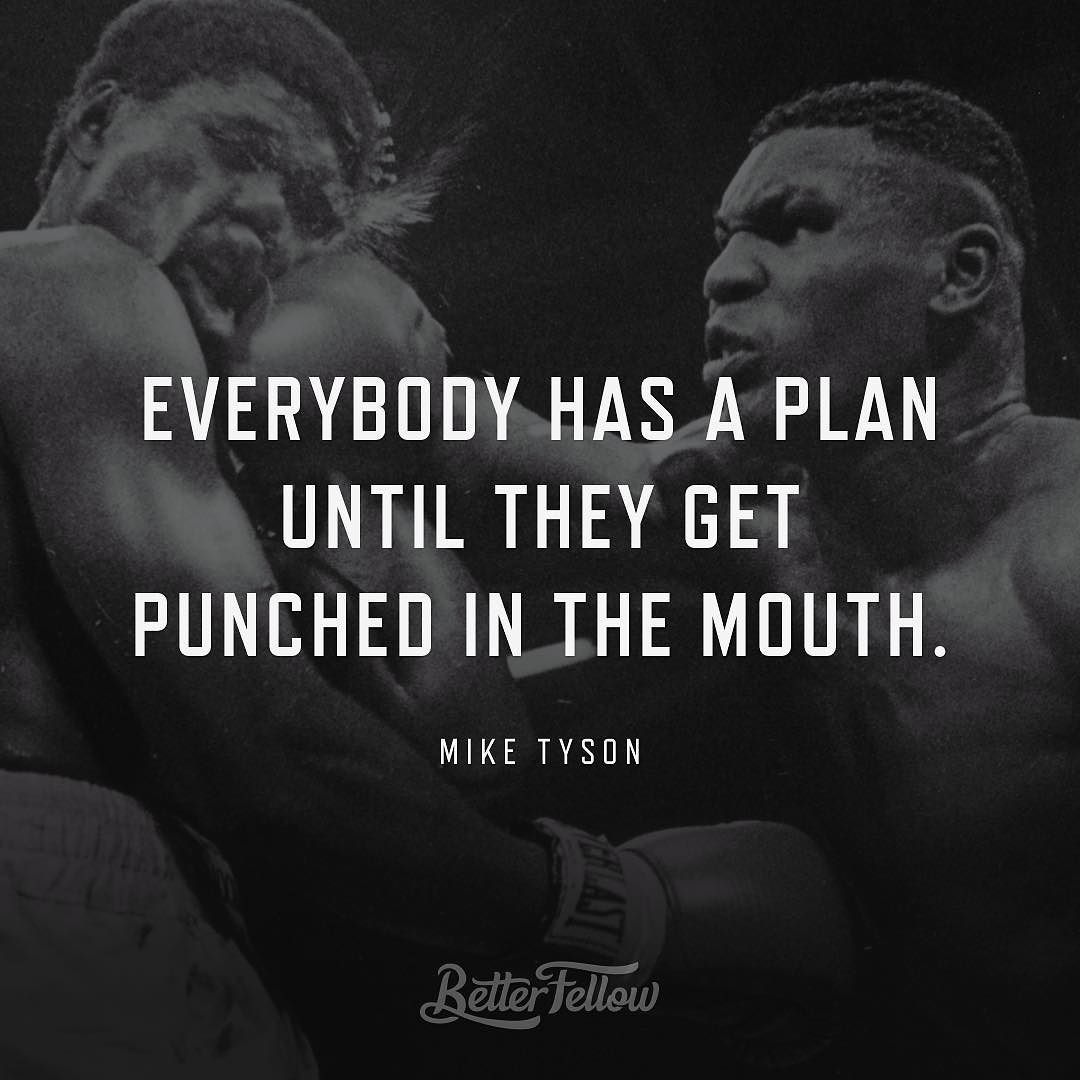
This is fascinating to me on a number of levels. Not least of all because virtually all first-person accounts of war I have read describe some manner of confusion and chaos to a degree that was unexpected to the writer. My flailing fist fights over the years confirm this; and as “Iron” Mike Tyson said:
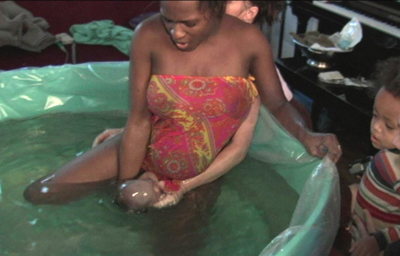
So if war is to some degree about confusion and chaos, perhaps the true warrior is someone who uses their power to bring these things back into a calmer balance? This then is about a warrior responding to and resolving conflict rather than instigating it, even if it is they who strike first. Without doubt there is a rightful place for violence in this, but also many other elements. Sticking to the realm of the physical, another version of the warrior could be a woman in labour finding her strength and power and calmly birthing just when things were at their most chaotic and the pain most intense. (Image from here)
But if we are to use this warrior concept to its fullest extent, literally and metaphorically, perhaps the most important thing is to apply it across the medicine wheel. So this gives us emotional, spiritual, and mental warriors; any and all ways in which a being can use their strength and power to bring conflict and disorder back into balance.
Note that this bigger version of warriorship does NOT just mean these other aspects of warriorship being in service of physical violence, such as mental energy being devoted to better weapons technology, or emotional quieting and centring that improves fighting ability. It means recognising their deep value to our being in and of themselves and together in balance.
This topic came to me when thinking about men and masculinity in the context of healing and reconciliation between Anglo-Celtic Australians and Aboriginal Australians. If we restrict our thinking about and valuing of warriorship to literal, physical combat, this makes such healing hard, such was the intense lopsidedness of the physical contest.
I don’t think it is controversial to say that in the world of Aboriginal Australians, weapons and warfare were just one part of what made men and warriors in those cultures whole and powerful. The weapons they had been using for millennia more than did the job they were needed for. Europeans, on the other hand, were by 1788 riding a wave of centuries of escalating prowess in using violence, supercharged by technology and in service of greed. Warriorship caused more conflict and trauma than it resolved.
With this fuller version of warriorship comes some understanding of what I as an Anglo-Celtic colonist lack, and what I need for healing. I don’t yet value my heart and spiritual warriorship enough.
On both the oppressor/colonist side, and the survivor/colonised side of this ledger is ample reason to grow through helping each other to see warriorship more fully. When we do this we’ll need no self-shaming to see the deep value of the balanced warriorship of Aboriginal masculine culture. We colonists can learn what being a whole mature warrior means, and Aboriginal men can learn to value who they are more fully. Then we can do ceremony to bring the conflict and disorder back into balance. (Image from here)
Exercise: Taking a strengths-based stance, think about how your sacred masculine (regardless of your gender) displays warriorship across the Medicine Wheel.
Exercise for Australians: If you are doing an Acknowledgement of Country (especially when there are only men present), try acknowledging the Aboriginal warriors as well as Elders.
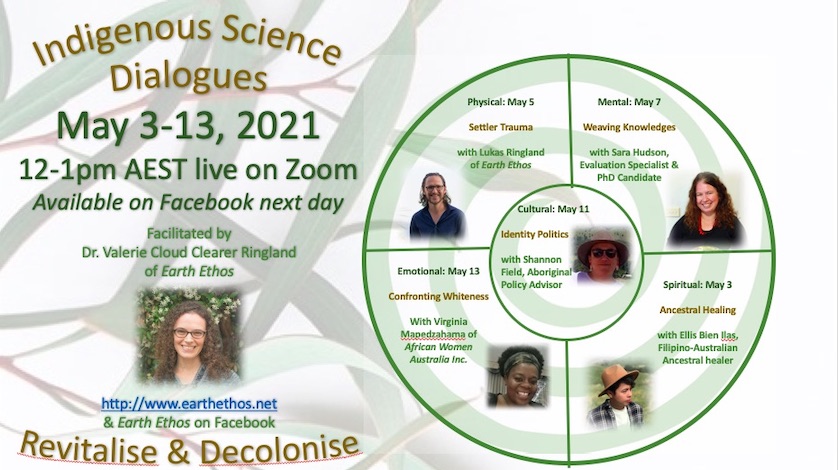
At the heart of the Earth Ethos Indigenous Science Dialogues earlier this year was the issue of identity politics. The dialogue of that name was with my friend Shannon Field, a Walbunja woman of the Yuin nation, a traditional owner of the land where Lukas and I currently live, the land his first settler ancestor claimed for himself through the crown of England and in whose name the Australian government is still run today.
With identity politics at the centre, all dialogues touched on that issue. Anglo-Celtic Australian man Lukas Ringland spoke for the PHYSICAL, sharing his experiences of settler trauma, including the pain of being part of a corrupt social majority. On the Crown’s genocidal survival strategy for ex-convicts, he explained: “The more wild the land was, the more likely it was to be given to an ex-convict, like, ‘you go to war against the Indigenous people.’ So you had this battle for life being fought between newly freed convicts and Indigenous people, and then closer to the centre of the colony you had the higher-ups who didn’t have to participate in that.” (Image from here)
Filipino Australian Ellis Bien Ilas spoke for the SPIRITUAL about the trauma of leaving the Philippines for Australia as a child, and his subsequent complex journey of ancestral healing: “I was literally shaken by an event on July 2, 2015…in the ER with an undiagnosed cardiac condition…I was having symptoms medical professionals can’t explain, and…it was looking back…[realising the date of my event] was my grandfather’s death anniversary, and I [] carry his name…That event was a huge catalyst for my spiritual awakening which occurred here in Sydney, Australia.”
Jewish Pakeha (non-Maori New Zealander) woman Sara Hudson spoke for the MENTAL about the close-mindedness in Aboriginal governmental policy: “When [the government] could verify [some Indigenous knowledge], they were like ‘Ooh! Okay, maybe there is something to this, because it matched what we found ‘scientifically,’ so therefore maybe we will listen now to these Indigenous knowledge-holders around water.’ This is the crazy stuff – ‘I only listen to you once we have it verified by our Western scientific methods.'” (Image from the ABC, link unknown)
Shona (Zimbabwean) Australian woman Dr. Virginia Mapedzahama spoke for the EMOTIONAL, about her experiences navigating whiteness trauma as an African migrant, the absurdity of Australia’s racial labels (Anglo-Celtic, Indigenous, and CALD – culturally and linguistically diverse), and how invisible she feels because “we have never dealt with the race issue with our Indigenous Australians…[but] the WHOLE THING is based on a system of whiteness…[and] we’re not looking at ourselves and the system that led us to do these things…[and now the definition of CALD is] so broad that the only people not captured by that category are Indigenous Australians!”
At the HEART centre, Walbunja Australian woman Shannon Field spoke about “cultural mining”, how “non-Aboriginal people mine our knowledge, mine our experiences in order to form up views, opinions, politics, positions…but in doing so, not providing us with a legitimate and/or authentic opportunity to have influence on what those outcomes actually are….So basically taking the authority and control of our knowledge into White hands.” She also explained, “For me, what identity politics is, that isn’t always a comfortable topic…as an Aboriginal person with fairer skin…I don’t know if it is called a colour privilege, but certainly there are some biases that are applied in terms of palatability of lived experience for White people taking on a Blak story or Blak history…that fits a narrative of what White people want to see….That’s something as I’ve gotten older I’ve become more aware of…[And] while I feel like I personally have had a fairly benign experience as an Aboriginal person, your life as an Aboriginal person is not unpoliticised…your mere existence [is under constant political scrutiny and attack].”
This “mere existence” of Aboriginal people as humans worthy of dignity collapses the entire ‘legal’ foundation of the Australian nation. The High Court overturned terra nullius and declared that the Australian lands were inhabited at colonisation, but no treaties have been signed, and the Native Title system designed to return Crown land to Aboriginal control (which often takes decades to do so) is fatally flawed. My heart bled last week when I read these words from Gamilaroi-Irish woman Aimee Mehan: “[O]ur Native Title Act does not give Indigenous Australians the right to refuse development on our ancestral lands…imagine that you are told about the impending trauma to a relative [your land/home]. Now you, together with your extended family, must ‘negotiate’ [the] event. You cannot prevent [it]…you must not only endure the trauma…you must sit month after month at the table to negotiate the future occurrence of it with a tribunal. [Then] imagine watching your close relative’s perpetrator being promoted by the Australian government on the world stage in Glasgow.” Gamiliroi Man Wollumbi Waters added: “All of which triggers the trauma and pain we carry as Aboriginal people, the true caretakers of our sacred lands. We walk with our ancestors every day, as the earth is our body and the water is our blood, and the trees and rocks our brothers and sisters, and this is what we hold on to.” Aimee describes this trauma as part of the #metoo movement from an Indigenous science perspective, with non-consensual boundary-breaking rapes and related actions that violate the vitality of the Sacred Mother, the land. (Image source)
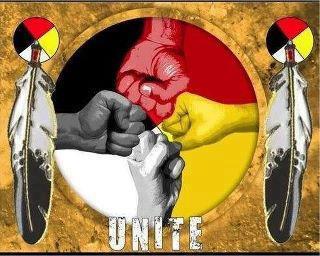
When I hear transhumanists like Jeff Bezos talk about ‘using up’ the resources of Mother Earth (i.e. destroying our home and source of life) necessitating the colonising of Mars, I cannot understand how we continue to give that insane and destructive a person so much power and control over so many resources. I pray for transformation of our rotting, greedy and destructive collective psychosis towards fulfilling the wisdom of Sioux scholar Vine Deloria Jr. instead: “The future of humankind lies waiting for those who will come to understand their lives and take up their responsibilities to all living things. Who will listen to the trees, the animals and birds, the voices of the places of the land? As the long forgotten peoples of the respective continents rise and begin to reclaim their ancient heritage, they will discover the meaning of the lands of their ancestors” (Quote source, Image source).
Exercise: Reflect on your own lived experience of Identity politics. You may want to listen to the Indigenous Science Dialogues and share to inspire rich, healing conversations with loved ones.
 If you value this content, please engage in reciprocity by living, sharing and giving.

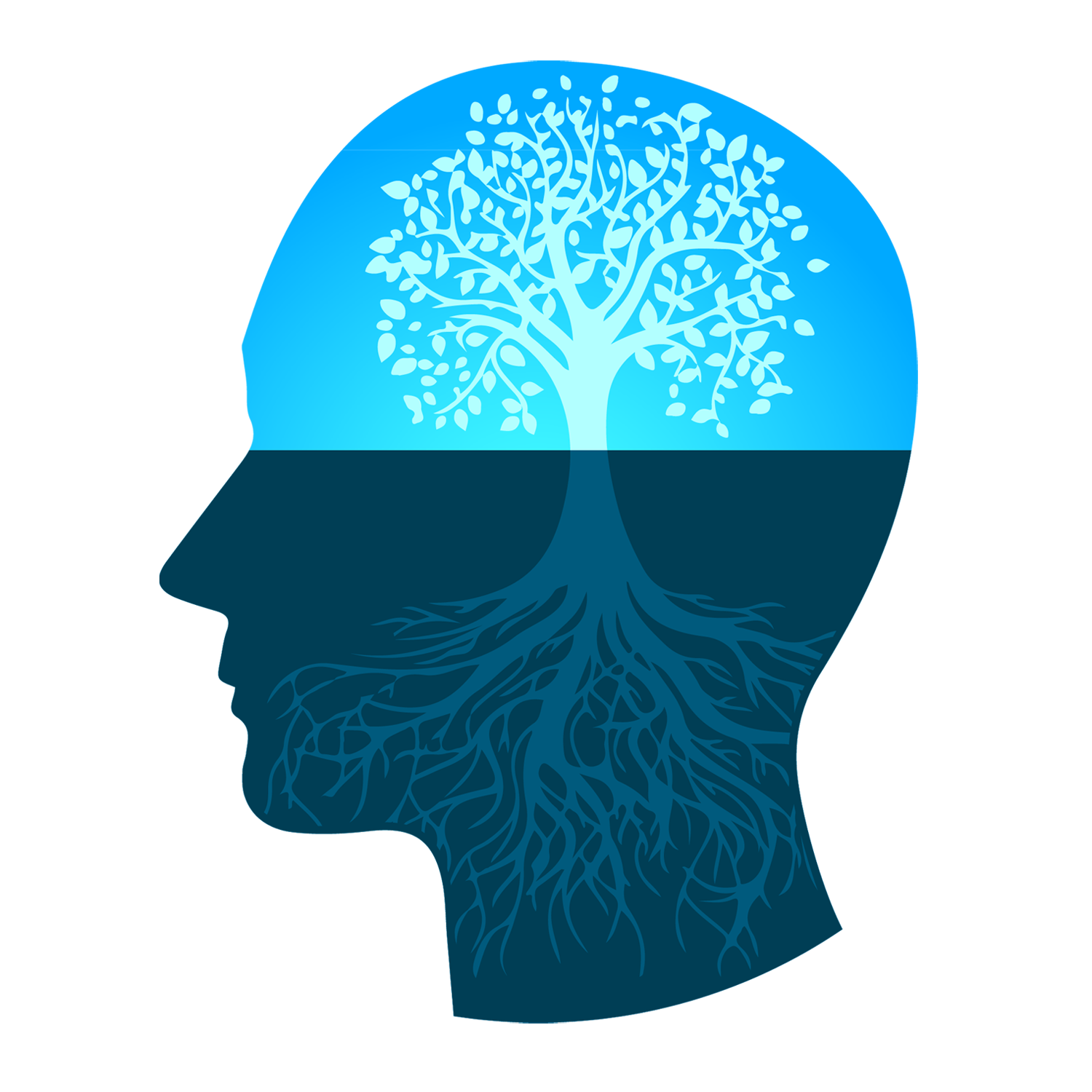 For me it has been vital to live in two worlds: (1) a social reality that is based on a Western worldview, and (2) an earth-based reality based on an Indigenous worldview. When I’m caught up in a survival struggle in the Western world that’s terrifyingly real, and I’m feeling rejected and judged and shamed and angry, I can spiritually connect with the knowing from the Land and my ancestors that I’m not only allowed to exist but that I am wanted. This powerful medicine is all I have found that alleviates my existential wounds. Without it I feel like I would not still be here on this Earth, as my roots would have rotted and not been able to hold up the rest of my inner tree of life. (Image from
 Altering my consciousness is another survival tool I use daily, primarily through
  There is so much power in
 As an Indigenous scientist living far from ancestral lands, from a socio-political perspective, I am a settler

 The dialogue of that name was with my friend
 Shona (Zimbabwean) Australian woman
  This “mere existence” of Aboriginal people as humans worthy of dignity collapses the entire ‘legal’ foundation of the Australian nation. The High Court overturned
  When I hear
  Earth Ethos