Category Archives: Spiritual Skills

Calendars, Seasons & Cycles

Blog by Valerie

There are four types of calendars:

  • A lunisolar calendar follows both the cycles of the moon and sun. Because the days, weeks and months are fixed, holy-days determined by the lunar cycle fall on different calendar days each year. (e.g. Hebrew, Buddhist, Hindu, Chinese, Korean, Tibetan, and pre-Christian Germanic tribes)
  • solar calendar like the Gregorian and Julian ones we are most familiar with follows the cycle of the sun only. It tends to be used by agricultural cultures. (e.g. Christian, Berber, Tamil, Bengali, and the French Republican calendar)
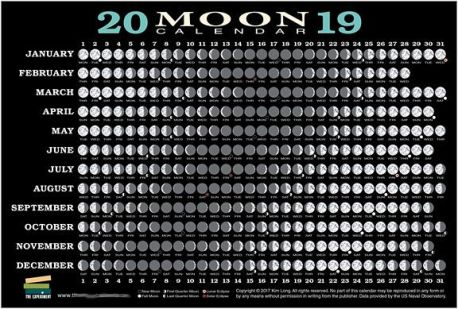
  • mooncalendar.jpgA lunar calendar follows the cycle of the moon only and may have 12 or 13 months in honour of the number of moons in a year. (e.g. Islam, Igbo & Yoruba of Nigeria)
  • A seasonal calendar is based on elemental (earth, air, fire, water), floral (plant) and faunal (animal) patterns throughout a year. The number and types of seasons are dependent on specific places, so even tribes near each other may have different seasons if their land has a river that floods during a “wet” time, or if an animal migrates through their land at a specific time of year. (e.g. Aboriginal Australians)

You may think that four seasons a year has been standard in European cultures, but the old Norse calendar had only two: summer began in mid-October, and winter in mid-April. The “Wheel of the Year” is a common calendar used by modern-day pagans of European ancestry and is based on the equinoxes and solstices, and the half-way moments between them to mark changes of a four-season calendar. The images below are of Heathen (modern-day Germanic and Norse pagan) and Celtic pagan calendars. If you are in the Southern hemisphere and wish to honour this calendar, Glenys of Pagaian Cosmology translates it so your celebrations are seasonally appropriate.
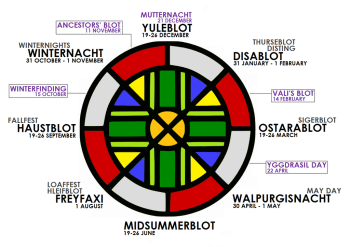
1024px-heathen_holidays

wheelofyear

There are many ways of acknowledging seasons and cycles because of the diversity of environments, traditions and beliefs that influence a culture. The term “pagan” may make you think of someone in pre-Christian Europe who worships multiple gods, but it actually refers to people who are “fixed or fastened” to the land, i.e. villagers and country folk. In other words, pagans are people who have not yet experienced cultural genocide and disconnection from their ancestral homelands and whose culture is indigenous to, or rooted in, a specific environment and place. Aboriginal Australians offer us a reminder of how all humans once lived “fastened” in sacred connection with our environments:

(Clip from here.)

Exercise: Wherever you live, consider how to describe a seasonal calendar in your area. You may want to use the image below adapted from this template as a blank canvas, with this complex blended calendar offering some inspiration.

In the template, cross-quarter days are marked as circles and lines mark equinoxes and solstices. Aspects of your Medicine Wheel may be written in the upper open area, land-based cycles in the next layer, and important dates below the months. Don’t worry if you don’t know some things. You can’t do this wrong; you have a unique ancestry (of land(s), lineage(s) and spirit) and the way you celebrate seasons, solar and/or lunar cycles can be your own.
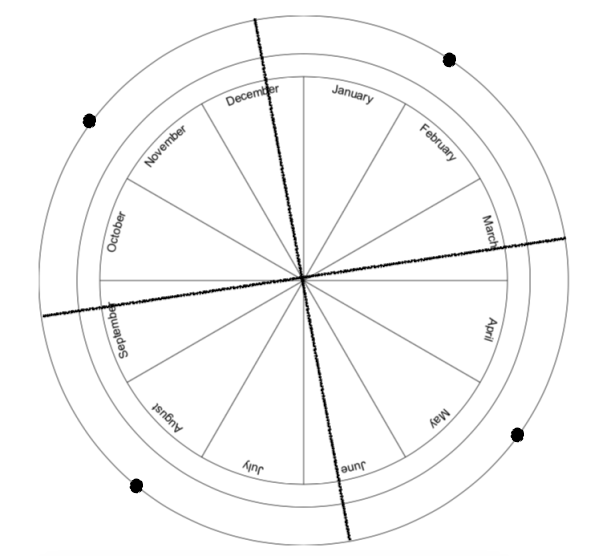
Calendar Medicine Wheel

To give you some examples, in my Medicine Wheel / adapted Wheel of the Year calendar, each of the four parts is associated with a season, a colour, an Earthly cycle, an aspect of ancestry, and a totemic plant or animal – so my direction of north represents the mental, the element of air, the season of winter, the colour black, the Earthly cycle of rebirth, my Sumerian (Jewish) blood lineage, and the date palm (a sacred plant). Transposed over the Wheel of the Year, I am developing an understanding of the land-based seasonal calendar for Yuin country on the south-eastern coast of Australia, where for example, humpback and southern right whales migrate north to breed in May, and then back south with their babies in October. Also transposed are a few holy-days I like to honour with others around the world include Earth Day, the International Day of Peace, Indigenous People’s Day, and Martin Luther King Jr.’s and Nelson Mandela’s birthdays. I also honour birthdays and death days, as well as new and full moons and eclipses.

giveheart If you value this content, please engage in reciprocity by living, sharing and giving.

Kinship

Blog by Valerie

In a previous post I wrote about ancestry:

Through a Shipibo elder of the Amazon I learned that about 90% of the thought-loops that circulate our minds are not based in ego, but in ancestral trauma. I learned through Dakota Earth Cloud Walker that ancestry is defined in three ways: blood lineage, ancestry of place, and personal karma. Personal karma refers to past, present and future versions of ourselves, and all of the complex identities we take on during our lifetime (or multiple lifetimes if you see things like that). Blood lineage is the most common way we think about ancestry, reflected in a family tree. Ancestry of place includes places where the people in our family tree lived, as well as where we have lived and live now.

totem-poles.jpg

This blog and this short lecture about kinship from an Aboriginal Australian perspective are a reminder of the kinship relationship indigenous cultures traditionally have with animals, plants, landforms, and elements of nature. Aboriginal Australians and many First Nations in the northern US and Canada constructed totems (or tokens) as emblems of these relationships. (Image from here.) It’s a stark contrast to modern living, well said in a post of The Druid Garden’s Blog:

One of the great challenges of our age is that humans are radically disconnected from nature; our food comes from somewhere else, our products come from somewhere else; we don’t know the names of plants or animals in our local ecosystem, we don’t know what a healthy ecosystem looks like. We could not survive in our ecosystem without modern conveniences in place, as our ancestors once could. Through learning about nature, through nature study, wisdom, and experience–we learn how to be in nature.  Once you begin seeing nature as sacred, you treat it as sacred.  

Since an Earth Ethos is based on interconnectedness, it is important to honour non-human kinship relationships and ancestors. Most of us do this to some extent every day, through choices such as bringing a bag to the supermarket to be respectful of Mother Earth’s resources, but we could go a lot deeper. We may consider our pet dog or cat a member of our family, but we generally struggle to see non-humans as kin. In one of Peter Wohlleben’s books he asks if we humans are the most intelligent species on the planet, why we work so hard to teach other animals like parrots and chimps to speak our language, rather than learning to chirp or hoot in their languages. This is not as far-fetched as it might sound. For example, many hunters have tools that mimic bird or mammal calls, a few years ago I took a class on bird language in Texas, and Aboriginal Australians traditionally integrate animal calls and movement patterns into their music:

Something that helped me shift my thinking and ways of being was learning sweat lodge. In a sweat lodge, we refer to the rocks we use as our grandfathers, because they have been on Earth much, much longer than any of us. Many have broken off of mountains and been on long journeys before they become small enough for us to pick up. When we build the fire for sweat lodge, we ask which sticks and logs will give their lives for us and thank them for changing forms for our ceremony of purification. We ask which rocks will come into lodge and give their lives to us, meaning their life force energy and the wisdom of their long journeys, so that we can purify our hearts, minds, and bodies during the sweat. Often while we are preparing a bird will circle overhead or a mammal or reptile will visit a while, and we thank them for blessing our ceremony and ask what we may learn from them. This kind of thinking is a refreshing change from seeing ourselves as the pinnacle of evolution, to the humble new species on the block. human-evolution-vector-74195(Image from here.)

Research has shown that plants grow better when humans speak to them. So next time you walk past a tree, why not nod in greeting? Or as you water a bush, thank it for flowering?

Exercise: To connect with our non-human kin, as previously mentioned, a great method is a sit spot. A variation of this is to do a sit in the wilderness (even your garden or a park) blindfolded, or at night, so that you focus on using your non-visual senses. If you have access to a stethoscope, you can use it to listen to the heartbeat of a tree. Another fun way is to greet non-human kin like plants or animals. Finally, check out fun videos like the one below that link plants’ carbon dioxide emissions to sounds we can hear:

giveheart If you value this content, please engage in reciprocity by living, sharing and giving.

The cynicism trap

Blog by Valerie

If you’re reading this, chances are you are someone who walks willingly into uncomfortable feelings and values lessons gained through pain. Thank you. Your presence on the planet makes a difference when you walk such a path. I too have been on a hardcore heart-warrior journey for years with an understanding that energy is trans-form-able. I have trusted that being with and creatively expressing painful emotions is a valuable way to be of service. In some respects, this perception is misguided. Mary Shutan reminds us that certain primal energies related to survival are by their nature quite brutal. They are worthy of being with and expressing creatively, but they are not transformable. Most of us have witnessed a predatory animal stalk and eat its prey. Most of us have physically stood near an animal that humbled us and showed us our place in the food chain. (Who wants to swim near this guy?)

gator.jpg

Most of us have experienced forces of nature bigger than we are, such as tornadoes or flash floods. Some of us have faced homelessness or joblessness and been unsure how our basic physical needs will be met. Experiences like these challenge our individual survival and ask us to stand in faith. I define faith like Christina Pratt as “a liquid state of grace”, a free-fall, a letting go and allowing something bigger to steer us for a while.

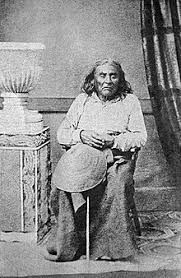
seattleIn his famous speech Chief Seattle foretold that the way U.S. settlers were treating Mother Earth was moving us collectively into “The end of living and the beginning of survival.” I find it helpful to think of survival as more complex than fight, flight or freeze. One researcher suggests the following survival strategies: rescuing, attaching, adapting, asserting, fighting, fleeing, competing, and cooperating (Valent, 1995). Knowing that a small proportion of people are controlling physical resources, and that through various ways of looking at inequalities physical survival fears are very real, and that legal systems are maintaining many of these imbalances, I can see why some say that trauma-induced behaviours such as hyper-vigilance are actually evolutionary protective mechanisms to help us survive modern life (Silove, 2007). (Image from Wikipedia.)

Across the planet species are going extinct, human languages and cultures are dying, polar ice caps are melting, and lands are disappearing underwater. In an Earth Ethos, we are all interconnected, so if we didn’t feel pain with those things going on, we wouldn’t be living! I think it is important to accept we live in a time filled with survival struggle energy that it is brutal by nature and often seems to have incredibly unfair impact. Accepting this does not mean that we give up, lose hope, renounce faith, or fall into the cynicism trap by giving up on a healthy, balanced future vision for generations to come. While we may not be able to transform primal survival energy, we can transform cynicism and question ourselves when we or others get caught up serving survival strategies. I say “serving” because, years ago Tom Lake said to me there is a difference between “being of service” and “being a servant.” When we are guided by rigid stories in our minds, we are servants blindly acting them out. Consider the “good person” story. We feel the need to do certain actions and avoid others to prove we are “good,” then we judge others’ behaviour as “bad” and justify acting on our righteous anger by punishing them, which is the basis of our criminal justice system. I find this story incredibly destructive, and I agree with Sadhguru that there are no good or bad people, only miserable and joyful people.

imwithher.jpgWhen we are miserable we are rejecting or rebelling against reality, which is destructive and results in existential crisis. When we are accepting we remain in the present moment, however painful. Many of us understandably feel overwhelmed by the depth of pain on the planet right now, so we numb ourselves with substances such as sugar, caffeine or alcohol; run away to our heads to avoid certain feelings; and seek out “light work” or “positive psychology” to create bubbles of security around ourselves. This is so common that a famous social psychology study published in the 80s suggesting that “overly positive self-evaluations, exaggerated perceptions of control or mastery, and unrealistic optimism…promote mental health” has yet to be refuted. So not only are we serving a story (like being a good or bad person) that doesn’t need to survive, we are avoiding the important responsibility creating a vision for future generations of a world we want them to live in, but the cynicism trap doesn’t even improving our mental health! The medicine I find works best when you catch yourself falling into the cynicism trap is to let go of that cynical vision and move into a graceful free-fall instead, living on faith for a while. The more I stand in faith, the more clearly I see that Mother Earth has a beautiful vision she’s desperately trying to communicate to us when we move through our survival fears and make space to listen and act on her guidance and wisdom. (Image from here.)

Exercise: What survival strategies do you most commonly use (rescuing, attaching, adapting, asserting, fighting, fleeing, competing, and cooperating)? Where are you serving a story that does not need to survive? What is preventing you from letting go of control and standing in faith?

giveheart If you value this content, please engage in reciprocity by living, sharing and giving.

Social belonging

belonging.jpg

Blog by Valerie

The etymology of the word “belong” is “together with” or “related to.” It’s a tribal concept. Years ago I worked with a shaman who said human nature is tribal, not national, by which he meant, the colonialist social experiment of countries would naturally devolve into tribes. These days I agree with this. Places like the US are too diverse and too big to be governed by anyone but a strongman holding it together through control. Before colonisation, Native Americans had governance structures of inter-tribal councils where power was not concentrated in one person but in a diverse group of elders that needed to reach consensus on contentious issues, and tribes had their own internal governance structures on top of that. But these days, what is a tribe? I like this definition, that in when we’re in our tribe, we feel normal and accepted. A clan is a more tightly bonded sub-group within a tribe, and a family is a more tightly bonded sub-group within a clan. A community is made up different tribal members and is formed either out of necessity (such as living as neighbours), or shared interest (such as attending the same school or church). (Image from here.)

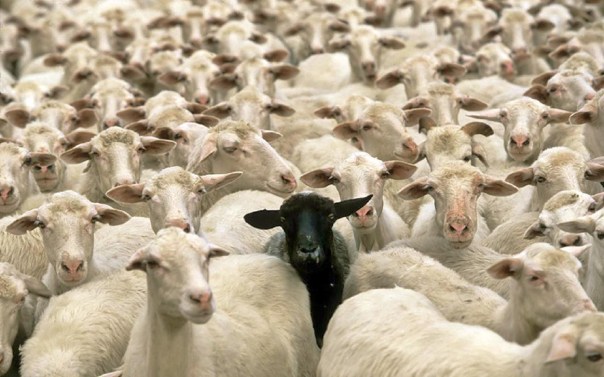
I have been a member of communities my whole life, but experiences with tribe, clan and family have been much more recent. The most memorable time I felt part of a “family” was a few years ago right before an indigenous dance ceremony with a group of people I had never met before. I had an “aha” moment sitting in a kitchen watching people buzz about preparing things for the ceremony and savoured that feeling so it would imprint in me and I would remember it. As a “black sheep” it took me a while to realise that for me family is based on feeling, and that being born out of intertribal conflict literally creates “bad blood” that I’ve needed to reconcile in order to survive. My tribe is scattered across the planet, and that’s okay. And many members of my tribe are invisible, ancestral spirits.

black sheep.jpeg

An experience I have often is “whitewashing,” where people look at me and immediately assume that I am a Christian of Anglo Saxon colonial background (though I have no Anglo Saxon blood that I know of, and I was not raised as nor do I identify as Christian). Growing up in the American South, I had a friend whose parents were Jamaican who similarly grew weary of being referred to as African American. We really project a lot of identities onto people without realising. Someone said if you really want to change the world, be mindful of your own projections, and boy do I agree with that. Even then, a projection and an internal felt sense of belonging are not remotely the same thing. (Image from here.) I am reminded of an experience in a sweat lodge where a Tiwa woman said she had been hoping there was no “white blood” in her family because the karma of that energy was so hard to deal with, but that a DNA test had shown she had some European ancestry. I said a prayer during that lodge: May all our intertribal conflict remind us that we are one big human family. May we celebrate our diversity and enjoy healthy boundaries. Aho. A cactus may appreciate a water lily, but they can’t survive in the same environment, so why would they go against their nature and try? Some of us must be in the wrong place physically, or else we would not have so much conflict in our communities. Sometimes we’re so used to being malnourished, it takes a while to imagine what it would be like to really flourish.

I’ve been reflecting on genocide, where one tribe has an overgrowth of the psycho-spiritual Wetiko virus convincing them that they are existentially better than another tribe so they set about violently trying to prove this by removing the “other.” If energy cannot be created or destroyed, when a tribe is killed, where does that energy go? I realised it emerges as ancestral trauma within the dominating tribe in successive generations in an attempt to reconcile the conflict from the inside out. Many of us who feel we were born into the “wrong” family, tribe, culture, body, etc., are bearing this diversity.pngkarma of humanity out. It’s all over the place: it’s conservative Christian parents confronting their prejudice with an LGBT child; a Southern Baptist who falls in love with a Catholic; a strong patriarch with a young daughter wiser than he is; a mother who worked so hard to break into the corporate world whose daughter wants to stay at home with her kids. Over and over again I see situations in which that which we judge, hate or reject is presented to us in an even more intimate way so that we learn to love and accept it. (Image from here.)

Exercise: Where, when and with whom do you feel belonging? What does it feel like? Next time you feel lonely, isolated or alienated, be with the “longing” for that aspect of yourself and explore why you feel that. What part of you feels rejected and why? What do you need to feel more present and whole in that space?

giveheart If you value this content, please engage in reciprocity by living, sharing and giving.
Questioning Cosmology

christin-hume-482896-unsplash.jpg

Blog by Valerie

Stories are great teachers. They help us give meaning to events, teach core values, and inform our understandings of social order and individual identity (Engel, 1993). We each carry stories, personal mythologies, that form our core values and beliefs, help us understand our place, and guide us on our path. The concept of empathy, of deep listening and heartfelt storytelling, is central to oral-based cultures, and even in cultures that privilege the written word, such practices are considered deeply sacred, like the Catholic Confessional, or an important part of daily life, like meeting a friend or family member for a chat/yarn. (Free use photo by Christin Hume on Unsplash)

In practice, empathic listening, and the safe sharing stories, is limited by the cosmologies of participants. When we share a story with someone, and that person is in a state of being in denial/judgment about what we are saying, we experience rejection/lack. When we receive this reflection, we tend to feel shamed. And especially as children, or because we feel fear of being exiled from our family/tribe/community, we carry this shame in our own hearts and minds, fuelling feelings of low self-worth. Rejection is a deep pain to process, a lack of feeling whole. And most of us have inherited much of this due to ancestral trauma. An Earth Ethos suggests that those of us who are involved in violent behaviours, in whatever role (victim, offender, or bystander), carry elements of shame in our very senses of identity (Thibodeau & Nixon, 2013; Sawatsky, 2009). This shame, often referred to as “sin” creates feelings of lack of worth and dissociates us from fully being present. We fear social exile, and rightly so, because without connection with other people, it is hard to live. (Image from here)

exclude

When I did research with sex offenders, I heard a lot about the depth of social shame they felt. I heard about some men who were disturbed by sexual thoughts of children and were too terrified to seek help until they acted on it, and others who did seek professional help and were reported for abuse they had not committed. I felt an intensely painful energy in the space of social stigmatisation where so many of these people and their family members and friends, these fellow humans, live.

compromiseI encourage you to connect with your own cosmology and question rejecting/violent statements/thoughts like “He should have known better”, or “It serves her right.” Such words indicate an internalised denial/judgment and fuel shameful, painful feelings inside you, the person you are speaking/thinking about, and our collective culture. Even when we believe/think something is wrong, we can still hold that aspect of our cosmology with compassion and respect. These words are pointers to places of yourself that could be further explored, unpacked, and transformed. Dangers and fears come in many forms, including physical, emotional, psychological, and spiritual. Watching an interview with someone who has killed another person, for example, may trigger emotion you are carrying and show aspects of your cosmology that could be shifted from judgment or denial/lack into compassion and empathy, and gratitude that you did not need to learn such a lesson the hard way. (Free photo by Christin Hume on Unsplash)

Exercise: Reflect on how many compromises you make in the name of “social harmony”/fear of change, and when it is important to you to go against the grain. See if you can connect with an aspect of your own humanity that is unfamiliar, like your “inner prostitute,” “inner abusive parent,” or “inner murderer”, and be with the discomfort that comes up in order to hold people in that space, and yourself, in more compassion and gentleness.

giveheart If you value this content, please engage in reciprocity by living, sharing and giving.
Space Clearing

smoke

Blog by Valerie

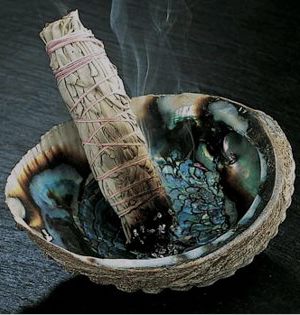
When I have lived in big cities such as Mumbai and L.A. I would come home and wipe visible grime off my skin. But I also picked up a ton of invisible psychological, spiritual, and emotional grime, and we often forget about this. Imagine how many people’s thoughts are projected onto you each day, how many people’s and other animals’ emotions you pick up on, and how much spiritual energy (probably mostly negativity) you pick up too. When a friend asked an indigenous elder how cleansing worked, he said the smoke eats us. What that means to me is that the smoke literally eats away at all the energies we are carrying that are blocking us. These days the only serious cleanses of spaces we tend to do are fumigations with toxic chemicals for pest control. Yet cleansing our space is a simple way to shift our energy, lighten our loads, and literally make space for new blessings to flow into our lives. Hospitals, schools, cars and homes are all very different spaces when we release the myriad of projections and energy patterns that build up in them! (Image from here.)

smudge

In indigenous cultures, purification with smoke is often referred to as smudging. Plants chosen for burning carry symbolism for a culture and are local to a place. Native Americans burn tobacco, cedar, sweetgrass and sage. Palo santo wood is burned in the Amazon. Aboriginals in Australia burn acacia, eucalyptus, paperbark and treefern (Guédon, 2000). Plants are burned to symbolise the purification of a space for healing. This reminds us of the sacredness of life and helps us be in the present moment. In Tiwa language of the American Southwest, the word “nah-meh-nay” refers to land, which means “the self that purifies” (Rael, 1998, p. 29). (Image from here.)

Clearing a space by burning incense, plants, or resin is done for similar reasons in many Christian, Buddhist and other religious and medicinal traditions. Scientific studies investigating herbs used by indigenous cultures suggest that smudging may cleanse bacteria from the air (See e.g. Nautiyal, Chauhan, & Nene, 2007; Mohagheghzadeh, Faridi, Shams-Ardakani & Ghasemi, 2006). In fact, as recently as during WWI, rosemary was burned in hospitals for cleansing a space.

In an Earth Ethos, we clear space by working with the four elements (earth, air, fire, water). To honour the earth element, we use incense, herbs, plants or resin; to honour the fire we light it; to honour the air we allow the smoke to spread throughout the space; and to honour water we spritz it (often mixed with an essential oil or infused with an herb or flower) around the space to finish. When cleansing a space, it is important to set an intention that everything unnecessary/not yours be released. Feel free to use specific prayers if you follow a certain tradition. While plants, trees and flowers have unique strengths that herbalists know, using something you feel intuitively drawn to or that you have a relationship with already (like you have grown it in your garden for a while), will strengthen the cleanse. For example, sage is commonly sold and used to cleanse a space, but it is traditionally used not to cleanse a space, but to create sacred space before a ceremony (Mary Shutan, 2018)

bathBefore you cleanse the space outside of you, it is important to smudge your body and walk through a spritz of the water you will use so you are as clear as the room! A full body smudge is often done in the shape of a cross going along one arm across the chest to the other, up above the head and down to the feet, and then the same around the back of the body. For a more thorough bodily cleanse, consider a mindful bathing/cleansing ritual. Spiritual bathing, whether just in pure water or with additional herbs or minerals, is an ancient practice of purification done across cultures and religious traditions. It takes the form of baths, steams, saunas, hot spring soaks, and sweat lodges. Science has shown that the skin is our largest organ, so it helps keep us healthy on physical, emotional, mental and spiritual levels to cleanse it in an intentional, ritual way. A simple and effective bath you at home is adding salt to bathwater, along with a spoonful of non-piped-in water such as collected rainwater, seawater, or water from a nearby lake or river to strengthen the power of the water. This blog has useful basic information about spiritual bathing. And if you don’t have a bathtub (which I didn’t in my previous apartment), it’s amazing what a weekly saltwater/essential oil intentional foot soak can clear!

Unless you have a lot of stuck energy in your life, or there has been a lot of arguing or pain in your space or your body, a once a month spiritual house cleanse and once a week spiritual body cleanse should be sufficient (Mary Shutan, 2018). It’s a small ask that can deliver big results. 

Exercise: Clear your space and cleanse your body with a spiritual bathing ritual. Even better, do regular rituals for a few months, and see how it improves your life’s flow!

giveheart If you value this content, please engage in reciprocity by living, sharing and giving.
Being & Doing

Blog by Valerie

When walking the medicine wheel in everyday life, we choose where to place our focus. The lower world, the invisible, felt world of Mother Earth is a metaphor for our state of being. Out of our state of being arises action in the physical, visible world of Father Sky. By focusing on our deepest values, we feel more solid, like a tree with a strong foundation in the Earth. By focusing on specific actions and situations, we feel more like an individual leaf that may be tossed about by a breeze. treebg

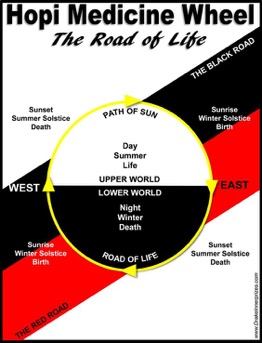
Using the Medicine Wheel as a metaphor for our life path shows us how this works. The concept of the Red Road and Black Road is distilled from numerous traditional tribal teachings of indigenous cultures of North America. The illustration below suggests how to walk the Red Road. Imagining a line drawn across the Medicine Wheel below shows that on the Red Road the majority of our focus is on the lower world of Mother Earth, on letting go. This means we are focusing on embodying our deepest values, such as compassion, empathy, grace, and kindness. It means we are regularly purifying ourselves individually and in community so that we deepen our ability to remain present. It also means that we trust that all of us on this planet are of innate value, that the Earth wants us here because we are being supported to live right now, and that we have gifts to share. Sometimes it takes leaps of faith to be willing to trust that we are valuable. We may get caught up in proving our worth through our intellect or actions. Most of us carry stories from the Old Testament of a God that asked us to do good actions to prove that we are worthy of living another year. When we are behaving this way, we are walking on the Black Road. We are focusing on actions and outcome, often justifying means that conflict with our most cherished values to reach certain ends, because we feel scared, overwhelmed, or confused.

hopiroadoflife

Many indigenous languages focus on action verbs and vowel sounds to embody this Red Road path. In this kind of thinking, there are fewer labels and fixed ways of being. I am not a noun called “Valerie” or “Cloud Clearer,” I am “Valerie-ing” and “Cloud Clearing” in every moment as I flow through the world. The avoidance of labels like “right” or “wrong” gives us space to exist no matter how we behave, or where we place our focus. Yet, if we choose to be on the Black Road, there are consequences. For example, if we don’t tell the truth, we are in a state of being untrustworthy and create shame. In modern Western culture, we often feel an expectation to have an opinion or respond to a question with an answer. We even talk over each other in spirited debates. On the other hand, to show respect for each person’s place, many indigenous cultures traditionally practiced deep listening in silence, only responding after more silence once the person finished speaking, to show that their words were considered first.

To walk the Red Road has much in common with A Course in Miracles. What we can dream up on our own pales in comparison to the miracles that can occur when we truly let go of resistance and allow our lives to flow. Sometimes we are so full of emotion, stories, and unprocessed past experiences, that what we need most is to create space. Crees teach seven ways of releasing negative emotion: crying, yelling, talking, sweating, singing, dancing, and praying (Ross, 1996). We also need practices to help us return to and retain states of being that we prefer. In my life, meditation is an invaluable daily practice in this regard. In meditation, I listen to my inner voices, practice compassion, honesty, and letting go, and create space so that miracles may occur.

bryant-mcgill-heart-broken-expanding-love-9q1m

Exercise: Our hearts are for-giving and for-getting. What are you giving and getting in this moment? If it is painful, remember that you already survived it, and feeling it fully, expressing and releasing the emotion, is a courageous and freeing choice to let it go. May you enjoy the flow.

giveheart If you value this content, please engage in reciprocity by living, sharing and giving.

The Medicine Wheel

Blog by Valerie

Indigenous cultures around the world are based on a philosophy of innate wholeness of all beings. The medicine wheel is the “essential metaphor for all that is” (Rael, 1998, p. 35). Walking the circle of the medicine wheel is a life path, and the medicine wheel in any physical form is a tool for learning, growth, and remaining in balance. A visual representation of the medicine wheel tends to be a circle divided into fourths (though some cultures such as in China and India divide the circle into five). There are many metaphors for the four parts of the circle, including: the four directions (north, east, south and west); the four seasons (winter, spring, summer and fall); the four times of day (morning, afternoon, evening and night); the four stages of life (infant, child, adult and elder); the four elements (earth, air, water and fire); and four aspects of being human (physical, spiritual, emotional and mental) (See e.g. Bell, 2014; Charbonneau-Dahlen, 2015; Dapice, 2006; Rael, 2015). The medicine wheel below in 2D is from the Hopi tribe of southwestern North America as an example of one culture’s symbolism for the wheel.

hopimedwheel

To see the medicine wheel in 3D, imagine a central point below the ground, a point in the centre of the circle representing the heart that unites us all, and a central point above the ground. The portion of the medicine wheel above the ground represents Father Sky (aka Pachapapa), the visible parts of life, and the lower half of the medicine wheel represents Mother Earth (Pachamama), the invisible parts of life below the ground. Mother Earth is experienced through feeling and intuition; she is mysterious, a dark womb of life. One of Joseph Rael‘s teachings is that darkness is the purest form of light, because all colours come out of it. Mother Earth nourishes all of us who walk on her surface.

vitruvianWhat is outside the medicine wheel is without form, what we refer to as the unknown or the shadow, whereas inside the medicine are known aspects of a culture or individual’s world (Rael, 1998). Energy is constantly cycling in and out of the medicine wheel. In the Hopi medicine wheel some energy may enter in the North, the mental realm, and give us an idea: I forgot to brush my teeth. Then the energy moves into the East, the spiritual, where we give meaning to the idea: I might get a cavity. Then it moves to the South, the emotional, generating feelings based upon our meaning: Fear of cavity! Our feelings then move us into taking action in the West: going to the bathroom and putting toothpaste on our brush. By expressing the energy, we move to the centre of the circle, the Heart, where we reconcile the energy and experience it in 3D as human lightning rods (or channels or hollow bones) connecting the Earth and Sky. To imagine the medicine wheel in 3D, consider da Vinci’s drawing of the Vitruvian man, which is based on an indigenous Greek drawing.

All directions need to be in balance for us to live in well and be centred in our hearts. So the medicine wheel shows that each of us humans is a symbolic embodiment of our spherical planet Earth. A talking circle, in which a group sits in a circle with open space between them (and may pass a talking piece around) is based on this sort of Earth Ethos cosmology. The talking circle represents a communal medicine wheel where every being is interconnected within an inclusive web.

medicinewheelexerciseExercise: Consider where you may be in and/or out of balance by filling out this empty medicine wheel chart. Write down what is going on in your mind, what you are experiencing in your spiritual world (aka what is giving your life meaning and purpose), what emotions you are experiencing, what’s going on physically in your body and environment, and what keeps you centred/keeps your heart open. Notice if something is out of balance, and consider what area(s) of the medicine wheel might need some attention. This is a tool I developed that can be used periodically to check-in with yourself, or be given to friends or clients to do so to help notice progress and change.

giveheart If you value this content, please engage in reciprocity by living, sharing and giving.

Flow

Blog by Valerie

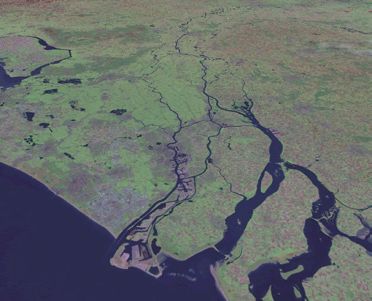
We often say “random” to refer to something unexpected happening. In English, “random” arose from the word “run”, which is related to the Rhein river in Germany, and refers to “flow.” When we have space for the unexpected, miracles flow. When we live in obligations and expectations and keeping up appearances, we feel dead inside. How well life works when let go of our traumas and projections and are able to trust and accept the natural flow of events. Judgment comes from existential black-and-white/right-and-wrong thinking; we dissociate part of life that we do not accept and carry that energy as guilt, shame, or hatred. Then we project these dissociations onto people, events, experience, etc. and judge our own projections. It’s a very destructive game. (Rhein delta image from: http://www.delta-alliance.org/deltas/rhine-meuse-delta)RhineMeuseDelta.jpg

There is a difference between seeing events and experiences as neutral and allowing meaning to emerge, and making meaning out of events and experiences by projecting our wounds (traumas, emotions, beliefs, etc.). There is a difference between carrying a dream, praying/wishing for it to come into being, and taking action to bring it into reality, and of forcing a dream to take form based on our own vision and desire. It’s the difference between being a dictator, and a co-creator or co-dreamer. As a co-creator or co-dreamer, we acknowledge that we are not in charge of the “how.” We may not even know “why” we have a particular dream, “where” it came from, or “who” will support its birth into being. We may only have a vague sense of “what” the dream is, because we know it needs to evolve in a context much bigger than our own mind can know.

For example, we may dream of being a parent, and we may carry a vision of what that looks like, such as: a stable romantic partnership, financial security, a safe home environment, and a caring community. But the events and experiences of our lives may be very different to our vision. We may struggle to become pregnant, lose our job and be unable to afford some things we wanted, or get pregnant in an uncommitted relationship. Why do these things happen? The best answer I have is, I don’t know! And that answer is so freeing. I help my mind be okay with not knowing, because I practice flowing and accepting. I also choose to trust that life is always helping me to awaken, evolve, and become a more authentic and present version of myself. So when I experience unexpected hardship, I feel alive, and I know I will learn something.

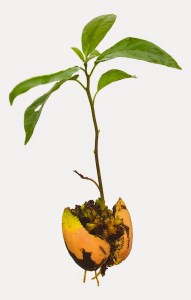
Trauma gets a bad rep. Sure it triggers pain and can be overwhelming. I have experienced a lot of that. But trauma is a powerful birth/death crisis-type of energy that has potential to teach us about ourselves and our world, to help us remember on a Avocado_Seedlingdeeper level who we are, and to offer us new life experiences. You can’t plant a seed in the ground without digging a hole and traumatising a small patch of earth. And a seed can’t begin its journey of growing into a tree without traumatising the seed encasing its energy and expanding into the soil. Trauma is part of the cycle of life, of birth-life-death-and rebirth. We can look at a tree and label it “dead” and forcibly chop it down. Or we can look at it and realise it’s decaying, and that there are numerous insects, animals, fungi and bacteria living in that environment who are helping transform the tree back into earth. It is a witnessing of energy changing form. We may also notice that even tree stumps may be “alive” through the interconnection of their roots with other trees in a forest, to keep a network of support and communication flowing between trees living above ground. Sometimes stumps even sprout new trunks and regrow themselves entirely.  (Image from: http://blog.daleysfruit.com.au/2014/03/grown-by-grafting-cutting-seedling.html)

Sometimes our minds are so full of stories, our lives so full and structured with meeting expectations and fulfilling desires that we lose touch with flowing energy. Rivers rarely flow in straight lines, and so flow energy tends to meander and take us into the unexpected and the unknown. We get surprised by “randomly” running into an old friend, rather than seeing that as a natural experience we could be choosing to make more space in our lives for. When we let go of controlling the “how” of our dreams and visions, and even let go of some of our dreams and visions altogether, we make space for flow to emerge. We experience interconnectedness in an organic way, and through the feelings of pain and pleasure of fulfilled and unfulfilled desires, something more precious starts to emerge: an understanding of a purposefulness to our journey, and a peaceful acceptance of the messy reality of being human.

christmasbush copy

Exercise: A simple practice is to regularly block off some time where you do not schedule anything or have any plans. Keeping some time sacred to allow flow energy to emerge demonstrates a commitment to making space for miracles. You then spend that time relaxing as best you can and doing whatever organically arises. You may be surprised to find yourself getting in the car and seeing where you end up. You may also do things that you do most days, but in a different sequence or at an unexpected time, or in a slightly different way than you’re accustomed to. When we honour flow energy in our lives, traumas that arise may seem less intense, because our psyches become used to the unexpected. Give it a try!

giveheart If you value this content, please engage in reciprocity by living, sharing and giving.

Earthing/Grounding Yourself

Blog by Valerie

For many thousands of years, humans have been sleeping on Mother Earth and walking barefoot or with leather-clad feet that keep us connected with the Earth’s energy. It is only fairly recently in our species’ history that so many of us have moved into high-rise buildings, worn rubber-soled shoes, driven in rubber-tired vehicles, and slept on elevated mattresses. All of these changes have disconnected us from the Earth literally, and elevated our anxiety levels through an increase of ungrounded head-y energy.

circulationgrounding

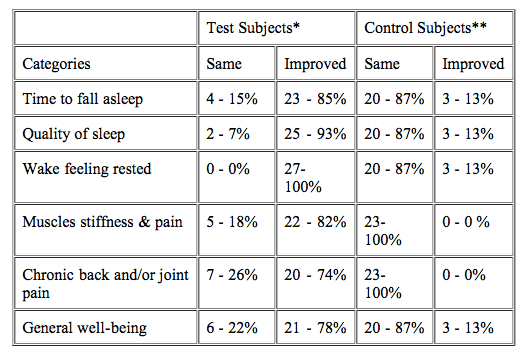
It is not surprising that a number of scientific studies have found evidence for the benefit of earthing/grounding ourselves, though many are small-scale. The figure above shows increased circulation in the face on the right after 20 minutes of grounding. One study of 60 people sleeping for one month with real or control (faulty) earthing/grounding mats in their beds found the following results:

groundingstudy1.png

Another study (with a lot of graphs and figures you could check out) found that inflammation “may be a consequence of lack of grounding, and of a resultant ‘electron deficiency’. Wounds heal very differently when the body is grounded. Healing is much faster, and the cardinal signs of inflammation are reduced or eliminated.” This is because “[a]ntioxidants are electron donors, and the best electron donor, we strongly believe, is right under our feet: the surface of the Earth, with its virtually unlimited storehouse of accessible electrons…Our immune systems work beautifully as long as electrons are available to balance the ROS and reactive nitrogen species (RNS) used when dealing with infection and tissue injury. Our modern lifestyle has taken the body and the immune system by surprise by suddenly depriving it of its primordial electron source. This planetary separation began accelerating in the early 1950s with the advent of shoes made with insulating soles instead of the traditional leather. Lifestyle challenges to our immune systems proceeded faster than evolution could accommodate. The disconnection from the Earth may be an important, insidious, and overlooked contribution to physiological dysfunction and to the alarming global rise in non-communicable, inflammatory-related chronic diseases.”

A study of 12 subjects found that sleeping with a grounding/earthing mat regulated cortisol cycles:cortisol levels grounding.png

The figure above is from a paper cataloguing a number of earthing/grounding studies. Overall, studies are finding that earthing/grounding:

  • Decreases inflammation and chronic pain by releasing excess positive electrons
  • Improves sleep by normalising biological rhythms
  • Improves blood circulation
  • Lowers stress by regulating cortisol
  • Improves menstrual cycle pain symptoms
  • Accelerates wound healing and shortens injury recovery time
  • Relieves muscle tension and headache
  • Supports adrenal health

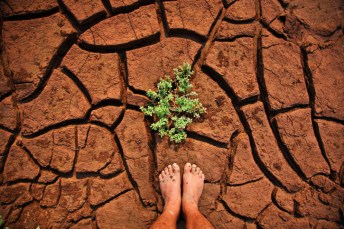
So how do we get grounded? One way to stay connected to the Earth in an office or city is to wear grounding/earthing shoes like traditional leather-soled mocassins, shoes that have carbon grounding you, or to turn any shoes into grounding shoes with a kit. (All of those products I have and receive no compensation from. I’m sure there are many other good ones.) Even better, walk barefoot on sand, grass, soil, concrete, or ceramic tile. You can also walk in saltwater at a beach, or soak your feet in saltwater in your home. (Walking on asphalt, wood, rubber, plastic, vinyl, tar, or tarmac will not ground you.) You can also lie on the ground with your whole body, and if you do this regularly such as on a blanket in a park or your yard or camping, you may notice your stress levels decreasing.

groundingimage.jpg

I have lain on the ground every day for thirty minutes for eight months straight, which did help me. I also started wearing grounding shoes a couple years ago and really noticed a difference in the office. I regularly soak my feet in saltwater. I used to crave going camping, and for a six-month period managed to sleep on the Earth nearly every other weekend. I enjoy walking barefoot when appropriate. But the game-changer for me was to sleep in my bed with a grounding mat. I use this one, but you could make your own by searching for advice online, or buy other products. The first few weeks my husband and I slept with a grounding mat we sometimes felt tired and achy when we woke up, and generally felt a bit discombobulated and had some emotional junk come up. As we settled into it, we felt a lot better, and now I take the mat with us whenever we travel. (As a side note, it’s surprising how often I find outlets in hotels and houses that are ungrounded.) (Image source)

Last week’s post included the concept of the land under our feet being the source of indigenous tribal culture, where cultural wisdom emerges from the Earth below. I have heard indigenous people describe the feet as our eyes to Mother Earth. If we walk around insulated from the Earth, disconnected from our sacred Mother, then our culture is literally ungrounded, and it is not surprising we feel a bit like zombies lost in our heads. So here’s to grounding ourselves. It’s not just part of an Earth Ethos, it’s part of being a healthy human being!

giveheartIf you value this content, please engage in reciprocity by living, sharing and giving.