Category Archives: Culture

Parenting with Indigenous Science

Blog by Valerie
 
There’s so much parenting advice, and so little I resonate with, so I thought I’d share my perspective.
 
Parenting is about building relationships through developmentally appropriate leadership (which is related to a previous post on governance and the YouTube video below on sacred leadership/eldership by Tjana Goreng Goreng, PhD). Kids, whether our own, family, or community, challenge us to confront triggers, fears and insecurities, as well as allow us to more clearly see our strengths, values and capacity to connect. 


When babies cry out we give them instant attention and soothing, but that is not always a good idea with older kids, much less adults! Often we set patterns into motion because of our own limitations (read about some of mine here). I knew a mother who considered her adult daughter mentally and emotionally fragile (which I didn’t). She martyred herself to avoid her daughter feeling pain and experiencing certain struggles. But some of that seemed to me (and the daughter’s therapist) necessary growing pain for the daughter’s development. And I felt the mother was projecting her own mental and emotional fragility onto her daughter because she felt unable to hold space in certain ways. They both seemed a bit stifled. 
 
I say that with deep compassion, because we all have limits and struggles. Part of the fulfilment of any spiritual work, and certainly parenting, is bringing our deepest challenges to the surface so we can make peace with ourselves (and our ancestors, younger and older!) to become even better leaders — i.e. more powerful, grounded, centred and humble human beings.
 
When I look at my child, I see some struggles she’s come here with, some that feel linked to her father and that ancestry, some linked to me and mine, and some connected to her context and the land and ancestors where we live. (Ie ancestors of spirit, lineage, and land). When I am able to shift something that she’s also carrying, I expect her to have a big emotional response because we are connected with very open hearts. My shifting innately moves her heart and affects our shared ancestors, and she has to process it too. All of that emotion is likely to also affect my husband, because we’re all very sensitive. So when I feel something shift, I both feel excited and tend to brace myself to be able weather some emotional storms that my leadership has set into motion. 
 
I’m very aware that being committed to deep spiritual work asks a lot of myself and people who choose to be intimate with me. I don’t feel like I have a choice, though, in the way a singer can’t (or ought not!) stop themselves from busting into song throughout the day. To stifle it is to self destruct and snuff out my life force. Parenting feels the same in that it’s not a choice, it’s an honour and responsibility that defines the structure of my life.
 
I remember a book that made news years ago about parenting being all joy and no fun. To me, that says the parent is overwhelmed and may not know any other way to lead and set up their life. I’ve seen quite a bit of a so-called ‘gentle parenting’ approach, which feels like a reaction to authoritarian parenting and actually seems to me to stress out the children by giving them too much leadership space and not enough containing and consequences to uphold values and norms.
 
I appreciate some elements of the ‘sturdy parenting‘ approach and agree that there’s a big difference between punishment and consequences (Image from here).
 
And I add to that an Indigenous worldview in which there’s a huge difference between deeming behaviours as unacceptable and judging a person as unacceptable.
 
It seems to me in an effort to limit the destructive impact of the existential judgment and punishment wound in the western worldview, there arose a popular idea that yelling at kids destroys their self esteem. I do not agree. I think expressing anger and showing that it’s an intense emotion that we all experience is part of healthy leadership. And after I express anger, I offer a cuddle. I tell my child that I love her no matter what I’m feeling, and that there’s nothing wrong with her. (And if I was angry with someone else, I make sure to tell her it wasn’t about her and still offer a cuddle if she wants.) She now says to us, ‘Sometimes we get angry’ with the same tone as ‘Sometimes we get sad’ or ‘Sometimes we get wrinkles’ (referring to what happens in the bath). It shows me she feels that it’s okay to experience intense emotions within herself and with others in her environment (Image from here).
 
Recently I sat down and cried before bed and told her that I felt sad because she had been very hard on me that day. It was the highest defiance and worst day of listening yet. I could tell she felt bad. She came over and hugged me and said, “It’s okay, I love you no matter what, Mommy.”  That helped fulfil me both as a parent and helped my inner child feel safer than I had with my mother.
 
Parenting, like other forms of leadership in Indigenous science, is an exercise in unconditional love and existential acceptance, while embodying core values and cultural norms and creating consequences for breaching them. I hope it resonates with you, and thanks for reading!
 
giveheartIf you value this content, please engage in reciprocity by living, sharing and giving.
Clean & Dirty Pain

Blog by Valerie

I recently came across the concepts of clean and dirty pain. This is a well written deep dive if you want to read it before I share my perspective. I’ll describe it as follows:

    • Clean pain is when we accept and move through what life gives us in fullness of emotions and experience; and
    • Dirty pain it when we resist, deny, and layer shame, blame and guilt on top of the pain life has brought us so that we multiply our suffering and so as to punish or even torture ourselves. (Image from here)

It’s been my mission for some years now to honour all energies, feel all feelings, and witness all thoughts with acceptance, love and compassion. It’s been especially important this week as we’ve been a target of some online abuse, as well as rejection from a few people we care about who have become bogged down in shame. I am used to being a presence that some people find it hard to be with, but that doesn’t make it easy! I have purposely been to many dark spaces, and I have honed some fierceness through some soul-wrenching boundary-setting, and I understand that not everyone wants that mirror. Yet more and more of us seem called to move through intense pain, and it seems at times that our only choice is how clean or dirty will the path we take be.

I think about how those who are brave enough to share something soul-led, something real, in a world that is so often about superficial image and illusion, in a world that is so quick to judge, to dismiss, to be outraged and unkind, are those who will save this world…To be able [] to be ourselves, to share of ourselves, to have access to the dark parts of Self to bring forth what we will from our personal Underworld is perhaps the point of the human quest, or at least one of the main bullet points.–Mary Shutan on Facebook

I’ve written a few times about trauma being neurobiologically encoded in our brains at the intersection of disgust/aversion and terror. That Western science knowledge has really helped me to judge when I need to move through something painful and when I’m potentially re-traumatising myself. After many years, I now feel like my instincts and flow are trustworthy. It makes the pain a lot easier to be with when I trust that it’s valuable, and I trust when I feel moved to shy away or go into it directly.

Accepting clean pain might sting for a day or two, but it doesn’t linger or fester.

So, to the people who have been sharing disrespect and rage with us recently, we feel your pain and pray that by grounding your projections and reflecting compassion back as best we can, that you are able to feel something more than overwhelm.

And we want everyone to know that however overwhelmed you feel in a moment, you’re not carrying it alone. With thanks to Shannon of Providencia Waco for sending us this song by Alexandra Blakely, we invite you to close your eyes and receive this musical medicine:

giveheart If you value this content, please engage in reciprocity by living, sharing and giving.

Transitions

Blog by Valerie

Years ago when I was practicing restorative justice/discipline in schools, what consistently came up as the toughest aspect of change were periods of transition. Teachers said, when the kids are in class we can get into a good space together, then the bell rings and they transition into the hall and it’s instant mayhem and reverting to old patterns. They reported a similar struggle with teacher staff meetings getting into a good space, but interactions in the break room not feeling great. Transition spaces were the last to be impacted by efforts to change the school culture and embed restorative values. (Image from here)

2º- LA MÉTÉO | Le Baobab Bleu

We’re in a period of transition at the moment of shifting boundaries with people, some we have known a long time and connected with deeply; shifting visions of how we’re spending our time day to day getting ready to facilitate retreats on the land here; and recently shifting our last connection with commercial or Christian Christmas to a simple seasonal solstice celebration. The past month has brought up feelings of increased freedom, loss and grief, isolation, and a witnessing and cleansing of deep roots so that we ground where we are with as much integrity as possible. (Image from here)

The Mythmakers - Nanda Maiki

I understand the trickiness of transitions; we tend to find it easier to do things by habit. But what if we have habits that we don’t like or don’t feel great? Removing oneself from collective habits, such as getting together and giving gifts on December 25, if one realises that such a habit doesn’t feel authentic, is hard work. And while it feels good to be more in alignment, it doesn’t initially feel great to purposely do mundane things on such days. It’s like a come-down from a collective program. It helps to remind myself that we’re always in transition, and being attuned to the land and seasonal cycles of the Earth means being flexible and ready to engage with sudden change. (Image from here)

Milankovitch Cycles – Obliquity | Green Comet

In social spaces it seems like people with means can pay to insulate themselves from having to experience unwanted transition. For example, if it hasn’t snowed and your holiday is already booked, you can expect snow to be manufactured and needn’t rely on winter weather or worry about the effects of climate change. So when some celebrities criticise California for not having enough fire fighters, while simultaneously hiring private ones and trying to avoid paying tax, I feel a sense of relief that class, entitlement and material privilege doesn’t insulate anyone from the need to transition and adapt to change. (Image from here)

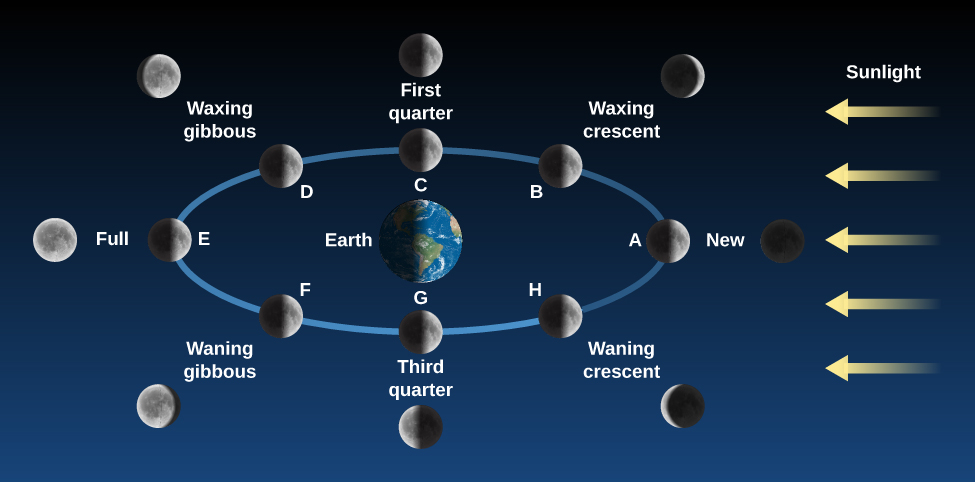
4.5 Phases and Motions of the Moon – Astronomy

Lukas and I have been reflecting recently how we don’t have many people in our lives who could see us when we were younger and still know us and can see us now, as we have changed our lives and identities have evolved quite a bit as we’ve grown up. I realise that isn’t everyone’s journey, and I think it is more common than we tend to collectively admit. I find it deeply valuable when we allow each other to change and remain in relationship and make an effort to witness each other throughout seasons and cycles, whether in human-human relationships, relationships with a place, with animals or plants or ancestors. I invite you to reflect how much you value that.

Exercise: Think of someone you witnessed change their life and sense of identity. How have you supported that transition? How have you projected a ‘past self’ onto that person and had to change/challenge your perspective?

giveheart If you value this content, please engage in reciprocity by living, sharing and giving.

Material Wealth

La antigua Biblos: El bibliomotocarro de Antonio La CavaBlog by Valerie

When I was growing up, I watched my father hoard food, books, even household cleaning items. I remember the pain I felt when he told me the story of realising as a young teenager that he’d read every book in the library van that visited his small town every month. He went to university, the first in his family, so there was no shortage of books to read from the age of 19, but he couldn’t shake those early experiences, he worried he’d have to do without if he didn’t have things on hand. Coming from a home where I had access to multiple libraries, and many used and new book shops that we frequented regularly, I was happy to give away and trade books with trust that if I needed one again I’d find it. I didn’t need to be weighed down by a home library. But I also remember the pain I felt when I went with my dad to our favourite used book store with some boxes of books from cleaning out my room at my parents’ house. He didn’t understand why I wanted to let them go, and kept asking if I was sure. But he didn’t try to stop me. (Image from here)

Growing up, I watched my mother hoard money (and related to that, jewellery); and though it may sound strange, she also hoarded social privilege. But it felt more intense than my father trying to rebalance some pain from childhood. Hers felt existential, as if she hoarded and guarded these things like her life depended on it. The first time I earned money through babysitting, I came home with a twenty dollar bill feeling proud of myself. I had gotten the little girl to sleep despite one of her dogs nonstop fearful bellowing about a thunderstorm. My mother asked how much I made, and when I showed her, she took it, and said that she needed a cut. I couldn’t tell if she was joking. It didn’t feel like it. Then she wouldn’t give it back to me, and taunted me, hiding the bill and waving it out of my reach. That felt scary and deflating, one of many power and control games she played with me. It was as if she needed money more than she needed to be connected with me and would abuse her power and trusted role in my life to get it.

Wealth PNG Transparent Images | PNG AllWhen my father died many years later, that was my experience with her as we entered into estrangement. My mother chose money, lies and trickery over me. I have come to see that as rooted in her Jewish wounding, where through being disconnected from country for milennia, she learned to existentially cling to money, jewellery, and social status to survive. I understand that’s her survival strategy, integrated with identity and culture. I can’t be intimate with those wounds though, it feels too destructive and desolate to me, like I’m spinning in a hopeless vortex of nihilism and materialism, disconnected from the planet and my body. (Image from here)

I don’t yet feel respectful of what I experience as collectively acting out a traumatic and highly destructive wound. I focus most of my energy on deepening compassion and processing grief. I have been feeling this a lot lately with actions in the Middle East. I feel like Palestinian, Lebanese, and Iranian peoples are my spiritual kin. The hatred some of us feel towards ourselves and each other is so intense, it makes my heart feel heavy with grief. The material greed and holding in supremacy certain people and lands while dehumanising and exploiting other peoples and lands pains me deeply. I have been to Jerusalem, which many consider to be the most holy city in the world. I felt its deep and rich history. It also felt very layered in pain and messiness. There was tension, some bombing, and UN vehicles patrolling when I was there. It felt like a powder keg with everyone on edge, and that was fifteen years ago.

Everything is connectedI choose a worldview in which all lives lost, of any culture, of any animal or plant, are existentially equal, though I obviously experience some of those losses with much more intensity than others because of my own identity and connections. As this worldview and my values have solidified over time, I have found myself recently with more material ease than ever before in my adult life. I had gotten used to embodying ordeal, living without enough material wealth, devaluing its importance to rebalance growing up with my mother putting material wealth über Alles, humbly acknowledging that I needed to find ways to be more financially stable and secure, trying things and burning out, growing savings and going through them.

I’m grateful for some material ease and abundance now, and I’m grateful for experiences of lack so these experiences have more meaning to me. I don’t think I’ve now got it all figured out. I do know that weeding by going into trauma and negativity have been more valuable to me than trying to plant positive affirmations. I’ve found healthy beliefs emerge when I clear the way. And, at the moment, some material wealth has emerged. I’m allowing myself to feel more ease when we buy groceries, practicing saving without hoarding, and humbly sharing as we go. I have started to feel lately like for the first time in this life I am living the life I want to and am meant for.

Matthew 11:28 Scripture - Rest from Burden | ChristianQuotes.infoHere’s hoping your relationship with material wealth feels balanced and centred too. Blessings at a season of reflecting on thankfulness. I’m thankful you care enough to read this blog. And if you are able, I humbly ask you to consider leaving a review of my book Healing through Indigenous Wisdom on Amazon, giving a copy to a friend, or otherwise passing on the word. Sacred reciprocity makes the world go round (fodder for a future blog).

giveheart If you value this content, please engage in reciprocity by living, sharing and giving.

Tattoos & Tradition

Blog by Valerie

Deq (tattoo) - WikipediaThis blog idea came to me a while ago when I read an article about the revival of Deq, a traditional tattooing technique in Kurdish and some other Arabic and Northern African cultures. I had always been told you can’t be buried in a Jewish cemetery with a tattoo, and something about this tradition resonated as more ancient and true to my Sumerian roots. The article explained that Deq is a form of worship, with tattooing the skin believed to also engrave a person’s soul. It is a women’s tradition that uses breast milk and another substance (such as soot) to create the ink. (Image from Wikipedia)

Deq differs greatly from modern conceptions of tattooing. While today individuals often get tattoos for decoration or to memorialise events, people, or beliefs, deq is traditionally done to request abundance, protection, blessings, or fertility from God.

Spiritual protection is a common reason for tattooing in Indigenous science. According to Western scientist Lars Krutak of the Smithsonian, traditional cultural tattooing is done for the following reasons:

  1. Adornment
  2. Identity
  3. Social status
  4. Therapeutic/Health
  5. Spiritual protection/Animal mimicry

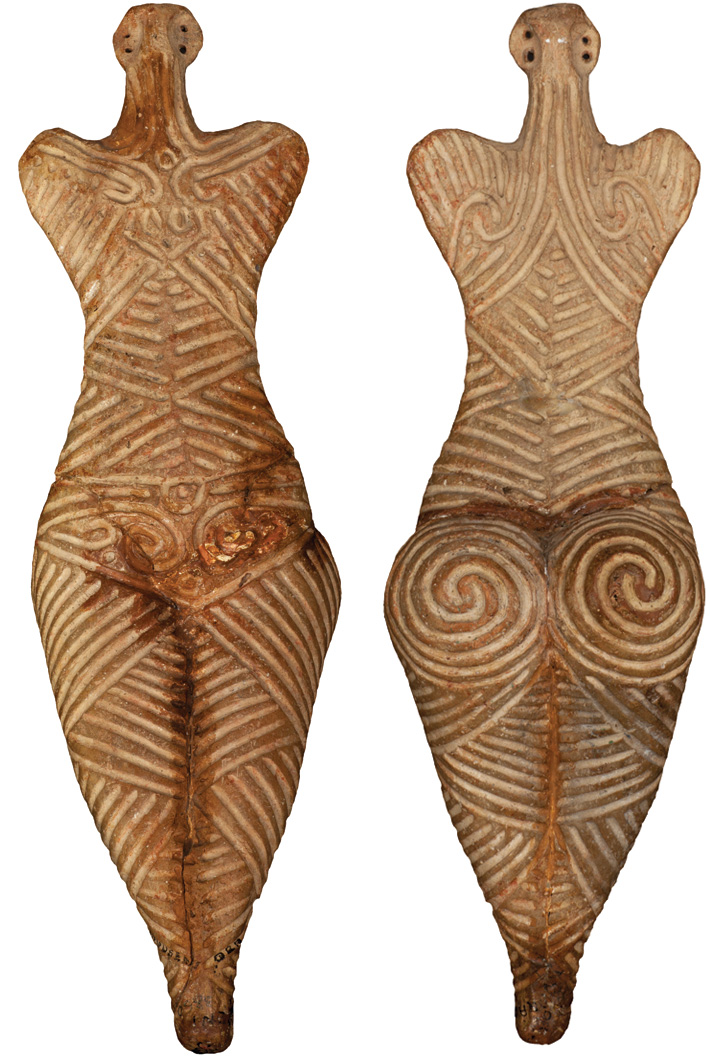
(Krutak, L. (2015). The cultural heritage of tattooing: a brief history. In Tattooed skin and health (Vol. 48, pp. 1-5). Karger Publishers.) Most of these we can relate to today, though you may be wondering what therapeutic or health tattoos are. Among our ancient ancestors are tattooed ceramic figures that are over 6000 years old found incucuteni-tattoos modern day Ukraine and Romania, and a 5000 year old mummy found preserved in ice in the Italian Alps who appears to have therapeutic tattoos in places on his body that look similar to a practice in traditional Asian cultural medicines. Such tattoos tend to be at joints and in the lower back. Tattooed mummies have also been found from Egypt to Siberia to Peru, and tattooed earthenwares of human or spirit figures have been found across the world from ancient Mississippi to Japan to the Philippines. 

taavaha headdress polynesian tattoo manThe word ‘tattoo’ was brought into English from James Cook’s 1770s journey to New Zealand and Tahiti, and supposedly inspired Western sailors to start a tradition of tattooing themselves to remember where they had traveled and people they missed at home. (Image of a Ta`avaha (headdress) with tattoos, Marquesas Islands, 1800s, via Te Papa from here) Though modern Polynesian tattoos differ by island and culture, generally tattoos are seen as a form of spiritual protection, cultural status symbols displaying rites of passage, and signifiers of ancestral lineage. Where tattoos are on the body, and what symbols and motifs are used, are also important as they link people to their Creation story: 

In Polynesian Mythology, the human body is linked to the two parents of humanity, Rangi (Heaven) and Papa (Earth). It was man’s quest to reunify these forces and one way was through tattooing. The body’s upper portion is often linked to Rangi, while the lower part is attached to Papa.

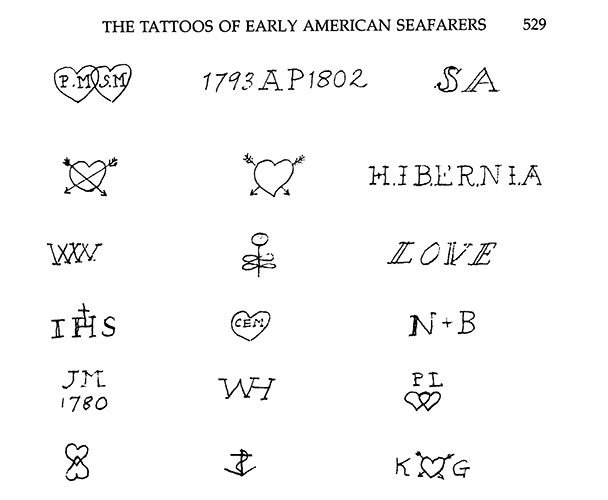
But tattoos have a long reputation as being lower class in Western culture due to their link with slavery and criminality, which can be traced back at least to ancient Greece and Rome, and likely to ancient Mesopotamia before then. As recently as in the 1800s in parts of Europe tattoos were being outlawed and seen as unChristian. And while the major world religions are not associated with traditional tattooing, there are exceptions, such as a Buddhist monastery in Thailand that “anchors” people into scripture with tattoos. (Image from here of Angelina Jolie).Angelina Jolie Sak Yant Tattoo's MeaningAnd while I can’t speak for how locals feel about Angelina’s tattoos (she was given Cambodian citizenship and adopted a child there, so she has come cultural connections), I feel uncomfortable about the amount of cultural appropriation that goes along with tattooing in Western culture. I remember a trend some years ago of getting Chinese characters tattooed without many people even knowing or speaking the language. (I used to wonder how people weren’t scared they were lied to about what their tattoo said!) And many modern designs in Western culture have originated from those early sailors’ tattoos in the 1700s and 1800s. However, many have not, and where some celebrities like Dwayne “The Rock” Johnson express Samoan heritage through tattoos, others like Mike Tyson who is not of Maori descent has a ta moko design on his face (See this article on a history of tattooing in the U.S. by Sara Etherton). (Image from Visual log of tattoos seen on sailors in a survey done in 1809. (Ira Dye, “The Tattoos of Early American Seafarers, 1796-1818,” Proceedings of the American Philosophical Society 133, no. 4 [1989]: 520-554. accessed here).

I have two tattoos. The first commemorates a flower I have a cultural connection with as well as a number, a colour, and some simples values; the second commemorates an insect I have a cultural and personal connection with. I got them both with close friends at the time during important moments in my life to mark endings/beginnings. Their placement is interesting – one on my right hip, and one on my left foot. I trust the intuition of those choices. I don’t notice them much anymore, they just feel like part of the fabric of me, and I’m thankful that though I got them when I was young, I still appreciate their presence on my body, and I have no need to be buried in a Jewish cemetery anyway.

Exercise: Reflect on any tattoos you have (or have considered getting). How do you feel about them – their aesthetic, meaning, and history? Is there anywhere you would or would not get a tattoo? Do you resonate with the idea that they connect you with your Creator or that they imprint onto your soul?

giveheart If you value this content, please engage in reciprocity by living, sharing and giving.

Birth as Ceremony

Blog by Valerie, following recent presentations with breastfeeding and pregnancy groups

We do ceremonies at important moments in our lives, such as weddings, graduations, and funerals. Ceremonies support us to gain knowledge, purify our spirits, and honour life. They can be as simple as a small act done with sacred intention, or as elaborate as a religious confirmation.

“In traditional practices and rituals, birthing involved more than the physical health of the mother and baby. Giving birth was a process of initiation and belonging to the culture that created spiritual links to the land and the ancestral Dreaming.”—Best, O., & Fredericks, B. (Eds.). (2021). Yatdjuligin: Aboriginal and Torres Strait Islander nursing and midwifery care. Cambridge University Press.

The birthing journey, from pregnancy to postpartum it is seen in Indigenous science as a time of spiritual initiation for the new mother. Initiations are transitional ceremonies that lead us through Earth’s cycle from life to death and rebirth into a new identity. For first time mothers, this journey is a profound shift from being a maiden into be-coming a mother, and for all mothers it is a journey of be-coming a mother within a new relationship.

Initiation ceremonies have three phases:

  1. Separation from daily reality;
  2. Ordeal or trauma; and
  3. Return or rebirth.

the tree of life ( our roots in life) | Creative Projects | Arte da ...In an Indigenous worldview, the mother is seen as a conduit between the spiritual and physical worlds, and birthing trauma as a meaningful initiation into spiritual adulthood. In fact, many Indigenous cultures have initiation rites only for young men, because childbirth (as a birthing mother, through miscarriage, and/or through supporting birthing women) is considered to be the initiation process naturally built into women’s bodies. (Image: Natural Birth Art Print by Sean Frosali, Society6)

Phase 1: Separation from daily reality – being pregnant

The moment a woman is pregnant, she and everyone she meets is in ceremony…The womb is our first orientation on Earth.–Patricia Gonzalez, Red Medicine: Traditional Indigenous rites of birthing and healing

During pregnancy, traditional ceremonies are based on:

    • Mothers and elders sharing wisdom about birthing, breastfeeding and childrearing;
    • Cleansing the mother’s space, including her body and home (i.e. massage, smudging);
    • Community support with certain tasks around the house for the mother;
    • Taboos and norms about foods, drinks, and activities a mother ought to do or avoid;
    • Honouring the babies’ soul entering the womb and protecting the mother and baby (i.e. with amulets, prayers, and rituals, and avoiding aspects of life such as funerals);
    • Helping to welcome and support a new baby (i.e. to ease a first time mother’s anxiety, baby showers).

Why we need to support Aboriginal women’s choice to give birth on countryThere are of course many cultural variations on such ceremonies. One example is in parts of India where there is a sort of baby shower called a Valaikaapu in which the mother-to-be is sung to by other women, adorned with bangles, soothed from anxiety with herbal treatment on her hands and feet, and fed traditional nourishing foods. After this ceremony in the third trimester, the mother-to-be traditionally stays at her parents’ house until the baby is born. Another example occurs in parts of Indonesia also begins in the third trimester with the mothers’ parents bringing food to their son-in-law’s family, and the mother ceremonially feeding her pregnant daughter before everyone else eats. The parents-to-be are then given blessings and encouragement by both the whole family, including being wrapped in traditional fabric as a symbol of strength for their union through the birthing journey (Silaban, I., & Sibarani, R. (2021). The tradition of Mambosuri Toba Batak traditional ceremony for a pregnant woman with seven months gestational age for women’s physical and mental health. Gaceta Sanitaria, 35, S558-S560.). (Image from here)

Phase 2: Trauma/ordeal – birthing

In the Mohawk language, one word for midwife…describes that “she’s pulling the baby out of the Earth,” out of the water, or a dark wet place. It is full of ecological context. We know from our traditional teachings that the waters of the earth and the waters of our bodies are the same.
—Rachel Olson, Indigenous Birth as Ceremony and a Human Right

During and immediately following birth, traditional ceremonies are based on:

    • Birthing sites in sacred spaces indoors (e.g. sweat lodges) and outdoors (e.g. natural pools);
    • Taboos about labour being quiet or loud, and women’s positions (e.g. squatting);
    • Norms about partners being present at birth, or having their own tasks to do for the baby;
    • Use of traditional herbal steams and poultices to cleanse the womb, stop bleeding, and help milk start flowing following the birth;
    • Protecting the baby and mother;
    • Umbilical cord ceremonial clamping and/or saving, or lotus birthing;
    • Sensual imprinting for the newborn through wrapping them in traditional clothing, jewellery, fur, and/or blankets; and
    • Body wrapping and womb re-warming practices for the mother after birth.

How Natural Birth Became Inaccessible to the Poor | by SAPIENS ...There are also many cultural variations for these ceremonies. For example, in Japan umbilical cords are saved and presented to new mothers in keepsake wooden boxes at hospitals. This tradition is meant to keep a good relationship between the mother and baby, and sometimes the box is given to the adult child when they leave home or marry to symbolise a separation in an adult-to-adult relationship. In Australian Aboriginal cultures, cultural birthing areas utilised natural depressions and sacred spaces such as rock formations, caves and water holes, to spiritually connect the child to their Country and their ancestors. Women followed ‘Grandmother’s Law’ which often included practices such as squatting over the steam of traditional medicinal plants after birth to prevent infection, how to name the child, and when the child would meet their father (Adams, K., Faulkhead, S., Standfield, R., & Atkinson, P. (2018). Challenging the colonisation of birth: Koori women’s birthing knowledge and practice. Women and Birth, 31(2), 81-88). (Image from here)

Phase 3: Return/rebirth – becoming a mother

We believe in waiting until 30 days after the birth for any celebrations. In our tradition, we believe that the unborn child has a guardian angel, who is the previous mother of the child. If we celebrate the pregnancy publicly, the spirit of the previous parent might come and reclaim her child — so that the new mother loses her baby!—Vietnamese grandmother quoted in Cusk, R. (2014). A Life’s Work. Faber & Faber.

In the postnatal months, traditional ceremonies are based on:

    • Protecting the baby and mother;
    • Naming and welcoming the baby to the land and family;
    • Building the newborn’s resilience with elements and weather;
    • “Firsts” (i.e. baths, foods, laughs, rolling over, walking, etc.);
    • Mother’s rest and recovery from birth (often 40 days); and
    • Placenta ceremonies.

Pin on PinturaA sweet example of such a ceremony comes from the Navajo/Diné people of North America have a ceremony to honour the babies’ first laugh, and the person who gets the baby to laugh throws a party where guests are given salt on the baby’s behalf as a symbol of generosity since it was traditionally valuable and hard to get (Brown, Shane. (2021). Why Navajos Celebrate the First Laugh of a Baby. https://navajotraditionalteachings.com/blogs/news/why-navajos-celebrate-the-first-laugh-of-a-baby). Across the world in Egypt, on the child’s seventh day after birth, a Sebou’ ceremony welcomes the baby with a number of traditions related to the cultural meaning of the number seven, such as placing the baby in a sieve and shaking them to symbolise life becoming more dynamic outside the womb, then stepping over them seven times saying prayers for protection and obedience to their parents; a candlelit procession of smudging the house; and a drink to increase breast milk production (Gamal, A. (2015).  The Sebou‘: An Egyptian Baby Shower, https://www.madamasr.com/en/2015/11/02/panorama/u/the-sebou-an-egyptian-baby-shower/). And in Nordic countries, babies are traditionally left to nap outside no matter the weather to build their resilience to the earthly elements. Called friluftsliv it translates to ‘open-air life’ and represents cultural importance of enjoying nature and the outdoors all year round (McGurk, L. (2023). Creating a stronger family culture through ‘friluftsliv’, Children’s Nature Network, https://www.childrenandnature.org/resources/creating-a-stronger-family-culture-through-friluftsliv/). (Image by Joey Nash)

Sponged placenta print to celebrate the tree of life. www ...Placental ceremonies are based on traditional understandings of the placenta as a spiritual twin, a baby’s guardian angel, a ‘death’ gift offered to the Earth to give thanks for a healthy baby, and a carrier of a holographic imprint for the baby’s life on Earth. Most cultures bury the placenta (a few even give it funeral rites), some burn or eat it, and a few do lotus births (where the placenta stays attached to the baby until it dries out and falls off). The Hmong people in Laos believe a person’s spirit will wander the Earth and not be able to join their ancestors in the spirit world without returning to the place their placenta was buried and collecting it, and the word for placenta in their language translates as ‘jacket’ (https://en.wikipedia.org/wiki/Hmong_women_and_childbirth_practices). In Maori language in New Zealand, ‘whenua’ is the word for both ‘land’ and ‘placenta’, and after childbirth the placenta is buried on ancestral lands to strengthen a child’s connection to culture, often beneath a tree (Soteria. (2020). Māoritanga: Pregnancy, Labour and Birth. https://soteria.co.nz/birth-preparation/maori-birthing-tikanga/). Placentas are dried and eaten to support the mothers’ or baby’s strength in many places, from China to Jamaica to Argentina (https://en.wikipedia.org/wiki/Human_placentophagy).

Today, it might be hard to decide what to do if you don’t know your Indigenous roots and their cultural traditions, and when because many of us birth in hospitals. I suggest relying on your intuition, and what resonates with you. Some ceremonies common across cultures that you may wish to do for yourself and your baby may relate to:

    • Prenatal blessings to keep the mother and baby safe;
    • Connecting the baby to the land and elements (earth, air, fire, water);
    • Postnatal rituals to keep the mother and baby safe;
    • Placenta burial; and/or a
    • Naming ritual.

Keep in mind that you can’t do a ceremony wrong if your heart and intention are in it. The way you feel during and after the ceremony will show you how it went. For my child, we did a prenatal baby shower/blessing with friends and family in person and on Zoom, and we printed out the blessings for our home-birthing space, then ultimately buried them with the placenta a few months after the birth. We chose our baby’s first sensual experiences – sight, smell, touch, and hearing, as her first taste was breastmilk! We brought earth inside to touch to her feet to connect her to the land as she was born in winter, and her placenta burial ceremony was on land where her great-great-great grandmother was buried.

I hope this has given you some things to reflect on and ideas for celebrating your journey into be-coming a mother in a way that feels sacred and special to you and your family. (Two other blogs you may find interesting about my birth and early mothering experiences are: about spirit babies, and mothering amidst intergenerational trauma).

giveheart If you value this content, please engage in reciprocity by living, sharing and giving.
What is Indigenous spirituality?

Blog by Valerie

A friend brought this question to me, and I thought it a good one to take on. For some, being ‘spiritual’ is like the U.S. Supreme Court decision about porn – ‘I know it when I see it’. For some it’s intertwined with religious rites. For me, spirit is an animating energy exhibited through an act or a relational dynamic that connects all of us beings on Earth. For example, the spirit of my relationship with my daughter is characterised by a lot of joy, and the spirit of my relationship with my dog is primarily one of companionship. Spirituality is cultural, and mine is Indigenous, based on an animistic understanding of the world. I see all beings on Earth, including rocks and even manmade plastic toys, as having spirit, some kind of animating energy.

MAGICK RIVER: RELIGION, SPIRITUALITY, AND TRUTH (repost)(Typical image of ‘spirituality’ from here)

Spirit with a capital S to me refers to a big creative and destructive energy that is more than any identity I can hold, of which I am a small part. Some say Great Spirit, some say God. Spirits plural to me refers to beings that I see in dreams or visions, or experience through the four invisible clair-senses (clairvoyance – seeing, clairsentience – feeling, clairaudience – hearing, claircognisance – knowing – described by Diné Elder Wally Brown as the counterparts to our five physical senses represented by our five fingers and the four spaces between them.)

So if this is what spiritual, Spirit, and spirits mean to me, what does it mean to ‘be spiritual’? First, it means acknowledging some energies/forces/beings that are too vast to be encompassed by an individual, or even our collective, human identity. Second, it means openness and awareness of the invisible clair-senses, and to experiences that are not explainable, or sometimes even experienceable, in materialist, physical terms.

My view is that children naturally see the world in an animistic way, and that through teachings begin to close their mind (and obscure their clair-senses) to other inputs. Recently a four year old asked me to read her a story about werewolves, then asked me if they were real. I said, I don’t know, what do you think? Have you seen one before? But her mother quickly jumped in to say that no, they’re not real. Of course she is entitled to teach her daughter that and presumably she believes that to be true. I have not personally encountered a werewolf in my dreams or visions (or the material world) but I tend to think that if such beings loom large in our collective human psyche, and even across cultures, that there is likely something to it.

When Scientists Dabbled In Clairvoyance | ThinkHow do we know the difference between a spiritual experience and our imagination? I have seen a lot of people struggle with this – with their minds tricking them into thinking they have encountered a Spirit, for example. For me the difference is in embodiment. And when in doubt, see if and how changes occur in your everyday life as a result of the insight or guidance you got. (Image from here)

That spiritual experiences are grounded in the land and embodied in everyday life is a foundation of Indigenous spirituality. In an Indigenous worldview, an identity is commonly seen as a collection of relational dynamics, including relationships with humans and non-humans. This interdependence is often honoured through totemic relationships and responsibilities to do rituals and ceremonies. If I see my identity and my very existence as tied to the water in a river nearby and the fish in it, then it makes sense to fight for their survival and even put my own life on the line. See this recent example from California regarding the centrality of salmon to Yurok, Karuk, and Hoopa Valley tribes.

This may seem extreme to Westerners, even environmentalists willing to put their lives on the line for Mother Earth, because it’s not just about how humans need water or fish to survive, it’s the particular patch of earth (or sea or sky) and relational responsibilities there that matter to your very existence. If those fish die, you die; there is no supermarket to run to for other food. If you have to leave your land, you may get killed by others when you go onto their lands, or you may die not knowing how to survive there and live in a sustainable healthy way there.

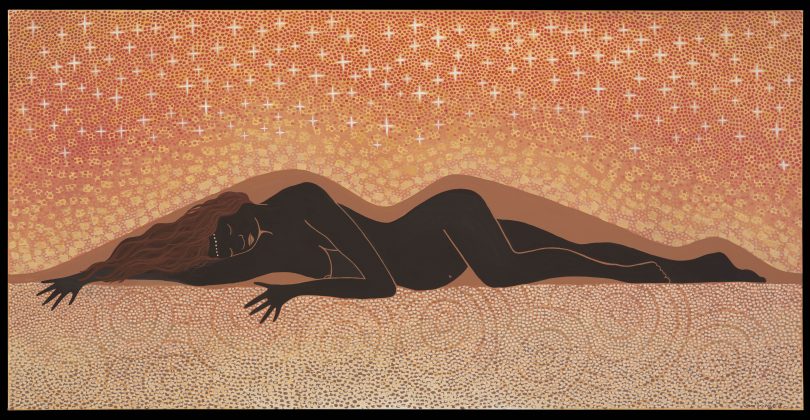
(Art by Cheryl Davison, Yuin woman, of the pregnant mother spirit of Gulaga mountain, protector of the land we are now grateful to call home, from this site)

In the Presence of Gulaga-2

(A photo of me in front of Gulaga taken a few years ago by Lukas before we knew we would be moving onto her country)

Western counsellors talk a lot about attachment theory. Right now when my baby cries (or is about to cry) I feel such pain inside, and such an urge to help her, I have to respond. Imagine feeling pain like that when a sacred site you’re responsible for is threatened with mining, and the urge to prevent it. Imagine the pain when it’s blown up and doesn’t exist in physical form anymore, just spirit and memory. Maybe you don’t need to imagine that – maybe you have tapped into that well of pain most of us are carrying in our ancestral roots. Maybe on your traditional lands, or like me, on lands you are spiritually adopting and feel are adopting you and your family too.

giveheart If you value this content, please engage in reciprocity by living, sharing and giving.
Initiation

Blog by Valerie – hope you enjoy another book chapter!

Initiations are rites of passage ceremonies marking existential life transitions. An important one across Indigenous and Western cultures is the transition from spiritual child into spiritual adult. Abagusii scientist Mircea Eliade describes it thus:

To gain the right to be admitted among adults the adolescent has to pass a series of initiatory ordeals; it is by virtue of these rites, and by the revelations that they entail, that he will be recognised as a responsible member of the society. Initiation introduces the candidate into the human community and into the world of spiritual and cultural values. He learns not only the behaviour patterns, the techniques and the institutions of adults but also the sacred myths and traditions of the tribe, the names of the gods and the history of their works; above all he learns the mystical relations between the tribe and the Supernatural Beings as those relations were established at the beginning of Time[1].

transitionInitiations intentionally lead us through Earth’s cycle from life into death then rebirth with a new identity through a purposefully traumatic process. (Image from here) As one Western psychologist explains:
The initiate, by virtue of encountering ritual trauma, was prepared to meet real-life trauma on terms that were integrative to the tribe’s social system and spiritual beliefs. Rather than encounter trauma as senseless and random, as many tend to do today, the initiate could meet trauma as an opportunity for meaningful participation with the greater spiritual powers[2].

SunwheelbyRyanSpellmanenhancedInitiations may be seen as having three distinct phases: separation (from daily reality), ordeal (trauma), and return (rebirth and resolution)[3]. The separation phase tends to include seclusion from family and time in the wilderness to take us out of everyday familiarity into unknown energies and into encounters with the elements, spirits, and our non-human kin. (Image from here)

In many Indigenous cultural traditions, men are put through painful initiation ordeals and women’s initiation is considered to be biologically built into the sacred ordeals of pregnancy and childbirth[4]. In some cultures, though, women are put through ordeals as well[5]. Spiritual initiations are painful because we tend to value what we earn through hard work, and we learn best through lived experiences.

Interestingly, a South Saami creation story[6] teaches that this entire world is the result of our previously taking the Earth’s bounty for granted and needing strong reminders of the value of her resources. This is similar to what I was told by some Mayan people in 2012 when the Western media was reporting that the Mayan calendar said the world was going to end. ‘No’, they told me, ‘our calendar says that in 2012 we are collectively moving out of spiritual childhood as a human species and into adolescence, and into a different calendar. They said overall we will become consciously aware that Mother Earth requires reciprocity, that we cannot just take from her, that there are consequences for our use of the Earth’s resources.

an_amazon_boy_needs_to_pass_through_these_painful_rituals_to_prove_his_adulthood_20171127120918One example of an ordeal is the Sateré-Mawé tradition of adolescent boys enduring the pain of repeatedly putting their hand into a glove filled with bullet ants that inject toxins into them[7] (Image from here). They are called bullet ants because the intensity of the poison they inject is meant to hurt as much as being shot. The boys are expected to endure this willingly, silently and stoically, which teaches them be hunters who can handle the toughest aspects of their Amazonian jungle home; it also affirms values such as courage and strength. It also represents a loss of innocence by teaching that their environment can be dangerous, and even deadly, for after each session of placing a hand into the ant-ridden glove, boys are given medicine that makes them purge. Keeping the ant toxins in their body can have lifelong effects, such as loss of sanity. The myth is that the ants originate from the vagina of an underworld snake woman – an embodiment of the dark side of the sacred feminine and the Earth herself[8].

AboriginalStoneArrangements1Initiations thus teach cultural myths and values, and ordeals without sacred spiritual stories attached to them are merely meaningless violence, reinforcing nihilism and lacking re-integration and fulfilment of a new identity along with its social responsibilities. In the example above, boys who complete the initiation are allowed to hunt and marry, which complete their rebirth as adult men in the community. Many of us grew up in cultures with rites of passage that included separation and ordeal phases but lacked full return phases to reintegrate us into a healthy new identity. We may feel called to question our cosmology and find a way to re-birth ourselves with limited collective ceremony or recognition of our hard work. (Image from here)
Exercise: What partial or full initiations have you been through? Were they facilitated by other people, or simply lived experience? If it was a full initiation, how do you celebrate your new identity? If it was a partial initiation, work with your ancestors and reflect how you may complete it to feel whole and celebrate your new identity.

giveheart If you value this content, please engage in reciprocity by living, sharing and giving.

[1] Kenya, S.W. (2002). Rites of Passage, Old and New: The Role of Indigenous Initiation. In Thought and Practice in African Philosophy: Selected Papers from the Sixth Annual Conference of the International Society for African Philosophy and Studies (ISAPS) (Vol. 5, p. 191). Konrad-Adenauer Foundation. citing Mircea, Eliade., (1965) Rites and Symbols of Initiation, translation by W.R. Trask, New York; Harper and Row, pp x.

[2] Morrison, R. A. (2012). Trauma and Transformative Passage. International Journal of Transpersonal Studies31(1), p. 40.

[3] Id. citing Eliade, M. (1995). Rites and symbols of initiation: The mysteries of birth and rebirth. Woodstock, CT: Spring. (Original work published 1958)

[4] See e.g. Gonzales, P. (2012). Red medicine: Traditional Indigenous rites of birthing and healing. University of Arizona Press.

[5] See e.g. Dellenborg, L. (2009). From pain to virtue, clitoridectomy and other ordeals in the creation of a female person. Sida Studies24, 93-101.

[6] See Nordic Story Time: A South Sami Saami Creation Story, https://www.youtube.com/watch?v=UTDKeZB7rnM&list=WL&index=16&t=474s

[7] See e.g https://sites.google.com/fsmail.bradley.edu/buanthro/satere-mawe-ceremony

[8] Kapfhammer, W. (2012). Tending the Emperor’s Garden: Modes of Human-Nature Relations in the Cosmology of the Sateré-Mawé Indians of the Lower Amazon. RCC Perspectives, (5), 75-82.

Identity politics

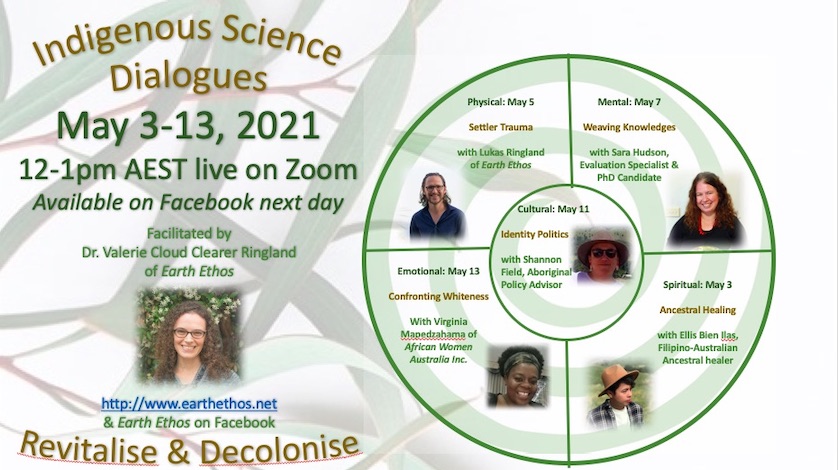
At the heart of the Earth Ethos Indigenous Science Dialogues earlier this year was the issue of identity politics. dialogues.5.2021-1The dialogue of that name was with my friend Shannon Field, a Walbunja woman of the Yuin nation, a traditional owner of the land where Lukas and I currently live, the land his first settler ancestor claimed for himself through the crown of England and in whose name the Australian government is still run today.

photo

With identity politics at the centre, all dialogues touched on that issue. Anglo-Celtic Australian man Lukas Ringland spoke for the PHYSICAL, sharing his experiences of settler trauma, including the pain of being part of a corrupt social majority. On the Crown’s genocidal survival strategy for ex-convicts, he explained: “The more wild the land was, the more likely it was to be given to an ex-convict, like, ‘you go to war against the Indigenous people.’ So you had this battle for life being fought between newly freed convicts and Indigenous people, and then closer to the centre of the colony you had the higher-ups who didn’t have to participate in that.” (Image from here)

Filipino Australian Ellis Bien Ilas spoke for the SPIRITUAL about the trauma of leaving the Philippines for Australia as a child, and his subsequent complex journey of ancestral healing: “I was literally shaken by an event on July 2, 2015…in the ER with an undiagnosed cardiac condition…I was having symptoms medical professionals can’t explain, and…it was looking back…[realising the date of my event] was my grandfather’s death anniversary, and I [] carry his name…That event was a huge catalyst for my spiritual awakening which occurred here in Sydney, Australia.”

Jewish Pakeha (non-Maori New Zealander) woman Sara Hudson spoke for the MENTAL about the close-mindedness in Aboriginal governmental policy: “When [the government] could verify [some Indigenous knowledge], they were like ‘Ooh! Okay, maybe there is something to this, because it matched what we found ‘scientifically,’ so therefore maybe we will listen now to these Indigenous knowledge-holders around water.’ This is the crazy stuff –  ‘I only listen to you once we have it verified by our Western scientific methods.'” (Image from the ABC, link unknown)

beautiful handsShona (Zimbabwean) Australian woman Dr. Virginia Mapedzahama spoke for the EMOTIONAL, about her experiences navigating whiteness trauma as an African migrant, the absurdity of Australia’s racial labels (Anglo-Celtic, Indigenous, and CALD – culturally and linguistically diverse), and how invisible she feels because “we have never dealt with the race issue with our Indigenous Australians…[but] the WHOLE THING is based on a system of whiteness…[and] we’re not looking at ourselves and the system that led us to do these things…[and now the definition of CALD is] so broad that the only people not captured by that category are Indigenous Australians!”

At the HEART centre, Walbunja Australian woman Shannon Field spoke about “cultural mining”, how “non-Aboriginal people mine our knowledge, mine our experiences in order to form up views, opinions, politics, positions…but in doing so, not providing us with a legitimate and/or authentic opportunity to have influence on what those outcomes actually are….So basically taking the authority and control of our knowledge into White hands.” She also explained, “For me, what identity politics is, that isn’t always a comfortable topic…as an Aboriginal person with fairer skin…I don’t know if it is called a colour privilege, but certainly there are some biases that are applied in terms of palatability of lived experience for White people taking on a Blak story or Blak history…that fits a narrative of what White people want to see….That’s something as I’ve gotten older I’ve become more aware of…[And] while I feel like I personally have had a fairly benign experience as an Aboriginal person, your life as an Aboriginal person is not unpoliticised…your mere existence [is under constant political scrutiny and attack].”

always was always will be aboriginal land | Aboriginal ...This “mere existence” of Aboriginal people as humans worthy of dignity collapses the entire ‘legal’ foundation of the Australian nation. The High Court overturned terra nullius and declared that the Australian lands were inhabited at colonisation, but no treaties have been signed, and the Native Title system designed to return Crown land to Aboriginal control (which often takes decades to do so) is fatally flawed. My heart bled last week when I read these words from Gamilaroi-Irish woman Aimee Mehan: “[O]ur Native Title Act does not give Indigenous Australians the right to refuse development on our ancestral lands…imagine that you are told about the impending trauma to a relative [your land/home]. Now you, together with your extended family, must ‘negotiate’ [the] event. You cannot prevent [it]…you must not only endure the trauma…you must sit month after month at the table to negotiate the future occurrence of it with a tribunal. [Then] imagine watching your close relative’s perpetrator being promoted by the Australian government on the world stage in Glasgow.” Gamiliroi Man Wollumbi Waters added: “All of which triggers the trauma and pain we carry as Aboriginal people, the true caretakers of our sacred lands. We walk with our ancestors every day, as the earth is our body and the water is our blood, and the trees and rocks our brothers and sisters, and this is what we hold on to.” Aimee describes this trauma as part of the #metoo movement from an Indigenous science perspective, with non-consensual boundary-breaking rapes and related actions that violate the vitality of the Sacred Mother, the land. (Image source)
Indigenous Justice & Restorative JusticeWhen I hear transhumanists like Jeff Bezos talk about ‘using up’ the resources of Mother Earth (i.e. destroying our home and source of life) necessitating the colonising of Mars, I cannot understand how we continue to give that insane and destructive a person so much power and control over so many resources. I pray for transformation of our rotting, greedy and destructive collective psychosis towards fulfilling the wisdom of Sioux scholar Vine Deloria Jr. instead: “The future of humankind lies waiting for those who will come to understand their lives and take up their responsibilities to all living things. Who will listen to the trees, the animals and birds, the voices of the places of the land? As the long forgotten peoples of the respective continents rise and begin to reclaim their ancient heritage, they will discover the meaning of the lands of their ancestors” (Quote source, Image source).

Exercise: Reflect on your own lived experience of Identity politics. You may want to listen to the Indigenous Science Dialogues and share to inspire rich, healing conversations with loved ones.

giveheart If you value this content, please engage in reciprocity by living, sharing and giving.

The power of communal dreaming

Blog by Lukas

File:Apollo 11 Launch2.jpg - WikipediaValerie recently asked me why space exploration so captivated me as a child and still evokes strong emotion for me today. I’ve realised it’s got something to do with the safety of collective achievement.

Through the eyes of a child, perhaps nothing feels safer and more secure than seeing adults working together in determined harmony and solidarity towards a shared vision. As a child of the 1980s and 90s, few had the grandeur of space exploration. And so it is with deep ambivalence that I experience the individualistic efforts today of Elon Musk and Jeff Bezos, even though I am still brought to tears by ham Hollywood depictions of golden era Space Race events like Apollo 11 and 13. (Image of Apollo 11 from Wikipedia)

There are easy critiques about the merits of investing massive resources in space exploration, such as the need to focus more on addressing climate change, poverty and disease. There are strong counter arguments, such as that solving complex challenges related to space exploration leads to technologies that can be used for overall good, as well as strengthening our collective problem-solving ability. That’s where the refrain to “moonshot it” comes from – that when we put so many resources into something it’s collective by its nature. Lately I’ve been thinking about differences in space exploration during the Apollo age and now, and what this says about our society. For me, Bezos’s and other company’s efforts highlight a disillusionment with and disconnection from collectivist and communal dreaming.

As a former space nerd, File:Hubble 4x61.jpg - Wikimedia CommonsI chuckle at the impotence of today’s individualistic and self-aggrandising efforts. For example, all of the Mercury Program’s flights in the early 1960s travelled higher than Bezos did, and in terms of payload capacity, no recent effort has yet bested the Saturn V rocket that carried the Apollo program astronauts to the moon. Led mainly by Space-X, the commercial payload industry has grown immensely over the last decade, but none of its achievements come close to the complexity and technical difficulty of the Hubble Space Telescope missions of the Space Shuttle from over 20 years ago. This is especially ironic since the Space Shuttle was a fairly weak technological achievement meant to be a “proof of concept” of a reusable space vehicle. (Image of Hubble from Wikipedia)

It can be quite plausibly argued that the last true great leap forward in space technology was the space station SkyLab and related Soviet efforts, with their budgets waning ever since. Author of 2001: A Space Odyssey Arthur C. Clarke’s vision of space travel in the year 2001 now seems so off the mark, but considering the pace of achievements at the time of the Apollo program, they were not that far-fetched. He failed to account for the political reality that having effectively ‘won’ the Space Race, the U.S. appetite for massive collective investment in Space Exploration would drop off so considerably.

Il 4 ottobre di 60 anni fa ci fu il lancio dello Sputnik 1 ...Of course the collective achievements of this era have a massive dark side. The Space Race was just another front in the Cold War. The bedrock of the technology and indeed the scientists who advanced it were from the German rocket program of the Second World War. (If this is new to you, check out Operation Paperclip, the Allied Mission to secretly bring German rocket scientists to America.) I think it is fair to say that the U.S. of the 50s and 60s was not much more collectivist than it is now, but one thing people did know how to do was come together to fight a war. The American “war machine” of WWII is in my opinion one of the most spectacular achievements in the history of industrialised civilisation – just consider the material prosperity of the years since that was built on it. Capitalism was critical, but without the consent, taxes and labour of the people working in a war socialist footing, it could never have happened. This is true of the Space Race as well. (Image from here)

So in no way am I saying the achievements of the likes of Apollo were halcyonic. It was part of a war. The capitalist military industrial complex was supercharged. But on some level it was so massive an effort as to not be possible without some form of communal dreaming. This is what feels important to me.

World News #35 - Evil Empire (Amazon) | David BernieToday Bezos wants us to be impressed with his relatively meagre achievements precisely because he has done it without communal dreaming, though he thanked all Amazon customers for funding his personal vision. Materialist, consumerist individualism put Bezos into space, and he wants us to be wowed and entranced by the power of putting massive amounts of power and resources in the hands of a few. He doesn’t want us to worry about communal dreaming, just keep to following our individualist dreams where we fill our lives with goods and services and very few of us may go on to join him amongst the pantheon of the super-elite. (Image from here)

Por aqui passei eu:There are a number of challenges today waiting for us to approach them communally. I predict that when things get bad enough, the power of collective dreaming will become clearer and more appealing to us. But it is sad if only desperation and an existential war footing can prompt us to recognise what I consider a truth: there is inherent value in collective and communal dreaming, for our internal and external worlds.

giveheart If you value this content, please engage in reciprocity by living, sharing and giving.