Blog by Valerie
“The first step in liquidating a people…is to erase its memory…Before long a nation will begin to forget what it is and what it was. The world around it will forget even faster.”—Milan Kundera
Whether you are considered “white” or not, I feel confident saying you have been impacted by whiteness trauma, and as this quote suggests, that your people/s likely experienced and perpetrated genocide somewhere in your family line/s. Genocide is an intentional act to destroy a people, and whiteness is an intellectual construction based on traumatic social rejection from & disconnection with Mother Earth, self & cultural heritage, and other people. It was used as a tool by the ruling class to divide the working class, and so is also called “the bribe of whiteness.” David Dean gives a clear and compelling history of the creation and rise of the “white” identity in this article, People who have learned to identify as “white” tend to deny their own complex cultural heritage. Some people even study “whiteness theory” and “white fragility” to try to make sense of the shame they carry and the way this history of European identities being whitewashed and replaced by modern, nationalistic ‘Western’ identities still play out today. For example, did you know that assimilationist policies in the U.S. in the late 1800s and early 1900s led to companies like Ford running mandatory English classes and job training programs that finished with ceremonies in which people clad in traditional cultural clothing walked through a huge ‘melting pot’ then emerged in company uniforms? (Image from here)

David Dean cites the success of such policies & programs on two factors:
- The violent displacement of communities from their traditional lands in order to use that land for profit and create a dependent, exploitable workforce, and
- The replacement of traditional cultural identities that valued the welfare of the community and the Earth with a culture of capitalistic, possessive individualism with a social hierarchy divided along racial, gender, religious, and other identities.
As Tyson Yunkaporta points out in his new book, ‘Western’ is not an identity, because by its nature it is in reference to someone or someplace else (presumably ‘Eastern’); it is not inherent. To be ‘American’ or ‘Australian’ is also quite amorphous. I have out of curiousity asked a number of people what it means to them to be ‘Australian,’ and I have gotten one of two answers: (a) I am part of a multi-cultural modern soup, or (b) It means nothing to me, and I am English/Irish/Wiradjuri/Yuin/etc. living on this land we collectively call ‘Australia’.
My view is that whiteness trauma is based on a European history of intergenerational trauma, shame & pain. It was spread by the Romans & other empires dividing and subjugating peoples on their traditional lands; by the violent spread of Christianity through power & force, including the systematic desecration of indigenous & pagan sacred sites; and by horrendously hateful acts such as witch trials, inquisitions, slavery, rapes & genocides. It seems to me that over the last few thousand years, violence, terror & control became normalized as a method of asserting dominant leadership throughout Europe. Multi-generational disconnection with an innately human intimate & reciprocal relationship with the Earth were replaced by a power struggle for whose anthropocentric story is ‘right’, in a might-makes-right model. This led to land ‘discovery’ (i.e. colonisation) and other myths such as when upper class, white-skinned, Christian, land-owning males founded a ‘free’ government for ‘the people’ in the U.S. Ultimately, whitewashing & glomming together of many European peoples and cultures into “Western” expanded to non-‘white’ people, so that today millions of people around the world identify with a colonial nation rather than a traditional culture living within an empire.
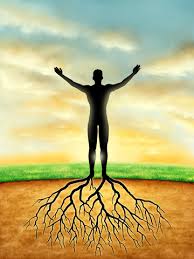
Here is a little poem I wrote about my own journey of healing ‘whiteness’ trauma:
Beneath the Roots
Ancestral trauma
Has defined me
But I kept digging
Because I knew
My taproot was deeper
And drinking in peace
Somewhere down there
To heal from whiteness trauma, I have found many helpful approaches, including: honouring ancestors, grounding, re-defining tribe & belonging, bridging multiple identities, healing power dynamics, and healing existential wounds. The following quote is a humbling reminder of what our indigenous minds carry somewhere inside of us from an Australian Aboriginal culture more recently colonised:
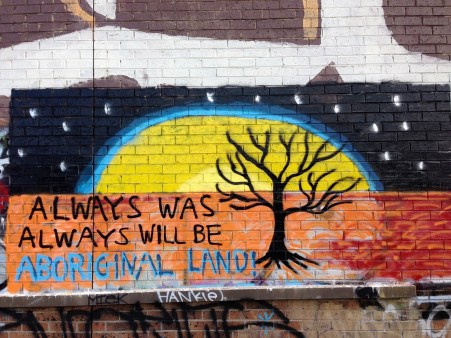
“The first peoples of this land don’t need statues of our heroes, we have mountains that remind us of our people. We don’t need painted portraits, we have rivers that flow with the stories of our dreaming. Our songs are filled with culture, our language of the land. So we don’t need books. Our history, our connections, our hearts are true to this country.”–Baker, 2017, quoted in Koori Mail, Oct 23, 2019 p. 24
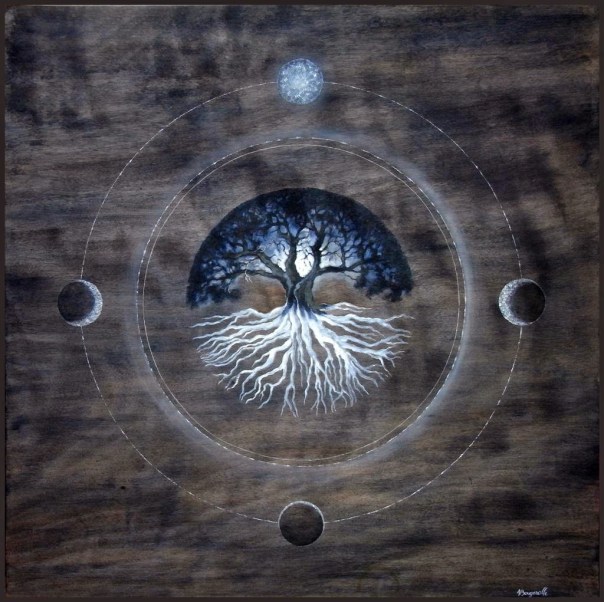
(Image from here, by artist Annick Bougerolle)
 If you value this content, please engage in reciprocity by living, sharing and giving.

 purposely into trauma or danger, but not to the point of becoming a martyr and building resentment. It can be a challenging line to walk. It requires very high personal standards along with loads of compassion for self and others. It can be isolating and incredibly fulfilling. Instead of being outraged about whatever stupid action Trump did this week, I was in awe to learn that fish underwater
 If you value this content, please engage in reciprocity by

 If you value this content, please engage in reciprocity by
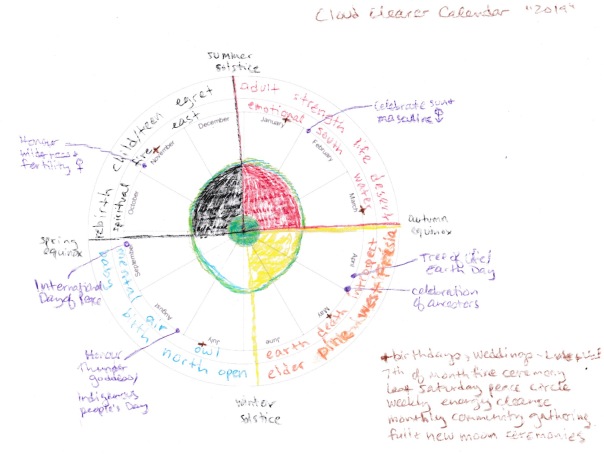
 Denying oppressive cultural stories frees not only you, but your ancestors, the lands, and indigenous people and their ancestors connected to the land where you live. A few hours outside of Sydney, Australia in
 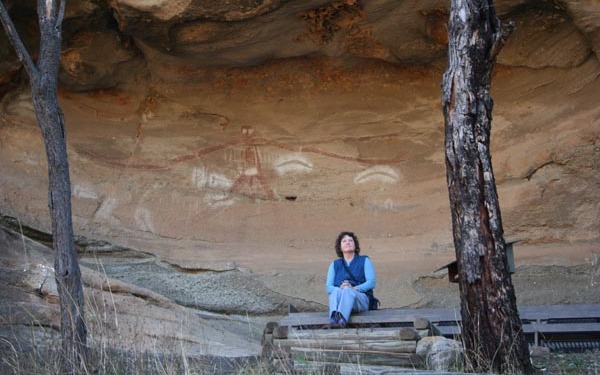 Though churches and houses were built on their sacred sites were intended as acts of dominance and genocide, they ensured that those sacred places survived as sites of worship. Today Wuradjuri people are going back to those places and re-membering their language and culture:
 If you value this content, please engage in reciprocity by

 If you value this content, please engage in reciprocity by


 If you value this content, please engage in reciprocity by
  Blog by Valerie
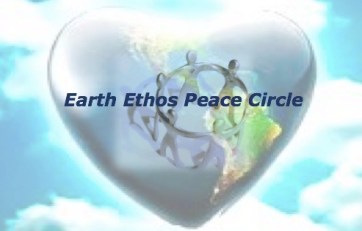
 The depth of relationships, and the experiences, feel quite different to participants. Similarly, instead of peace circles as a tool to help control behaviour or improve the way people speak and listen to each other as is common in westernised restorative justice practices based on a Judeo-Christian worldview, an Earth Ethos peace circle is an opportunity for a communal spiritual experience based on an indigenous cultural cosmology. Because of the intentional use of metaphor, it ought to feel different to participants (and certainly does to me) than simply sitting in a circle (or around a table where we are blocked from connecting with each other physically) and passing around a talking piece. Many indigenous peoples use oral traditions to preserve cultural wisdom. Verbal repetition and physical embodiment of teachings keeps them pure (
 Healing of, and prevention of, dis-ease requires ceremony. Ceremony is an important human practice connecting the visible material/physical world with the invisible, spiritual world. Life feels empty and unsatisfying when we do not do enough ceremony, and ceremonies are most powerful done regularly and intentionally in community (
 If you value this content, please engage in reciprocity by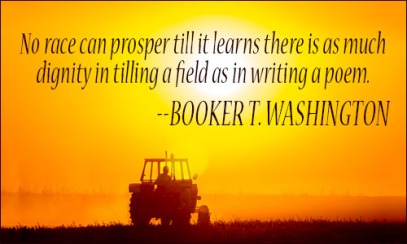


 materialist or a Christian, so I told people close to me I would focus on birthdays and important life events, and I stopped. I don’t want to deprive anyone of the joy of giving, but I don’t want to feel burdened receiving what is intended as a gift, so I told people close to me if they want to give me something, I prefer personal notes, meals, time together, and handmade art. I dislike expectations to behave a certain way on a day that is not especially meaningful to me, so Luke and I take short trips just the two of us over Christmas to enjoy Mother Nature instead. This all make it easier for me to stand in dignity because I am accepting me and not playing a victim by gracefully navigating a situation where my way of being is not socially privileged. Cultivating the discipline to deny ourselves that which brings us pain and suffering helps us stand in dignity and experience more joyful abundance.

 In his
  When we are miserable we are rejecting or rebelling against reality, which is destructive and results in existential crisis. When we are accepting we remain in the present moment, however painful. Many of us understandably feel overwhelmed by the depth of pain on the planet right now, so we numb ourselves with substances such as sugar, caffeine or alcohol; run away to our heads to avoid certain feelings; and seek out “light work” or “positive psychology” to create bubbles of security around ourselves. This is so common that a famous social psychology

 If you value this content, please engage in reciprocity by
  Earth Ethos