Tag Archives: culture

Parenting with Indigenous Science

Blog by Valerie
 
There’s so much parenting advice, and so little I resonate with, so I thought I’d share my perspective.
 
Parenting is about building relationships through developmentally appropriate leadership (which is related to a previous post on governance and the YouTube video below on sacred leadership/eldership by Tjana Goreng Goreng, PhD). Kids, whether our own, family, or community, challenge us to confront triggers, fears and insecurities, as well as allow us to more clearly see our strengths, values and capacity to connect. 


When babies cry out we give them instant attention and soothing, but that is not always a good idea with older kids, much less adults! Often we set patterns into motion because of our own limitations (read about some of mine here). I knew a mother who considered her adult daughter mentally and emotionally fragile (which I didn’t). She martyred herself to avoid her daughter feeling pain and experiencing certain struggles. But some of that seemed to me (and the daughter’s therapist) necessary growing pain for the daughter’s development. And I felt the mother was projecting her own mental and emotional fragility onto her daughter because she felt unable to hold space in certain ways. They both seemed a bit stifled. 
 
I say that with deep compassion, because we all have limits and struggles. Part of the fulfilment of any spiritual work, and certainly parenting, is bringing our deepest challenges to the surface so we can make peace with ourselves (and our ancestors, younger and older!) to become even better leaders — i.e. more powerful, grounded, centred and humble human beings.
 
When I look at my child, I see some struggles she’s come here with, some that feel linked to her father and that ancestry, some linked to me and mine, and some connected to her context and the land and ancestors where we live. (Ie ancestors of spirit, lineage, and land). When I am able to shift something that she’s also carrying, I expect her to have a big emotional response because we are connected with very open hearts. My shifting innately moves her heart and affects our shared ancestors, and she has to process it too. All of that emotion is likely to also affect my husband, because we’re all very sensitive. So when I feel something shift, I both feel excited and tend to brace myself to be able weather some emotional storms that my leadership has set into motion. 
 
I’m very aware that being committed to deep spiritual work asks a lot of myself and people who choose to be intimate with me. I don’t feel like I have a choice, though, in the way a singer can’t (or ought not!) stop themselves from busting into song throughout the day. To stifle it is to self destruct and snuff out my life force. Parenting feels the same in that it’s not a choice, it’s an honour and responsibility that defines the structure of my life.
 
I remember a book that made news years ago about parenting being all joy and no fun. To me, that says the parent is overwhelmed and may not know any other way to lead and set up their life. I’ve seen quite a bit of a so-called ‘gentle parenting’ approach, which feels like a reaction to authoritarian parenting and actually seems to me to stress out the children by giving them too much leadership space and not enough containing and consequences to uphold values and norms.
 
I appreciate some elements of the ‘sturdy parenting‘ approach and agree that there’s a big difference between punishment and consequences (Image from here).
 
And I add to that an Indigenous worldview in which there’s a huge difference between deeming behaviours as unacceptable and judging a person as unacceptable.
 
It seems to me in an effort to limit the destructive impact of the existential judgment and punishment wound in the western worldview, there arose a popular idea that yelling at kids destroys their self esteem. I do not agree. I think expressing anger and showing that it’s an intense emotion that we all experience is part of healthy leadership. And after I express anger, I offer a cuddle. I tell my child that I love her no matter what I’m feeling, and that there’s nothing wrong with her. (And if I was angry with someone else, I make sure to tell her it wasn’t about her and still offer a cuddle if she wants.) She now says to us, ‘Sometimes we get angry’ with the same tone as ‘Sometimes we get sad’ or ‘Sometimes we get wrinkles’ (referring to what happens in the bath). It shows me she feels that it’s okay to experience intense emotions within herself and with others in her environment (Image from here).
 
Recently I sat down and cried before bed and told her that I felt sad because she had been very hard on me that day. It was the highest defiance and worst day of listening yet. I could tell she felt bad. She came over and hugged me and said, “It’s okay, I love you no matter what, Mommy.”  That helped fulfil me both as a parent and helped my inner child feel safer than I had with my mother.
 
Parenting, like other forms of leadership in Indigenous science, is an exercise in unconditional love and existential acceptance, while embodying core values and cultural norms and creating consequences for breaching them. I hope it resonates with you, and thanks for reading!
 
giveheartIf you value this content, please engage in reciprocity by living, sharing and giving.

Trickery of heartfelt words

Blog by Valerie

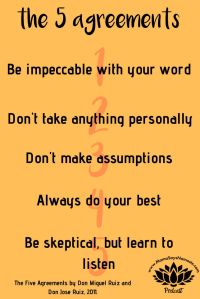
Many of us are familiar with the four (or five) agreements concept of spiritual teachings Miguel Ruiz wrote about based on ancient Toltec wisdom. The first is: Be impeccable with your word. It is much easier to be tricky with our words than our actions. Actions require lack of awareness, sneakiness or even betrayal at times to follow through on a trick, whereas being tricky with our words seems to have become so common that it’s often forgotten a few minutes after we’ve done it.

Unless you are in intimate relationship with someone like me who has an elephant’s memory for words. Growing up, watching how well someone’s words were aligned with their actions helped me judge how safe I was with them, because my home environment was so dangerous and my nervous system so often triggered that I couldn’t rely on feeling safe in my body to discern which people were safe to be around. Even now in my forties after years of estrangement from my family of origin and many healing experiences, I am still uncovering layers of feelings of unsafety and relational dynamics where I was tricked because I loved someone and gave too much benefit of doubt when they told me something I wanted to hear and their actions didn’t quite align…

I had a conversation with a friend about colonisation a few years ago, and she said an elder told her that the British didn’t have superior manpower or military strength when they invaded; they overpowered the people with their words. I have written before about unconscious sorcery, and it continues to be something I experience and witness regularly. But this blog is about the way we use our words, and the tricks our minds play on us and those we love when we believe what we say (at least in the moment).

I have had experiences with people who are in their hearts in a moment, but then dis-ease such as Wetiko takes over and their minds get to work changing the story and tricking them. How many of us say something and mean it in a moment, then think about it later and realise we don’t still feel that way, then go back and correct it with the person? It’s hard to do that. And yet those words sit there, and we may not realise how much of our relationship is built on them and the emotional power they possess.

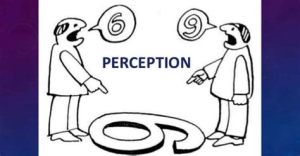
I see this as one of the greatest tricks playing out right now in the world; on a big scale, there are people saying things like: “[Y]ou always want to go with what’s come out of his mouth rather than look at what’s in his heart” about Donald Trump’s incongruent words and actions. On a small scale how many of us say “I’m good” when asked how we are, when in fact we do not feel good, or at least not wholly so. It took me a few years to work out ways of navigating these interactions gracefully in shops and places where people are meaning to make small talk but I don’t want to smile and lie and build that energy into my day. I find saying something I  like tends to work, e.g.: “How are you today?” “I’m appreciating the sunshine outside.” “Oh yes, it’s a hot one.” (Image from here)

Some friends have told me I expect too much from people. That bums me out, because I don’t expect more than I ask of myself. Others say, just take people at their word and decide if they’re safe or not based on actions, but it feels too harshly black-and-white to me to put people into categories labelled ‘safe’ or ‘unsafe’.

I had a conflict with a friend many years ago, and we talked about it and made up, but I felt insecure with her for years afterwards. When I brought that feeling up a few times she told me I was being crazy; then when another conflict arose and I said I felt hurt by some of her behaviour, she immediately brought up our conflict from five years prior and said she had forgiven me for that so I had no right to bring up something else, I had to just forgive her as well. I certainly didn’t feel forgiven! I felt like my insecure feelings had unfortunately been vindicated. A few months later when she wanted to meet and put everything behind us, I felt like I couldn’t trust her anymore, so there was no point. Without the potential for building trust, I can’t feel safe in a relationship. So even thought it really hurt, I had to let it go.

I do believe that she believed she had forgiven me. And I don’t know if she didn’t know how to or what the block was, but when it became clear she was still upset about the first conflict and was denying it, I lost hope for healing together. And that friend who talked about colonisation being a conquering of words, well, she conquered the doors to my heart with some powerful words that it turns out were not impeccably used. I can accept that we both were tricked in good faith, and I can rebuild trust by talking about it, so the words between us change and we can do our best to be more impeccable this time around. The responsibility of using our word belongs to each of us to co-create a healthy world together! (Image from here)

giveheart If you value this content, please engage in reciprocity by living, sharing and giving.
Clean & Dirty Pain

Blog by Valerie

I recently came across the concepts of clean and dirty pain. This is a well written deep dive if you want to read it before I share my perspective. I’ll describe it as follows:

    • Clean pain is when we accept and move through what life gives us in fullness of emotions and experience; and
    • Dirty pain it when we resist, deny, and layer shame, blame and guilt on top of the pain life has brought us so that we multiply our suffering and so as to punish or even torture ourselves. (Image from here)

It’s been my mission for some years now to honour all energies, feel all feelings, and witness all thoughts with acceptance, love and compassion. It’s been especially important this week as we’ve been a target of some online abuse, as well as rejection from a few people we care about who have become bogged down in shame. I am used to being a presence that some people find it hard to be with, but that doesn’t make it easy! I have purposely been to many dark spaces, and I have honed some fierceness through some soul-wrenching boundary-setting, and I understand that not everyone wants that mirror. Yet more and more of us seem called to move through intense pain, and it seems at times that our only choice is how clean or dirty will the path we take be.

I think about how those who are brave enough to share something soul-led, something real, in a world that is so often about superficial image and illusion, in a world that is so quick to judge, to dismiss, to be outraged and unkind, are those who will save this world…To be able [] to be ourselves, to share of ourselves, to have access to the dark parts of Self to bring forth what we will from our personal Underworld is perhaps the point of the human quest, or at least one of the main bullet points.–Mary Shutan on Facebook

I’ve written a few times about trauma being neurobiologically encoded in our brains at the intersection of disgust/aversion and terror. That Western science knowledge has really helped me to judge when I need to move through something painful and when I’m potentially re-traumatising myself. After many years, I now feel like my instincts and flow are trustworthy. It makes the pain a lot easier to be with when I trust that it’s valuable, and I trust when I feel moved to shy away or go into it directly.

Accepting clean pain might sting for a day or two, but it doesn’t linger or fester.

So, to the people who have been sharing disrespect and rage with us recently, we feel your pain and pray that by grounding your projections and reflecting compassion back as best we can, that you are able to feel something more than overwhelm.

And we want everyone to know that however overwhelmed you feel in a moment, you’re not carrying it alone. With thanks to Shannon of Providencia Waco for sending us this song by Alexandra Blakely, we invite you to close your eyes and receive this musical medicine:

giveheart If you value this content, please engage in reciprocity by living, sharing and giving.

Transitions

Blog by Valerie

Years ago when I was practicing restorative justice/discipline in schools, what consistently came up as the toughest aspect of change were periods of transition. Teachers said, when the kids are in class we can get into a good space together, then the bell rings and they transition into the hall and it’s instant mayhem and reverting to old patterns. They reported a similar struggle with teacher staff meetings getting into a good space, but interactions in the break room not feeling great. Transition spaces were the last to be impacted by efforts to change the school culture and embed restorative values. (Image from here)

2º- LA MÉTÉO | Le Baobab Bleu

We’re in a period of transition at the moment of shifting boundaries with people, some we have known a long time and connected with deeply; shifting visions of how we’re spending our time day to day getting ready to facilitate retreats on the land here; and recently shifting our last connection with commercial or Christian Christmas to a simple seasonal solstice celebration. The past month has brought up feelings of increased freedom, loss and grief, isolation, and a witnessing and cleansing of deep roots so that we ground where we are with as much integrity as possible. (Image from here)

The Mythmakers - Nanda Maiki

I understand the trickiness of transitions; we tend to find it easier to do things by habit. But what if we have habits that we don’t like or don’t feel great? Removing oneself from collective habits, such as getting together and giving gifts on December 25, if one realises that such a habit doesn’t feel authentic, is hard work. And while it feels good to be more in alignment, it doesn’t initially feel great to purposely do mundane things on such days. It’s like a come-down from a collective program. It helps to remind myself that we’re always in transition, and being attuned to the land and seasonal cycles of the Earth means being flexible and ready to engage with sudden change. (Image from here)

Milankovitch Cycles – Obliquity | Green Comet

In social spaces it seems like people with means can pay to insulate themselves from having to experience unwanted transition. For example, if it hasn’t snowed and your holiday is already booked, you can expect snow to be manufactured and needn’t rely on winter weather or worry about the effects of climate change. So when some celebrities criticise California for not having enough fire fighters, while simultaneously hiring private ones and trying to avoid paying tax, I feel a sense of relief that class, entitlement and material privilege doesn’t insulate anyone from the need to transition and adapt to change. (Image from here)

4.5 Phases and Motions of the Moon – Astronomy

Lukas and I have been reflecting recently how we don’t have many people in our lives who could see us when we were younger and still know us and can see us now, as we have changed our lives and identities have evolved quite a bit as we’ve grown up. I realise that isn’t everyone’s journey, and I think it is more common than we tend to collectively admit. I find it deeply valuable when we allow each other to change and remain in relationship and make an effort to witness each other throughout seasons and cycles, whether in human-human relationships, relationships with a place, with animals or plants or ancestors. I invite you to reflect how much you value that.

Exercise: Think of someone you witnessed change their life and sense of identity. How have you supported that transition? How have you projected a ‘past self’ onto that person and had to change/challenge your perspective?

giveheart If you value this content, please engage in reciprocity by living, sharing and giving.

With Dignity and Respect for All

Blog by Valerie

Earlier in my ancestral healing journey when I set boundaries, I would tell ancestors who couldn’t support me and my core values to go. I had heard a few people advise to only work with healed ancestors, though I’m still not quite sure what that means. All our human ancestors are somewhat healed and somewhat wounded. Sure, some are wiser and more healed than others, just like people living now. And even ancestors we may refer to as ‘enlightened masters’ have blind spots and things to learn. No one’s infallible.

It felt important for a while to build my strength and skills to take space and even reject some behaviours and values, to avoid certain conflicts. But I find that what we reject tends to comes back to us seeking deeper acceptance. And since I don’t believe in existential judgement, I needed to learn to coexist with all my ancestors. If there’s a crocodile in our environment, we need to learn to live with it, how to protect ourselves and avoid it as best we can. Because that’s where we are living now, and that being has just as much value here as we do, whatever feelings we have about them. (Image from here)

Aboriginal people, through thousands of years of living with crocodiles never have considered that they are dangerous animals. We have always lived with them. They lived their own life and we lived our own ways, as long as there is common respect for each other.

–Gularrwuy Yunupil’u in Living with crocodiles (ABC documentary)

How do we respectfully, even vigorously disagree when we feel that others are acting in ways that are disrespectful and undignified? From arrogant ‘I know better’s to moral judgements, to shameful denials to self serving greed or even something as deplorable as genocide, so many of our behaviours are rooted in existential judgement. Such judgements take us out of the web of life and create existential hierarchies. Wetiko creeps in, and we start to believe stories of supremacy. If we want to embody connection, then we have to make space for really tough stuff like experiences of existential judgment from others and the painful impact of destructive behaviour.

I have written before about estrangement from my family of origin. I still have dreams about many of them and experience connection. Sometimes I feel like we have worked through things in dream states, and other times I feel like the same dynamics that I walked away from are still present. 

For a few years I took space from some members of Lukas’s family due to unacknowledged behaviours that had destructive impacts on both me as an individual and us as a couple. We started slowly reconnecting after our little one was born because Lukas wanted her to get to know them, and I respected that. I don’t feel that different than I did before, but I feel like we are better equipped to maintain boundaries and protect ourselves than we used to be. 

Interestingly more of Lukas’s ancestors who have rejected me have been coming to me in dream states and telling me how they feel and why they’ve been so hard on us, that I’m not Christian and pull him away from Christianity, I’m not focused solely on his career and have one of my own, I took too long to have a child and am only having one, I ask too much of him around the house–all sorts of criticisms. In another culture (like my Jewish-Sumerian lineage), someone would have yelled at me about all that, but the Anglo Celtic culture struggles to speak directly, and often struggles to speak their truth. I now have more stories for what I’ve been feeling and behaviours that still play out, whether it impacts me directly or helps me witness patterns and struggles in the family with more clarity and compassion. I don’t yet feel like I’ve been welcomed into the family or have social belonging. I feel overall like I’ve been begrudgingly accepted, especially since I’ve had ‘their’ child, so that I’ll always be in the family tree now and there’s no point trying to break our marriage now.

For a while I resisted working with Lukas’s ancestors. I felt like that was his responsibility, and I was pretty full working with my own. As work with mine calmed down and we decided to get pregnant, I figured if some of Lukas’s ancestors would rather work with me that I had capacity. I want to support healing and prevent my child from inheriting intergenerational trauma as best I can. It’s been interesting if pretty unpleasant for the most part. But making space for such experiences feels important in the inner and outer world right now. Grace and compassion are so valuable. There’s a lot of conflict in the world. I think it will be a lot easier to work through it when we collectively accept as a baseline that all of us on the planet, human and nonhuman, are inherently worthy of dignity and respect.

Existential judgment may be the most destructive behaviour we humans engage in. And when we do, we add to our sense of shame. I have been noticing lately how efforts to avoid feeling such shame seem to be linked to an increase ghosting behaviours. So much to make space for and pray for healing about. We can be very spiritually enriched at the moment if we can avoid overwhelm! (Image from here)

giveheart If you value this content, please engage in reciprocity by living, sharing and giving.

On Gossip

Blog by Valerie
When you hear the word gossip do mostly negative images of talking about people when they’re not there come to mind? Does it make you feel uncomfortable? Like everything, there’s a dark and a light side to gossip, and it’s something I’ve been reflecting on lately.
I remember years ago reading a story about gossip in an African community being vital to controlling the spread of HIV; a few men were denying they had the virus but their former partners knew otherwise and spread information through women’s gatherings. Gossip, when used with care, can be used to warn and protect and to build trust.
Gossip | telling some secret.... what secrets can there be b… | FlickrI have found in numerous cultures a high level of judgement towards gossip, and a number of times I have felt like someone in such a culture has let me down by not warning me so I could protect myself. A few years ago I was sent to facilitate Aboriginal community consultations outside the city where I lived. I did not know the local politics, but my manager and other staff did. No one told me to expect a former executive with a vendetta towards the organisation would show up and cause trouble. He took the microphone we were passing around for comments and attacked me and the work. Someone stood up for me and pointed out I was indigenous too, not Anglo Australian like he accused me of being, and I tried after he stormed out to get the group back on track. It was tough. Afterwards when I called my manager, she said oh, he always does that, he hates us. I was floored she had an attitude of now you know, you’ve had your trial by fire with him too and hadn’t warned me. (Image from here)
If it were a hot piece of metal, she’d have told me ‘don’t touch it, it’ll burn you’. But for many, if the concern is about a person, it’s silence and watching and only sharing experiences after the other person has been hurt too. I would much rather someone warn me, and not just watch me learn the hard way, whether it’s about a concerning person or object!
Duty To Warn - Free of Charge Creative Commons Handwriting imageI tend to err on the side of sharing things that feel like warnings about concerning behaviours or values conflicts. I also share things I find especially hard to witness and want help with when I feel that others might be able to hold the story with compassion or offer me insight. I see many people who are averse to gossip both titillated with taboo interest in it as well as acting nervous. Interestingly, people who lean into caring gossip sharing I find tend to be less judgemental than those who shy away. It’s as if those who avoid it are scared of being judged so they want to protect themselves and others from that, even at the expense of improving protection. (I say caring gossip sharing because intention matters, and it feels different than spreading rumours or not letting someone live down one poor decision.) (Image from here)
I feel a sense of responsibility to share some personal experiences. And for behaviour that’s dangerous, I may also share a story from someone I trust. Some years ago I attended a spiritual group, and after a while brought a friend along. After some months I started seeing the leader misuse power, and by then my friend was a regular. I talked to her about concerns it was starting to feel cult-like to explain why I left. I still felt a bit guilty I had brought her into it, but at least I had shared my process so she could make up her own mind. (She did leave eventually.) But I found it hard to talk it through and reconnect with her afterwards though we tried.
Avoiding talking through things is really hard for me as I struggle to rebuild trust, but it’s common in some cultures to practice forgetting or face saving. When I worked in clergy abuse healing, I met a number of families who had gossiped enough to know which priest was an abuser and who in the family had been abused, but had not yet talked to each other directly. To me that is a dark side of gossip – there needs to be some direct follow through if something concerning comes to light, not just gossip.
Secret | Everyone has a secret to tell....what's yours? | val.pearl ...A friend recently asked members of her family if they had noticed concerning dynamics between her and her mother when she was growing up. They said yes. So she asked why they didn’t say anything at the time. And to they responded that it was between the two of them. I do not agree. I feel that social responsibility is more complex than that. (Image from here)
I once lost a close friend of eight years when I told her I was concerned she was in a domestic violence relationship with her husband, and that she was feeding that dynamic out of guilt that she had cheated by putting him in a position to punish her as she kept the secret. She did not speak to me for five years after I really that, and when she got back in touch she said she heard others say something similar a few years after I did when they didn’t think she was listening, and that she had recently divorced. She said what I did was really dangerous and risky. I told her I felt that as a friend I needed to be willing to risk ending the relationship to speak loving truth. The next step after gossip can make all the difference in demonstrating our values of protection, care, and believing in each other’s strength. As is discerning when it’s appropriate to gossip and with whom. Some secrets are meant to be kept, others are not. (That’s a dark side of loyalty, a subject for a future blog maybe!)
giveheart If you value this content, please engage in reciprocity by living, sharing and giving.
Honouring lack

Blog by Valerie
It is autumn here, and at the recent equinox we did a ceremony of thanksgiving. I like to read the Thanksgiving Address of the Haudenosaunee peoples. I find it really beautiful. We also asked for a few things, which later felt wrong to me, like it was the season of giving thanks for what we had, not to plant seeds and ask that they grow; so we did another ceremony expressing gratitude for what is working for us related to the area of life where we asked for change. That felt more balanced.
Lack of Support and Destruction of Health and Life - Symbolized by Word ...As much as I have and am truly grateful for, this experience highlighted how much lack is in my life at the moment. I started to reflect on that. I realised that I have had a belief that ‘I always have what I need’, and so if something isn’t present in my life, then I must not need it. But that belief doesn’t feel like it is honouring my life. It feels like trying to reject or mentally trick myself out of being in lack. In new age-y and positive psychology thinking, ‘light’-ness is privileged, and we are pushed to look at the bright side. There is value to that, but not, in my opinion, if it feels forced or rejects our lived experiences. Sometimes life feels heavy and dark, and it’s important to make space for that. (Image from here)
Dams and water supply schemes suffer due to lack of rain | Utility MagazineOn the planet right now, so many plants, human and non-human animals are lacking safety, security, healthy food, clean water, shelter, etc. Why would I be any different? I would expect there to be some lack in my life given our collective environment. Lack teaches me to appreciate what I have, and to cherish what comes into my life when lacks are transformed. (Image from here)
There are some areas of my life where I feel so deeply in lack that I feel pain and impatience even as I experience them healing. It is as if I’m coming from so far behind what I need that I can’t yet relax and feel at ease that it’ll keep going in a healthy direction. I need to keep it on my radar to pray about and act to improve within my power.
lack-of-motivation | Born RealistAs I am still breast-feeding and being a full time carer, Lukas has been looking for employment for a few months. That struggle has brought stress, fear, and lack for both of us, along with moments of finding deeper faith and trust, as well as gratitude and joy for extra family time. Another example: the more I parent my toddler, the mirror of my own childhood continually brings up grief and lack for me to be with, along with the joy and relief of breaking patterns as best I can by giving my child what I didn’t receive. (Image from here)
The love of money. stock image. Image of crumpled, quarter - 76482929In the Jewish family and the secular capitalist culture I was raised in, people believed not in reciprocity and gift economy, but in transactions. As a non-Zionist Jew, my understanding from my family was to place faith and trust in accumulating gold, jewelry and money for survival, not land, because we could carry those things with us if we were forced to move. They saw me as a commodity too, which felt incredibly de-humanising. It confused me for a long time, how I could feel so much love and pain at the same time. It also existentially denied my spiritual gifts and strengths. But that’s how they saw the world and what they believed in. And I’m not in the business of trying to change anyone’s beliefs but my own. Beliefs are very personal things. (Image from here)
So I have decided that I no longer believe that I always have everything I need. It feels untrue and unkind to carry that belief. I believe my responsibility is to discern my needs as best I can and act within my power to meet them; and that dignity requires me to honour Life by allowing all energies that arise within me to be celebrated. At the moment, that means honouring lack, and so here’s my blog celebrating that. I hope you find value in it.
giveheart If you value this content, please engage in reciprocity by living, sharing and giving.

Is it worth decolonizing my Filipino spirituality and mentality?

Blog by Ellis Bien Ilas

The Filipinos of today are the happiest people I know. Why revisit the past and why does it matter now?” She told me with an unsure smile. I only just met her for the first time five minutes ago and somehow, our conversation took an unexpected dip into the stories rarely told territory.

When two strangers realise they’re both Pinoys because curiosity has prompted either of them to ask “Are you Filipino?”, there’s typically a surge of excitement when it’s a match. Usually, I reply by either talking about how long since I’ve been back in the Philippines or how much fun I had in my most recent trip. In this case, I had just returned from a trip to my homeland after a 5 year drought.

I casually recounted that while my trip was short and sweet, I was also on a mission to discover some local books on Filipino History. A quest that took me at least 9 book stores until a kind soul directed me to a shelf filled of said books on the second last day of my trip. It was a welcome relief after being repeatedly directed to the Filipino cookbooks section in my prior search.

Back to our unplanned discourse, I couldn’t possibly not share a tidbit or two about how aghast I was at what I’ve learned so far. Especially how our distant relatives have been wrecklessly jostled about from the Spanish to the Americans in deeply degrading (and staged) circumstances.

“…why does it matter now?” she recoiled back.

The shelves of wonder. Thank you Fully Booked, Grand Central.

The sound of my name being called broke my reverie as I mulled her question. I was in an animal shelter and fortunately, it was my time in the queue to be attended to.

Being a Filipino-Australian who has been living in Australia since I was eight years old, I have also felt a gnawing inkling that now would be a great time in my life to rediscover my Filipino roots.

How does one start though? Scholarly articles and the very limited Filipino history ebooks on Amazon points to the fact that the colonial legacy of the Philippine’s past has left deep scars in the Filipino psyche, including “internalised oppression, self-hatred and colonial mentality” (David & Okazaki, 2006).

Hang on. Colonial Mentality? What does that actually mean?

Colonial Mentality

TRANSCEND MEDIA SERVICE » Colonial MentalityAccording to Nadal et al. (2016), colonial mentality refers to the internalisation of colonial values, beliefs and practices that devalue Filipino culture, language and identity. This can manifest as embarassment or feelings of inferiority over Filipino tradition and practices.

I recall when I first moved here in Sydney, Australia on several occassions, how several of my Filipino peers more often than not, proclaimed they were Fillipino-Spanish (even if that was 1/32th in bloodline). (Image from here)

It just makes me sound more interesting you know. I’m not just another flip (Inner West Sydney slang for Filipino back in that time) who’s also a fob (fresh off the boat)”, I vividly recall an acquaintance disclosing.

David and Okazaki (2006, p.335) defines colonial mentality as “the conscious or unconscious acceptance of the belief that traits, values and practices associated with the coloniser are inherently superior to those associated with the colonised”.

To dive a little deeper, the authors developed the Colonial Mentality Scale to measure colonial mentality, which includes the following dimensions:

1. Belief in the superiority of Western physical features (e.g., light skin, straight hair)
2. Belief in the superiority of Western cultural values (e.g., individualism, direct communication)
3. Belief in the superiority of Western education and credentials
4. Belief in the superiority of Western technology and innovation
5. Belief in the superiority of Western religion and morality

The authors found that colonial mentality was significantly associated with lower self-esteem, higher acculturative stress, and lower levels of Filipino cultural values and practices among Filipino Americans.

So basically, colonial mentality has negative consequences for our mental health and well-being.

Decolonizing the Filipino Spirituality

Mention the word spirit or espiritu to a Filipino and you’ll either be discussing about perceived ghost sightings/apparitions (which stems from one of the Philippines’ pre-colonial belief systems referred to as animism — the belief that objects, places or creatures all possess a distinct spiritual essence) or, you’d be discussing the divine power of the Holy Spirit (through the lens of the Romantic Catholic faith).

Filipino home, 1900-1902 | Native Filipino House Constructio… | FlickrConstantino (1975) argued that Spanish colonialism and Catholicism had a profound impact on the Philippines, including the suppression of indigenous spirituality and cultural practices (which were largely based on animism), leading to the creation of a colonial and clerical elite. It also strongly impacted Filipino values and beliefs, how Filipino society is organised and the perpetuation of patriarchal and authoritarian structures of power, gender inequality and resistance to social and political change. (Image of pre-colonial Philippines house from here)

Let’s look at the typical Filipino family unit. Respecting and obeying Filipino parents and elders are deeply ingrained value and practice that is often associated with the way Catholicism has spread in the Philippines. These values and practices are based on the belief that Filipino parents and elders have the ultimate authority and control over their children and younger family members, and that their decisions and actions should not be questioned or challenged.

However, this value and practice can also perpetuate toxic and abusive dynamics in the Filipino family unit, particularly in relation to the reinforcement of authoritarian structures of power. For example, Filipino parents and elders may use their authority and control to enforce strict and oppressive rules and expectations, such as the control of their children’s education, career, and relationships; the restriction of their freedom and autonomy and the perpetuation of gender stereotypes and roles.

These dynamics can lead to unknowingly abusing that power, such as the emotional, physical, and sexual abuse of children and younger family members; the neglect and marginalization of their needs and rights, and the undermining of their agency and participation.

In light of the above, I’m not saying that Catholicism was all doom and gloom. I acknowledge that it also helped develop the Philippines through education and healthcare, as well as a sense of community and solidarity (which appears to still hold strongly today). However, it has caused issues still pervasive today. Problems that manifest in everyday life and I would imagine, most Filipino family units. Problems that I’ve seen myself and maybe, you have too. It’s possible that you have also considered, in the grand scheme of things, how did we get here and what can I do about it?

So… is it worth decolonizing my Filipino spirituality and mentality?

Considering the complex, multifaceted and evolving nature of the process of decolonisation, I don’t think I can reach a point and say, yeah, I’ve become decolonized now. Far from it.

But I am interested in improving my mental health and well-being, and this aspect of decolinization is a part of that process.

Despite this being in the making in the past few years, I’ve really only just taken my first few steps. My goal is to share this ever-evolving journey with others who may have had this spark lit within them. I’m curious to hear from you.

References

Constantino, R., & Constantino, L. R. (1975). The Philippines: A past revisited (Vol. 1). Quezon City: Renato Constantino.

David, E. J. R., & Okazaki, S. (2006). Colonial mentality: a review and recommendation for Filipino American psychology. Cultural Diversity and Ethnic Minority Psychology12(1), 1.

Nadal, K. L. (2020). Filipino American psychology: A handbook of theory, research, and clinical practice. John Wiley & Sons.

giveheart If you value this content, please engage in reciprocity by living, sharing and giving.

Tattoos & Tradition

Blog by Valerie

Deq (tattoo) - WikipediaThis blog idea came to me a while ago when I read an article about the revival of Deq, a traditional tattooing technique in Kurdish and some other Arabic and Northern African cultures. I had always been told you can’t be buried in a Jewish cemetery with a tattoo, and something about this tradition resonated as more ancient and true to my Sumerian roots. The article explained that Deq is a form of worship, with tattooing the skin believed to also engrave a person’s soul. It is a women’s tradition that uses breast milk and another substance (such as soot) to create the ink. (Image from Wikipedia)

Deq differs greatly from modern conceptions of tattooing. While today individuals often get tattoos for decoration or to memorialise events, people, or beliefs, deq is traditionally done to request abundance, protection, blessings, or fertility from God.

Spiritual protection is a common reason for tattooing in Indigenous science. According to Western scientist Lars Krutak of the Smithsonian, traditional cultural tattooing is done for the following reasons:

  1. Adornment
  2. Identity
  3. Social status
  4. Therapeutic/Health
  5. Spiritual protection/Animal mimicry

(Krutak, L. (2015). The cultural heritage of tattooing: a brief history. In Tattooed skin and health (Vol. 48, pp. 1-5). Karger Publishers.) Most of these we can relate to today, though you may be wondering what therapeutic or health tattoos are. Among our ancient ancestors are tattooed ceramic figures that are over 6000 years old found incucuteni-tattoos modern day Ukraine and Romania, and a 5000 year old mummy found preserved in ice in the Italian Alps who appears to have therapeutic tattoos in places on his body that look similar to a practice in traditional Asian cultural medicines. Such tattoos tend to be at joints and in the lower back. Tattooed mummies have also been found from Egypt to Siberia to Peru, and tattooed earthenwares of human or spirit figures have been found across the world from ancient Mississippi to Japan to the Philippines. 

taavaha headdress polynesian tattoo manThe word ‘tattoo’ was brought into English from James Cook’s 1770s journey to New Zealand and Tahiti, and supposedly inspired Western sailors to start a tradition of tattooing themselves to remember where they had traveled and people they missed at home. (Image of a Ta`avaha (headdress) with tattoos, Marquesas Islands, 1800s, via Te Papa from here) Though modern Polynesian tattoos differ by island and culture, generally tattoos are seen as a form of spiritual protection, cultural status symbols displaying rites of passage, and signifiers of ancestral lineage. Where tattoos are on the body, and what symbols and motifs are used, are also important as they link people to their Creation story: 

In Polynesian Mythology, the human body is linked to the two parents of humanity, Rangi (Heaven) and Papa (Earth). It was man’s quest to reunify these forces and one way was through tattooing. The body’s upper portion is often linked to Rangi, while the lower part is attached to Papa.

But tattoos have a long reputation as being lower class in Western culture due to their link with slavery and criminality, which can be traced back at least to ancient Greece and Rome, and likely to ancient Mesopotamia before then. As recently as in the 1800s in parts of Europe tattoos were being outlawed and seen as unChristian. And while the major world religions are not associated with traditional tattooing, there are exceptions, such as a Buddhist monastery in Thailand that “anchors” people into scripture with tattoos. (Image from here of Angelina Jolie).Angelina Jolie Sak Yant Tattoo's MeaningAnd while I can’t speak for how locals feel about Angelina’s tattoos (she was given Cambodian citizenship and adopted a child there, so she has come cultural connections), I feel uncomfortable about the amount of cultural appropriation that goes along with tattooing in Western culture. I remember a trend some years ago of getting Chinese characters tattooed without many people even knowing or speaking the language. (I used to wonder how people weren’t scared they were lied to about what their tattoo said!) And many modern designs in Western culture have originated from those early sailors’ tattoos in the 1700s and 1800s. However, many have not, and where some celebrities like Dwayne “The Rock” Johnson express Samoan heritage through tattoos, others like Mike Tyson who is not of Maori descent has a ta moko design on his face (See this article on a history of tattooing in the U.S. by Sara Etherton). (Image from Visual log of tattoos seen on sailors in a survey done in 1809. (Ira Dye, “The Tattoos of Early American Seafarers, 1796-1818,” Proceedings of the American Philosophical Society 133, no. 4 [1989]: 520-554. accessed here).

I have two tattoos. The first commemorates a flower I have a cultural connection with as well as a number, a colour, and some simples values; the second commemorates an insect I have a cultural and personal connection with. I got them both with close friends at the time during important moments in my life to mark endings/beginnings. Their placement is interesting – one on my right hip, and one on my left foot. I trust the intuition of those choices. I don’t notice them much anymore, they just feel like part of the fabric of me, and I’m thankful that though I got them when I was young, I still appreciate their presence on my body, and I have no need to be buried in a Jewish cemetery anyway.

Exercise: Reflect on any tattoos you have (or have considered getting). How do you feel about them – their aesthetic, meaning, and history? Is there anywhere you would or would not get a tattoo? Do you resonate with the idea that they connect you with your Creator or that they imprint onto your soul?

giveheart If you value this content, please engage in reciprocity by living, sharing and giving.