Blog by Valerie
Estrangement is something we rarely talk about, and to be out of active relationship with one’s family of origin feels very stigmatised and taboo. Even after many years of accepting this reality for myself, I still feel vulnerable to social judgment and shaming about it. It’s a common and innocent question to ask someone about their family, and it’s often easier for me to say a little about them and not mention I’m estranged if I don’t know the person well. But it hurts, and it contributes to feeling the absence of my family constantly, which is especially hard during holidays and important life events.
It may help if I share a bit about my experience. When I came out to my family as an adult about being sexually abused by an uncle, that entire side of my family rallied around him. Some stopped speaking to me, others sent me nasty messages saying that I must be mentally ill, one tried to act like I hadn’t said anything then lost touch when I wasn’t willing to be invisibled anymore, and after five years of silence one wrote me to say the family had treated me unfairly, then didn’t respond to my reply and request for a relationship. The other side of my family was already very fractured before I came out about the abuse. A couple tried to pretend nothing had happened, one told me they’d be there for me on my healing journey but instead distanced themselves and one eventually admitted that it was too painful to be in relationship with me and ended it. Another blamed someone outside the family for abusing me, and when I wasn’t having that, started denying that I had been abused, lying to me and behaving increasingly hostile and aggressively, causing me to end things. That was the only relationship I ended myself, and even though it was an abusive lost cause, it still felt devastating and wrong to walk away from the last remaining family member in my life. (Image from here)
 I was raised to hold family sacred, and so processing the initial childhood betrayals, followed by the adult estrangements, has been incredibly painful. It felt like a sudden orphaning that was out of my control, a genocidal loss of everyone I deeply knew, had learned to rely on and share my life with. I am still in touch with one friend from childhood, one from middle school, and my nanny’s daughter who knew me as a baby. Though I am not close with them, it feels quite precious to me that they are still in my life and knew me when I was young. My husband and a few friends have walked with me through my estrangement and have met some of my family members, but hearing stories and seeing photos isn’t the same as having witnessed me as a child in the context of my family and seeing how far I’ve come as an adult.
 In every culture there are structures of kinship linking us with an extended family, and in Indigenous cultures, our kinship networks include humans and non-humans. Western kinship networks were severely weakened after the fall of the Roman empire when the Catholic Church greedily: (1) expanded the definition of incest marriage prohibitions to include even your sixth cousins (!), (2) criminalised polygamy, and (3) discouraged remarriage and adoption – all of which resulted in redirecting property and inheritance away from families and into the Church’s coffers. This devolution of kinship and focus on the nuclear family arguably created the foundation for individualism, civil society, and democracy (reference). European languages changed as well, so that separate terms for paternal and maternal relatives disappeared, as did different ways of referring to blood relatives, in-laws, and ‘spiritual kinship’ created by baptisms and sacraments (e.g. godparents) (reference). My understanding is that Indigenous pagan Germanic cultures like the Frisians encouraged cousin marriages, which wove families together within a tribe – a group of people connected by kinship through marriage and interbreeding (reference). It is also my understanding that a man’s brother was meant to be a second father to a man’s daughter in pagan Germanic cultures, and so on a spiritual level, that man abusing me feels even more devastating. In most cultures there is a sacred reciprocity within the cycle of a parent raising a child, and then a child supporting a parent in their old age. I feel I have been denied this experience, and I feel a loss and grief about it, which I put into spiritually supporting my family in a way that feels okay to me. (Image from here)
 It is a big deal to estrange, and I have counselled people who have told me they were considering it that it’s like the guy who got stuck in a crevice while rock-climbing and had to saw off his arm to survive – it’s drastic and changes your life forever, and sometimes just has to be done. There’s little accurate Western scientific research about estrangement, with studies in the US citing 10-40% of people having experienced it. Estrangement has certainly given me a lot of resilience, space, strength, independence, fierce boundaries and some humility. In terms of humility, I have a limited threshold for projections of family expectations and game-playing, which has resulted in separating myself from my husband’s family. I don’t expect people who know and care about me much less than my own family to dig as deeply into themselves and reflect on their behaviours as I need in order for them to be ‘family’ to me.
 As with any loss, my experience of estrangement has created opportunities for a lot of self-knowledge and spiritual growth. It has given me the time and desire to do gift economy work supporting people’s healing, as well as community-building, knowledge-sharing, and our other humble activities through Earth Ethos. If I had family obligations and relationships taking up my time and energy, I would not be able to serve in this way. So you can thank my family for estranging from me, as it has gifted these insights to you today. And if you know anyone who is estranged, don’t assume that their situation can, will, or should change.
 If you value this content, please engage in reciprocity by living, sharing and giving.
 Valerie recently asked me why space exploration so captivated me as a child and still evokes strong emotion for me today. I’ve realised it’s got something to do with the safety of collective achievement.
 I chuckle at the impotence of today’s individualistic and self-aggrandising efforts. For example, all of the
  Of course the collective achievements of this era have a massive dark side. The Space Race was just another front in the Cold War. The bedrock of the technology and indeed the scientists who advanced it were from the German rocket program of the Second World War. (If this is new to you, check out
 Today Bezos wants us to be impressed with his relatively meagre achievements precisely because he has done it without communal dreaming, though he thanked all Amazon customers for funding his personal vision. Materialist, consumerist individualism put Bezos into space, and he wants us to be wowed and entranced by the power of putting massive amounts of power and resources in the hands of a few. He doesn’t want us to worry about communal dreaming, just keep to following our individualist dreams where we fill our lives with goods and services and very few of us may go on to join him amongst the pantheon of the super-elite. (Image from
  There are a number of challenges today waiting for us to approach them communally. I predict that when things get bad enough, the power of collective dreaming will become clearer and more appealing to us. But it is sad if only desperation and an existential war footing can prompt us to recognise what I consider a truth: there is inherent value in collective and communal dreaming, for our internal and external worlds.
 Three cyclists were riding down a neighbourhood road when an older guy in sports car drove by and yelled, “Get off the road, assholes!”. Of course, cyclists are legally allowed to be on the road. The female in the group gave him the middle finger, angering the driver more and he turned his car towards her, then veered onto another street and into a carpark of a private club. She almost fell off her bike, scared and filled with rage. She blasted through the private club gate past the security guard while her fellow cyclists followed and called the police. You might be thinking that she was trying to get the driver’s plates, but she already got a photo of that. When he stepped out of his car she screamed in his face how wrong his actions were and how terrified she felt. He pushed her out of his way, and she raged even more and threatened to press charges for touching her. By this time her companions had gotten through the security gate. The security guard initially threatened to call the police and report the cyclists for trespass, but changed his mind when he saw the scene. Police arrived and explained to the driver that cyclists are allowed on the roads as much as he is, and told the cyclists they can’t charge the driver with anything but simple battery for pushing her because he veered his car away and didn’t hurt anyone. No one was happy with this outcome.
 think about a lion competing to be king of the hill
  The security guard started out competing but then accommodated the cyclists, represented by a chameleon changing its colours to fit the situation. The other two cyclists are collaborating with their friend, like a school of fish sticking together, and the police officer is
  compromising by offering to charge the driver with something since the cyclists want him to be punished. Compromise is represented well by a zebra with its dual-coloured stripes.

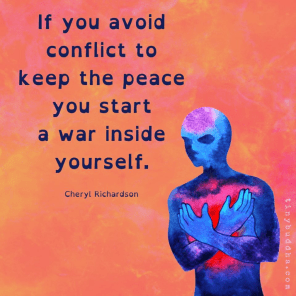 When we do choose to avoid a conflict, it helps to be aware of the Cycle of Indecision: ‘I feel bad. I should do something. Nothing will change. I gotta let it go. But I feel bad…’ I find when I avoid a conflict but over time it keeps coming up inside me, then I do need to do something to address it. That may involve talking to someone, creating art to express my emotions and tell my story, doing something ceremonial to keep the energy flowing without endangering myself, or finding a passion to advocate out in the world. For example, if I have a conflict with someone close to me, I tend to try to collaborate and talk it through when we are both less emotionally charged. But when I have a conflict with someone I don’t trust to collaborate with, I often write them a letter, leave it on my altar, and burn it so that the energy gets sent out in spirit.
 The driver’s interest is (likely) not being criminally charged and being able to express anger that cyclists are not riding single file (which they don’t have to). Maybe he has an interest in trying to change that law or have cycling lanes built on the road so he doesn’t have to share, or maybe he’s just interested in expressing anger, but his position seems to be ‘get out of my way’. We’d need to talk to everyone to unpack their underlying interests and potentially resolve the conflict in a more mutually beneficial way, but that’s not the job of the police officer. That’s something we could do through an Earth Ethos
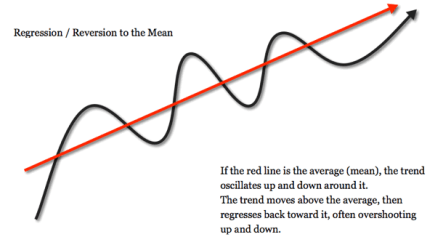 In social environments, it seems to feel proportionally less safe to be oneself the farther we identify from collective norms and ideals. There is a concept in mathematics called ‘regression to the mean’. It is basically the idea that when you put some ice into a glass of water, the ice will tend to melt and take the form of the water; in essence, it is about assimilating into a collective norm. Yet assimilation is a dirty word for many people, because we want to celebrate our uniqueness as well as being part of a peoples. (Image from
  Feeling safe to celebrate our difference depends on culture and context. These social wounds keep us trapped and unable to trust ourselves, each other, non-humans, and Spirit/God/oneness. Our capacities to heal and seek retribution are also based on cultural values and intergenerational traumas. Cultures that are more welcoming of outsiders seem to encourage healing and embracing collective wounds for transformation, whereas cultures that are more exclusionary seem to ‘other’ people and tend towards separation and seeking retribution. Fear of retribution can keep us trapped and unable to trust. It is as if there is a collective trauma belief that says, ‘if we let them in, they will hurt us.’ In my experience with Judaism, and what I am learning are my deeper Sumerian cultural roots, there seems to be a collective belief that ‘we can’t trust anybody.’ My own grandmother told me that as a child, and I asked her incredulously if I couldn’t even trust her. She didn’t answer, just stared at me in silence. Living in this social environment, I never felt safe. In fact, I felt terrified to even take up space. One wrong move could find me terribly punished, kicked out of the group, or worse, judged irredeemable by God. Despite constantly striving to be ‘a good person’, it never felt like what I did was good enough. I got used to feeling terrified that threats of judgment, punishment and retribution were always imminent. I worked hard to learn the rules I might break and the triggers I might set off that would result in my being punished. But I wasn’t in control. My brother had a habit of breaking rules and refusing to admit it, so we would both be punished. This was scary, too, because I didn’t know when the punishment would happen, or how intense it would. It felt safer at times to intensely control and punish myself so that I maintained a sense of autonomy. It also seemed safest to play the part of
  For most of my life I felt terrified to take up space. I felt like no space was ‘mine’ existentially or practically. For example, growing up, I wasn’t allowed to lock my bedroom door. I used to get dressed in my walk-in closet so I had some privacy and warning if my mother was coming into my bedroom. It took many years into adulthood – and practically ending many formational familial relationships that were untrustworthy just as my grandmother had told me – for me to become trustworthy to myself, be authentic and celebrate my difference, and surround myself with trustworthy and authentic people. By trustworthy, I mean people who say what they mean and do what they say, and when they can’t follow through on something, own it, apologise, forgive themselves, and make amends if needed. By authentic, I mean people who know their core values and practice embodying them in everyday life.
 It is still unsafe for me in many spaces where my values conflict with the collective. But I don’t feel a need to constantly strive towards some central ideal, nor do I feel like it’s me against the world at war. I feel peace in myself for accepting who I am and doing my best to navigate the collective morass, and for cultivating spaces where I, and others, are free to be. In this way, I can embody the knowing that we are enough. (Or ‘good enough’, whatever that means.) (Image from
 If you value this content, please engage in reciprocity by
  In this section of Mary Shutan’s Body Deva book, she has an exercise called

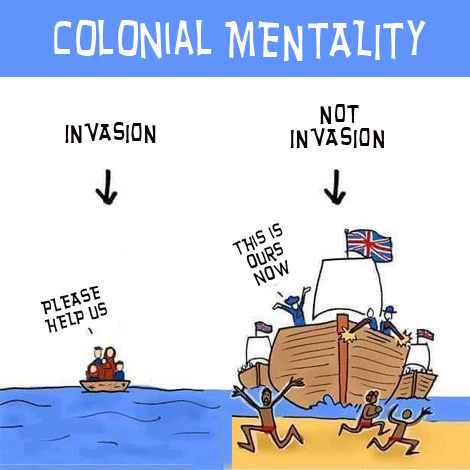


 This is the person with the most social power, both within their group and across groups. The Ringleader commonly lacks classic “excuses” for their behaviour, and usually comes from a relatively “
 The Henchmen are the bane of any true bullying victim’s life, dishing out most of the torment at the behest or with the support of the Ringleader. They are often quite dissociated emotionally and act without shame, which is both part of their resilience, and what makes them very dangerous.



 Earth Ethos
