Blog by Lukas
The odds of any one individual getting the Corona virus are so far quite low, and the probability of severe symptoms or death even lower. Making individual decisions based on this low probability is therefore, on some level, the rational thing to do. But on a long enough time scale — which in this case could be a matter of weeks — self-interested rationality becomes catastrophic. For some it may be physical, and for others psychological, emotional, and spiritual.
Perhaps the most visceral example of self-interest creating collective chaos in recent times is Australian toilet paper hoarding.
I will analyse this phenomenon from three frameworks of Western thinking starting with the Prisoner’s Dilemma. It goes like this: two prisoners are being interrogated. They have only two choices, rat on their mate or keep silent:
- If neither rats on the other, they both get one year in prison (two total years from a collective perspective);
- If one keeps his mouth shut and the other rats him out, the rat goes free and the one staying silent gets three years in prison (three total years from a collective perspective); or
- If they both rat on each other, they get two years a piece (four years total from a collective perspective).

If one’s individual goal is to avoid as much jail as possible, the most “rational” self-interested thing to do is to rat, because if you are acting in a self-interested fashion, so too might be the other prisoner. If you rat, you have a chance at going free, and your worst case scenario is only two years. Cooperating is a good option for the individual but is irrational because it cannot be relied upon and comes with the greatest personal cost. But this thinking falls down if one has confidence in the collective values of the other. The IRA were famous for fanatical silence under interrogation, such was each member’s commitment to the collective cause. For our prisoners, the cause could be a desire to collectively serve less time. Applied to our toilet paper example, it means that the decision to hoard toilet paper is like ratting on your accomplice. If you can’t rely on the other’s collective values, or even their spirit of selfish cooperation, it is best to join the hoarders. Best case scenario, you are fully stocked for months; worst case scenario, you will have a decent amount. Under no circumstances will you be left with none. (Image from here.)
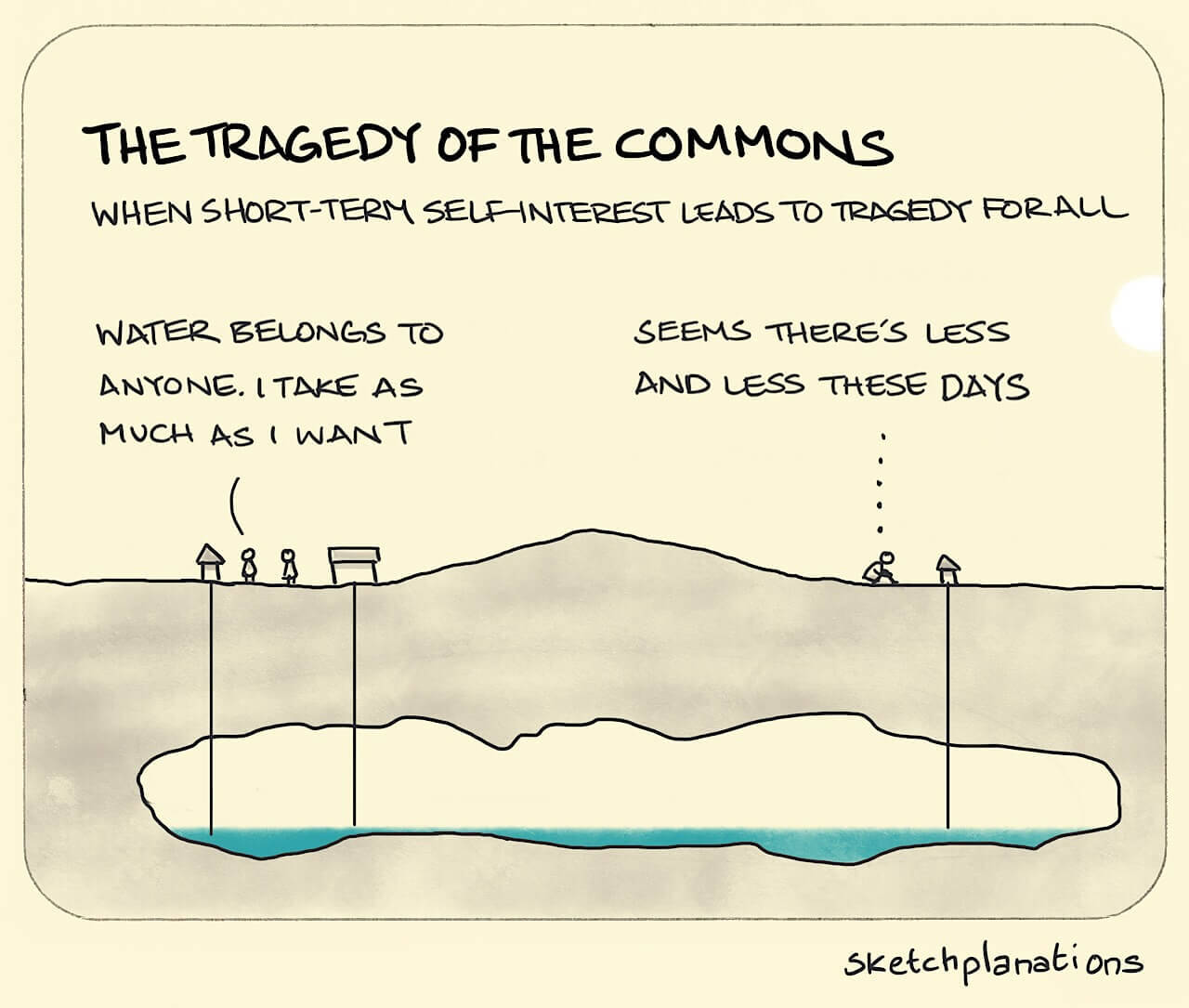 Another famous idea is the “Tragedy of the Commons”, an 1833 essay now part of the Western cultural lexicon. This is the idea that a common resource, for example grazing land, can easily become depleted or destroyed by individuals acting in their own self interest, i.e. grazing their own herd without regard to the long term effects on the land. This was in fact an argument — a terrible one if you ask me — for the morality of the enclosure movement, which was the creation of legal property rights over what was previously common land in the Britain, the idea being that an individual owning land will take better care of it, because it will be within both their interest and power to do so. This could mean that rather than our being trusted to collectively or cooperatively manage the supply of toilet paper, an authority needs to “own” the supply. This is perhaps like supermarkets ‘taking ownership’ of the situation and setting limits on TP purchases. (Image from here.)
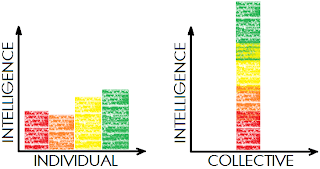
 A third framework of interest, and perhaps most relevant to our toilet paper dilemma, is the idea of Commonize Costs — Privatize gains. Also called “Moral Hazard” during the Global Financial Crises, it is an individual maximising their self-interest by being selfish with any benefits derived from their interaction with a common resource and offloading any negative consequences to the collective. In the toilet paper case this is people hoarding a personal stash and leaving the consequences and chaos to others to deal with. They got in early and those who didn’t can be damned. If this behavioural trait is common in a group, those with the most community-minded instincts or values in relative terms lose out (i.e. those who didn’t buy extra TP because to ‘do the right thing’ and now have none). (Image from here.)
 Looking at these articles on Wikipedia, it struck me how much that I think ought be deeply ingrained wisdom and self-evident knowledge has been studied intellectually and quantified as ‘evidence’. This is borne out by people acting like they need this kind authoritative guidance and advice before believing something is true. For example, the Tragedy of the Commons article mentions a study finding clear evidence that the culture of the people had something to do with how people treated common land! It is truly shocking to me that this needed to be studied. I do not wish to sound totally negative about the usefulness of these ideas. But it is clear to me they are fundamentally limited by ignorance of the worldview and cosmology from which both the behaviours and our attempts to understand them emanate. To me, the sheer complexity of systems at play in all of these circumstances call for indigenous thinking and science. From this vantage point, how to look after a common resources is self-evident, an idea antithetical to the Western scientific mind. (Image from here.)
If you value this content, please engage in reciprocity by living, sharing and giving. 


 If you value this content, please engage in reciprocity by

 If you value this content, please engage in reciprocity by
  Though much trauma is being acted out in the world right now that is sometimes referred to as ‘white privilege,’ no one is merely ‘white’, and I cringe when I am referred to as such. We all have cultural heritage with gifts to unpack and celebrate. My
 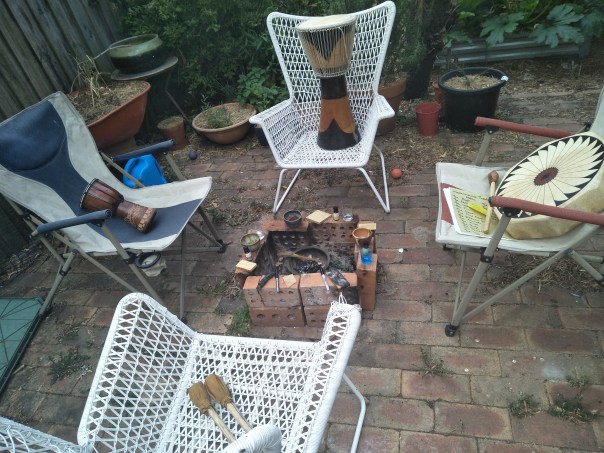 To honour my earth ethos, I celebrated a fiery summer solstice in ceremony with loved ones. (Literally, there were, and are, many
 If you value this content, please engage in reciprocity by
 purposely into trauma or danger, but not to the point of becoming a martyr and building resentment. It can be a challenging line to walk. It requires very high personal standards along with loads of compassion for self and others. It can be isolating and incredibly fulfilling. Instead of being outraged about whatever stupid action Trump did this week, I was in awe to learn that fish underwater
 If you value this content, please engage in reciprocity by
 Resilience is especially necessary when one’s path is based on existential judgment and conditional love. Without an earth ethos grounding us in our bodies, environments, and communities, we can’t experience unconditional love. And the Jewish identity I inherited is completely ungrounded–it is not even connected to Israel. Outsiders may laugh at Jewish neuroticism in a Woody Allen film, but I grew up with such people failing to take care of themselves or me, convinced there was something wrong with them that doctors’ pills could fix, and never satisfied no matter what they achieved. Having lived intimately with this addiction, abuse, and neuroticism, I’ve come to see it as based in self-betrayal, self-hatred and self-abandonment. I don’t know what set my ancestors on Jewish paths many generations ago. I know some of the traumas they and I have been through, and I feel that staying on the Jewish diaspora path has served to make our traumas bigger. For example, my grandmother told me as a child that I can’t trust anyone, and I asked with surprise, What about you?! It’s a much harder road to judge, confront, and forgive than to just accept in the first instance. I thank my Jewishness for this hard learned lesson. My current path is one of accepting unconditionally. I don’t feel this aligns with my Jewishness, so I seek to uncover what lies underneath that for me. I’m moved to close with this quote from someone else who has dug beneath the roots of her inherited identity:
 If you value this content, please engage in reciprocity by

 If you value this content, please engage in reciprocity by

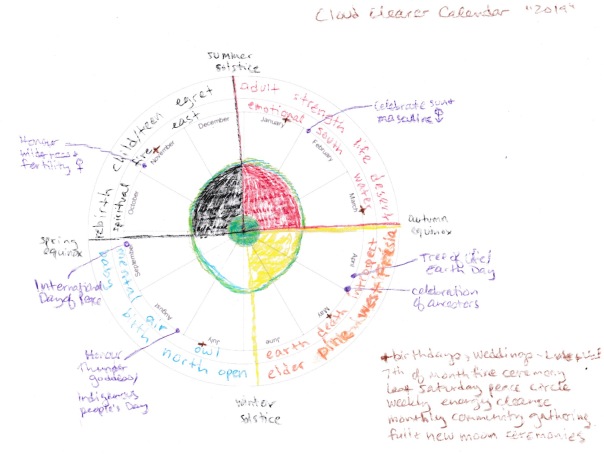
 Denying oppressive cultural stories frees not only you, but your ancestors, the lands, and indigenous people and their ancestors connected to the land where you live. A few hours outside of Sydney, Australia in
 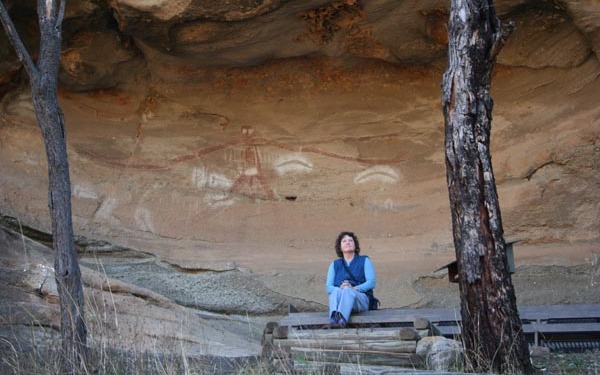 Though churches and houses were built on their sacred sites were intended as acts of dominance and genocide, they ensured that those sacred places survived as sites of worship. Today Wuradjuri people are going back to those places and re-membering their language and culture:
 If you value this content, please engage in reciprocity by


![INDIGENOUS AUSTRALIA[2]](https://earthethos.net/wp-content/uploads/2019/07/indigenous-australia2.jpg?w=604)
 Earth Ethos