Category Archives: Decolonising

On Indigenous Science

Doing science with awe and humility is a powerful act of reciprocity with the more-than-human world.

— Robin Wall Kimmerer, Potowatami scholar

A blog by Valerie

Most of us when asked what ‘science’ is will start to think of beakers and men in lab coats doing chemistry experiments. However, that is a limited Western perspective on studying and cataloguing knowledge within a controlled environment. The root of the Latin word ‘science‘ is ‘to know’, which comes from an older root word meaning ‘to cut/split.’ This is why a Western scientist when trying to gain knowledge about a butterfly will likely describe the environment of its capture, then kill and preserve one to do things like measure its wing dimensions, look at parts of it under a microscope, document the patterns on its wings, and label it with a Latin title. This is a way to gain knowledge through cutting or splitting the butterfly from its environment.butterfly

In Indigenous science, we do not aim to gain knowledge through separation and examination in isolation with such an individual focus. We instead want to study the butterfly in its environment, and it might take a while, a year or more, to observe patterns of behaviours and direct relationships a butterfly is part of. For example, we may observe that the butterfly pollinates certain flowers that the bee does not tend to favour. We may observe that the butterfly blends very well against one tree, but is very visible against another tree, and this may tell us something about where its chrysalis is likely to be hiding. We may learn about cultural lore of an important butterfly dreaming site on country. And we may feel awe when a butterfly flutters by or, if we’re lucky, feels safe enough to land on our hand. We may feel inspired when reflecting on the butterfly’s lifecycle that is filled with immense physical change to make a change in our own lives, or to appreciate immense change we have been through ourselves. (Image from here)

Indigenous science offers us a different lens, a holistic perspective, for building and testing knowledge. Most of us are aware of the Western calendar with four seasons (winter, spring, summer, fall) and the equinoxes and solstices that mark celestial moments in an annual cycle. But many Indigenous cultures celebrated seasons specific to their country and its cycle of life. Here is a representation of the Jawoyn seasonal calendar from the land where we currently live around Katherine, NT:

jawoyncalendar

In nomadic or empire-building cultures where people travelled a lot, especially by boat, it made sense to mark seasons by celestial moments. But in Indigenous cultures where people developed deep relationships with a place where they experienced belonging, it made more sense to mark seasons by weather patterns, plant and animal movements and food sources. This included marking times of year to avoid certain foods too, like no fishing of barramundi during their breeding season out of respect. (For those of you in Sydney, here is a D’harawal seasonal calendar explaining six seasons of that country.)

Considering the opening quote, I find that Western science may be done with awe, maybe even humility, but rarely reciprocity with our non-human kin. And for those of us living off of our traditional country, I find it helpful to keep in mind what Kenneth Jacob of Wellesley Islands, Queensland explains:

Our law is not like whitefella’s law. We do not carry it around in a book. It is in the sea. That sea, it knows. Rainbow knows as well. He is still there. His spirit is still watching today for law breakers. That is why we have to look after that sea and make sure we do the right thing. We now have to make sure whitefellas do the right thing as well. If they disobey that law they get into trouble alright.


I leave you with the following principles of Indigenous science to consider, based on work by Oneida-Gaul scholar Apela Colorado:

  • Nothing is objective
  • Non-humans are included in research
  • Research is done as a ceremony
  • Time is nonlinear & cyclical
  • Privileges relationships
  • Holistic, draws on all senses (spiritual, emotional, physical, psychic)
  • Healing, ends with feelings of peace, balance, vitality
  • At the end, we have not transcended but are more fully present and embodied
  • Humour and light-heartedness are important to the process

allindig

giveheartIf you value this content, please engage in reciprocity by living, sharing and giving.

Gifts of Colonialism

Blog by Valerie

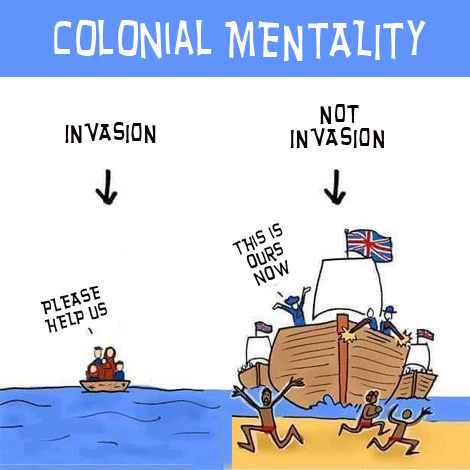
When we grow up feeling like no one’s in our corner, that life is us against the world and we can’t trust anyone, many of us go on a journey as adults of learning how to put ourselves first and practice self-care and fiercely healthy boundaries, as well as learning about personal limits of meaningful sacrifice and resentment-building martyrdom. Sometimes those of us with this wound feel the pain of it so acutely that we can’t focus on much else. We need the wound to heal so badly that we start to believe our needs matter more than others’, and like a baby crying to be taken care of, we often look for external care-taking even as adults, which tends to result in giving our power away and ultimately feeling victimised, reinforcing our distrust wound over and over again. People say when we don’t learn a lesson at a small scale, the universe keeps providing the lesson in bigger ways until we get it or it gets us. When this happens at a large scale, where many people share such a wound that it becomes an intergenerational trauma, entire families, cultures, and communities can collectively reinforce the wound in each other and embed it into social structures. (Image from here.)

TRANSCEND MEDIA SERVICE » Colonial Mentality

There are spiritual lessons in everything, and I’ve been thinking recently about the following teachings of colonialism:

  • corruption of power – giving us the opportunity to recalibrate how we view, carry and share power and re-order our social structures and governance;
  • corruption of trust – giving us the opportunity to let go of control within a separated individual identity to flow into a communal and interconnected identity;
  • corruption of belonging – giving us the opportunity to heal the wound of abandonment by feeling the grief and loss of disconnection from the Earth and allowing us to seek adoption by the country and traditional owners where we live;
  • corruption of faith – giving us the opportunity to re-place our faith into the creation of new cultures and institutions inclusive of all human and non-human kin to fulfil our special (species-specific, or speci-al) role as caretakers of this planet.

I’ll share a few stories and thoughts about each of these gifts.

Mahatma Gandhi Quotes Power | das leben ist schön zitate

Power: When power becomes too concentrated and reaches a human limit, people tend to explode out of their lands like volcanic lava and end up scattered all over the world spreading stories about how they didn’t steal or impose on others, ‘they conquered’ and ‘won’. Any superiority trip (an existential hierarchy) is corrupt, and it seems to me that over successive generations (such as after a colonial land grab), the nature of power becomes apparent to more and more people and passion for social justice activism and Indigenous knowledge revival emerge to re-balance us.

Trust: As a child, I didn’t have anyone around me I could fully trust, and I never felt safe because I wasn’t. I trusted untrustworthy (ill, innocent and/or naive) people as a survival strategy. So I learned trust through experiencing deep betrayal. It has been a powerful mirror of what not to do. Today I’m a highly sensitive person with increasingly fierce boundaries, and I find the fiercer my boundaries, paradoxically the gentler I am with people close to me. Seeing trust as a path and practice, as opposed to a given or a ‘should be’ taught me that it can be learnt and earned. And it showed me that at times I need to extend trust for practical reasons even if it feels dangerous, and at times that I can hold it back to protect myself from painful experiences. (Image from here)

Belonging: More painful than my wound of sexual abuse is my wound of maternal abandonment. I have felt for most of my life like I cannot cry enough to express this profound grief and pain. Lately, though, there are moments where I can hold this gift with awe. Last week I met a Walpiri lawman Wanta Jampijinpa Steven Patrick who has worked for years to share his understanding of Ngurra-kurlu (the home within) with his people and others. He told me the metaphor of Milpirri (see below), a festival he facilitates in the community of Lajamanu in partnership with a dance company in Brisbane every two years: the hot air from their desert country rises up, and the cold air from the sky falls down; as the air mixes, thunderclouds are formed that unite the energy and send lightning and rain to the earth, connecting the hot and cold air (the Aboriginal/yapa country, knowledge and culture and other/kardiya knowledge and culture from overseas). He asked me why so many people who come to his community want to share their culture and knowledge and do not learn from him so they can be adopted where they live and “we can all be Australian.” (Image from here)

Will There Be Faith? | Peg Pondering Again

Faith: Though growing up I was ostensibly taught to have faith in Western governments and their supposed ‘democracies’, capitalist markets, cleverness of mind, quick-wittedness, physical beauty, and a watered-down version of Jewish law, I steadily lost (or never placed) my faith in those spaces. Instead, I learned to have faith that peace can emerge from any violent conflict; that all trauma be healed; that there is value to experiencing evil, disgusting, and dangerous things. As Dr. Marcus Woolmbi Waters, a Kamilaroi man, wrote in his most recent column in the Koori Mail entitled Let’s not lose sight of who we are: “I am no victim of colonisation…We are survivors, enduring and ancient, who maintain a fight for justice and truth…Yes, our trauma is deep, it is intergenerational, it is historical and resides deeply in the present, but we are not our trauma” (emphasis added). (Image from here)

I am reminded of one of the biggest gifts of colonialism that we are still unpacking: a conscious awareness that we are all one big human family despite our diverse countries, cultures, communities and the conflicts between us, and that we are all in this together, human and non-human, in holy commun-ity. (Image from here) In the immortal words of Johnny Cash:

giveheart If you value this content, please engage in reciprocity by living, sharing and giving.

The Sacred Feminine

Blog by Valerie

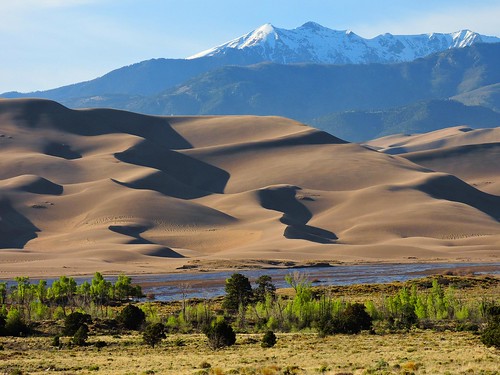
Springtime Cottonwoods, Dunes, and Medano Creek | NPS ...In 2016 I danced a healing ceremony on Tiwa country in view of their Place of Emergence (now the Great Sand Dunes National Park in Colorado, U.S., image from here.) It was the height of summer when we arrived, easily 40C, and a few people were already hard at work building a sweat lodge. Below are my photos of the bones of the lodge, including a medicine wheel made especially for the ‘crown’ facing the heavens (as you can see in the lodge’s shadow), as well as a photo of me. 

When I started writing this blog, it was the winter solstice where I now live, and two days ago marked the Aphelion here, when the Earth is farthest from the sun on its elliptical orbit. (In the other hemisphere you had summer solstice and the Periphelion where you were closest to the sun.)

During the ceremony, which was near summer solstice, it was stinking hot during the day and quite intense to be dry fasting in the desert. But the altitude meant that it cooled down at night, so in the morning when we woke at sunrise with chants and prayers of thanks as Grandmother Moon set and Grandfather Sun rose in the sky, it was pleasantly cool out. Without giving away more than is respectful, I can share that the ceremony started with a sweat lodge, then took place in a dance arbour with a small, resilient tree at the centre. There was drumming and chanting and dancing (and dry fasting as I mentioned), and sleeping outside for a few nights. During this dance I had the most profoundly sacred feminine healing experience of my life, and as I’m writing this, I’m realising that it’s significant that took place around summer solstice, when in my medicine wheel the sacred masculine is at its height of power.

Trail and Park Reviews: Zapata Falls, Frozen Glacial ...The desert strips away all that isn’t necessary, and like the bones of the sweat lodge, shows us what we are made of. During the ceremony I witnessed layer upon layer of trauma and grief being stripped from me. This was not new, but something I had been going through for some years. But when I found myself falling to my knees at tree in the centre of the arbour, I felt something different. I felt how deeply that tree, that country and those people loved me, and how very wanted I was by Mother Earth. I hadn’t realised how disconnected from my inherent worthiness I had been, and I cried tears of gratitude for the gift of knowledge reminding me of this. I felt quite weak at that point and soon after completed the dance, breaking my fast with a cup of mint iced tea. The next couple of days were filled with play, including hiking the sand dunes and finding oases to swim in the desert, such as an icy cold waterfall (Image of Zapata Falls from here) and a natural spring pool where I rented a swimsuit for $1. I didn’t know that was a thing, but I guess a few people show up in the desert surprised to find a natural spring pool and want to swim too!

When I left the desert after this experience, I felt raw and shaky, yet stronger in my body than I had been in this lifetime. And everywhere I went I kept seeing people who hadn’t yet connected with the Sacred Feminine and didn’t seem to know their worth, or how much we are all loved by Mother Earth, even as our behaviours and lifestyles wound Her. It helped me see the depth of wetiko in the world, and it helped me find my way to people who are as grounded as I am and consciously aware of the depth of pain and disconnection we are all in with our modern city living. It takes time and effort to integrate these teachings into our daily lives, and as one of Tiwa Elder Beautiful Painted Arrow’s (Joseph Rael’s) students shared in a recent blog, Joseph reminds us in his new book that “You have to go through separation before you can go through reunion” & “If everything is considered holy you are always in training.”

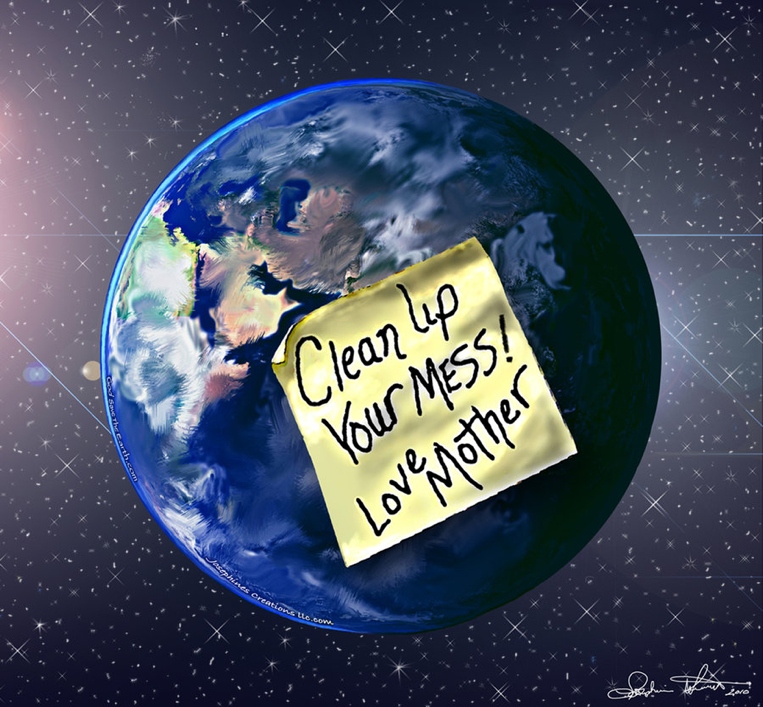
cleanupyourmess

At the winter solstice, where we connect deeply with the darkest light of our being, the light from which all coloured and bright light (and life) emerges, I remember this healing experience. And I give thanks for the Sacred Feminine, Mother Earth, and all mothers within and without. I give thanks for all the work I’ve put in so far to bring that knowledge fully into being in my world, and give thanks for the humility of how much work is still needed, mirrored in moments of trauma, pain and shadow emerging stronger than that sacred knowing of the worthiness of it all. Of every struggle. Here’s to us wild and crazy humans, and to Mother Earth who’s always supporting us whether we realise it or not. And to continuing to clean up our messes to show Her that we know how valuable we all are and that we want to honour that by living well. (Image from here.)

Wishing you a meaningful solstice season, whichever hemisphere you’re living in, and deepening of your conscious connection with the Sacred Feminine over the coming months.

If you value this content, please engage in reciprocity by living, sharing and giving. giveheart

Two-Eyed Seeing: Gift & Privilege

Blog by Valerie

The word gift has a very interesting etymology. I remember being surprised as a child to learn that Gift meant ‘poison’ in German. Turns out it means ‘poison’ in modern Dutch, Danish and Swedish too. The story goes that the proto-Germanic verb geftiz (to give) led to German’s geben (to give), and Gift (poison), the latter coming from dosis (a giving) in Greek (dose in English) being used to describe a portion (potion) of medicine given to a person who is sick. That this supposed medicine came to mean poison perhaps says a lot about how Germanic people felt about foreign medicines being brought in, but anyway.

Fungi - Wikipedia

This dichotomy got me thinking about gifts and how they differ from privileges. The etymology of privilege is from Latin meaning ‘private law’ – it is inherently an individualistic concept. The word privilege sure is thrown around a lot, and I do mean thrown – it often feels like it’s sent to people by throwing a word-spear with a poisonous arrow on the end. I can speak truthfully about painful gifts I’ve received in my life – familial betrayal, sexual violation, maternal abandonment, social rejection – and I can relate to both the English meaning of ‘gift’ and the germanic ‘poison’ meaning. In some parts of our lives we are all called up on to turn shit into fertiliser, to be like bacteria and fungi and allow the natural process of decay to enrich us and create space for rebirth.

The current mainstream social story around ‘privilege’ is to label people with certain perceived privileges from a Western materialist, capitalist, Euro-centric, Judeo-Christian (dare I say white supremecist) worldview, and expect people to be aware of them. From this perspective, I am privileged because I grew up middle class, in the U.S., I have light skin, received high-level formal Western education, have strong English language skills, etc. Yet from my Indigenous East Frisian worldview, this concept is an imposition – the only word that relates to this idea of privilege refers to whose turn it is to go when two people (or wagons) are at a crossroads. And from my Jewish-American worldview, the idea that Jews are accepted as ‘Western’ and ‘white’ is so new it feels incredibly insecure and desperate to consider myself part of that story, and I see many Jews become the neurotic caricatures outsiders expect them to be within a larger Western story. (Woody Allen anybody?)

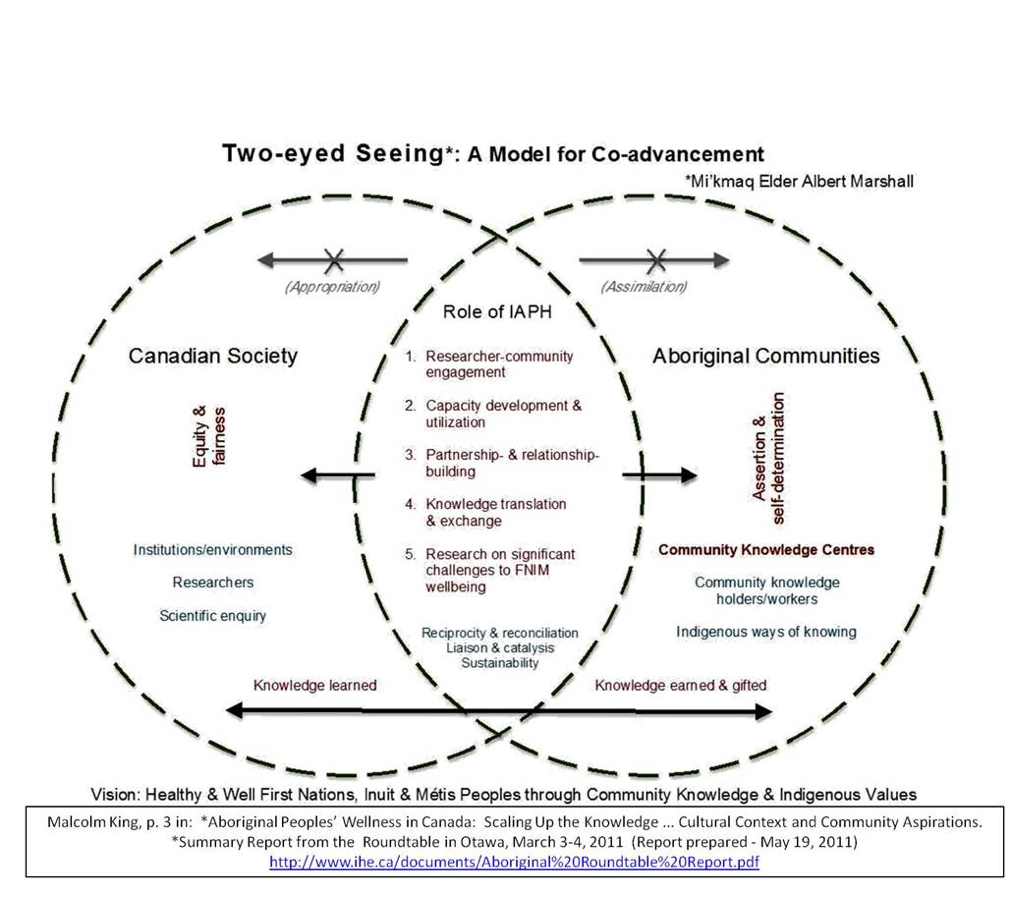
I find the concept of Two-eyed Seeing by Mi’kmaw Elder Albert Marshall is very useful here. It focuses on seeing the strengths of Western and Indigenous worldviews and making space for multiple perspectives and consciousnesses. (Image from here.)

Guiding Principles (Two Eyed Seeing) | Integrative Science

There are different ways that we can practice two-eyed seeing. For example, the Mi’kmaw model sees their cultural worldview and the Western worldview as somewhat overlapping and somewhat distinct, as in this Venn diagram showing room for knowledge-sharing and learning from each other:

twoeyed

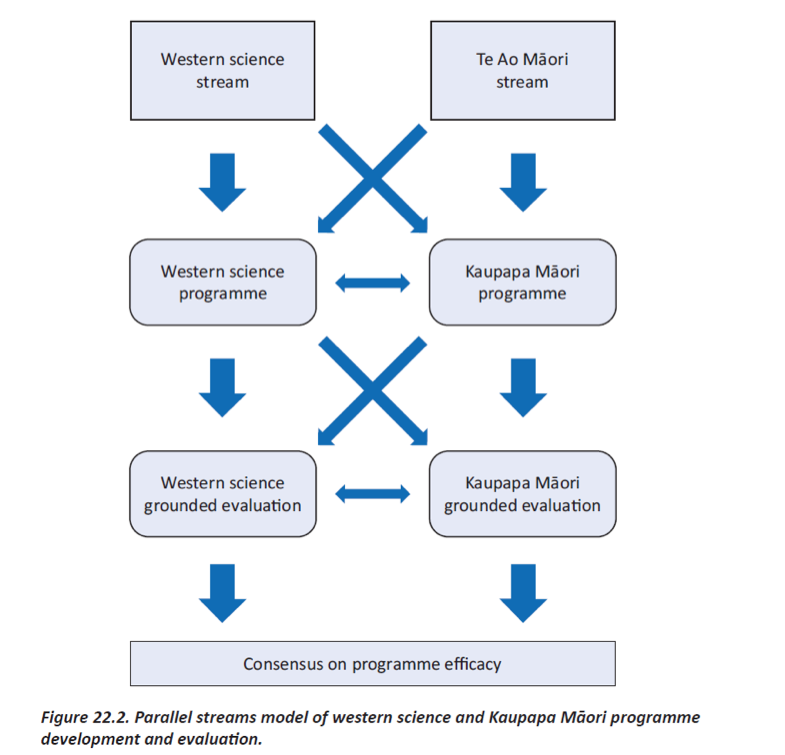
Another approach is the Braided Rivers approach that sees Maori and Western knowledges as distinct streams that need to be woven together to create a new system of knowledge based on the strengths of both worldviews.

maoririvers

As Indian psychoanalyst Sudhir Kakar said:

A degree of alienation from one’s culture, a deep exposure to other worldviews and even a temporary period of living ‘as others’ may indeed be necessary for heightening one’s perceptions about the culture and society one is born into.

poverty

By all means let’s confront our Western privilege, and while we’re at it, let’s reflect on what we privilege in our lives (and what we want to be privileging). For example, I privilege peace and balance. And when I think about the Western material privilege I grew up with, I also think about the imbalances that went along with it – spiritual desolation, mental illness, and physical and emotional pain – and to rebalance and find peace, my healing journey included many years of renouncing material privilege to strengthen other aspects of my being. The imbalance was a gift, to be sure, but a privilege? I’m not sure. I see that distinction as cultural. In closing, I am reminded of this photo from a small town in the Amazon that encapsulates my two-eyed seeing approach to gifts and privileges (translation: The poverty is in your head and not in your pockets…).

giveheart If you value this content, please engage in reciprocity by living, sharing and giving.

Facts in Right Relationship

Blog by Lukas

Across the globe an increasingly dominant worldview sees reality as ultimately physical. There are various expressions of this worldview in Western philosophy, including:  logical positivismempiricismphysicalismscientismnaturalism and causal closure. I would sum them up as follows: the only true reality is physical and material, and direct observation using the scientific method arranged into cohesive logic is the only way we can “know” and thus make statements about what is meaningfully and objectively “true.” The highest form of expressing a true statements is one that results in a “fact”, something that is “proven” true by evidence.

There are some been some big dissenters. Pragmatist philosopher William James, popular with a lot of Western Buddhists, asserted that something can only be said to be objectively true if there is subjective value to that being so. This is often misunderstood as saying something is true if it is subjectively valuable to someone, which is not the same. Commenting on the subjective value of truth itself, his idea of “radical empiricism” asserts that any philosophical worldview is flawed if it stops at the physical level and fails to explain how meaning, values and intentionality can arise from that.

There is no doubt that Western science is physically powerful, and this power seems to validate the worldview underpinning it. On a social level, Western science delivers great physical control into the hands of they who dominate physical resources. What we are left with is a very powerful confirmation bias that minimises the importance of other ways of being, and of experiencing and knowing reality. Far from seeing this kind of thinking as our saviour, I consider it responsible for much of the deepest suffering in the world today. Considering the medicine wheel, we have traded a lot of physical comfort and knowledge for much greater insecurity in emotional, psychological and spiritual realms. To me, the very existence of facts, and Western scientific epistemologies more broadly, can only ever be tools that exist in a complex relationship with subjective experiences that defy physical description. Core to understanding our experiences is an understanding of that which is meaningful in our lives, including how we materialise that meaning, both of which are based in values and worldview. Wise application of values can help us place logic and objectivity into proper relationship with our experiences.
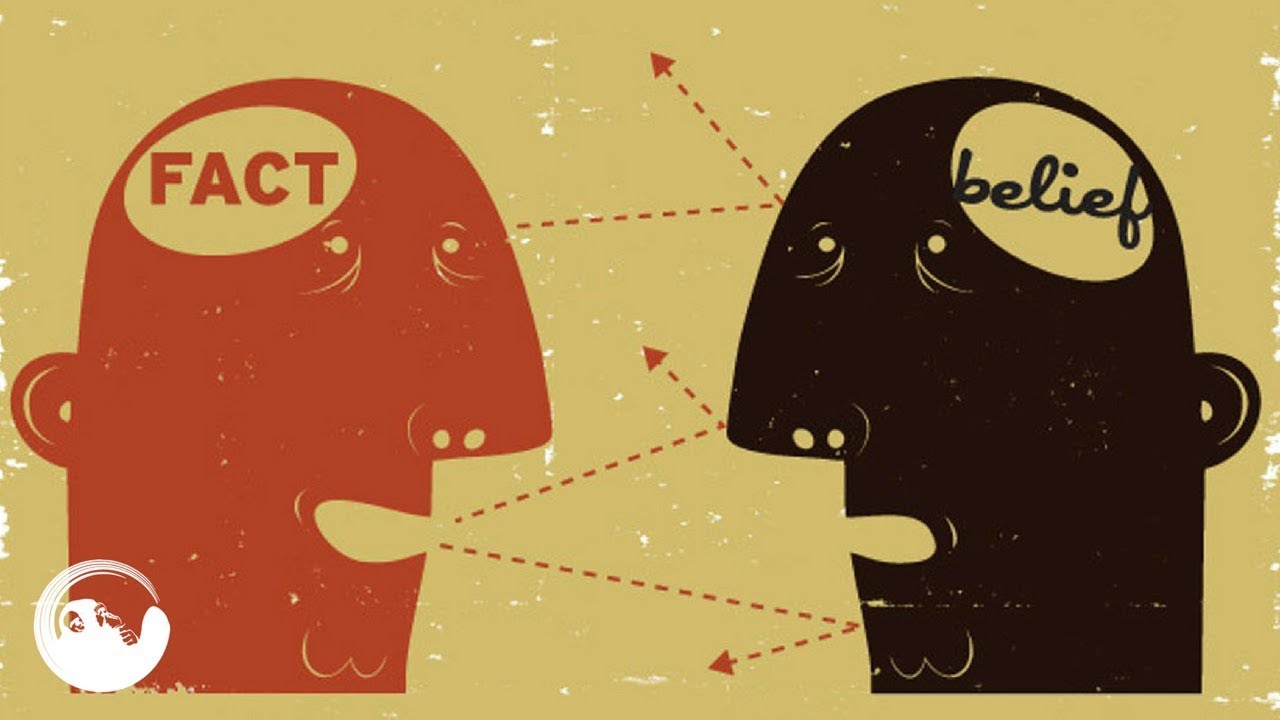
Confirmation Bias in 5 Minutes - YouTubeHowever much one tries to be “objective”, behind all science lies priorities and values, and this affects what ends up being considered real or true. Values inform priorities which help us develop meaningful goals as well as guide us how to err when faced with the inevitable uncertainty of complex systems. And, hard is it can be, values help us remain undistracted and unattached to the vicissitudes of life, and prioritise process over outcomes. By asserting the primacy of process, I am not rejecting consequences in favour of pure deontological “moral” frameworks. Rather, I am stressing that such frameworks are, amongst other things, methods for deciding how we ought err in uncertainty, to be used in combination with thought processes reliant on logic.

The wisdom, or dare I say the “truth”, of our values can be observed pragmatically over time and space in ways that are supra-rational as well as rational, relational and subjective as well as objective. Such dualities and the potential for them to be paradoxical are, I believe, intrinsic to the human experience. Their relationship to one another does not need to “make sense” intellectually. Subjectivity and supra-rationality are not antithetical to science or empiricism. Buddhist science is based on experience-based enquiries into the nature of mind and consciousness, and Indigenous science is based on people learning themselves and their land through subjective and relational ways of being. Whom would you rather ask questions about the nature of mind, a Buddhist lama or a cognitive scientist? And whom would you rather ask questions about sustainable land management, a Western-educated ecologist or a local Indigenous Elder? Your answers to these questions says a lot about you and your worldview.

Positivism Cartoons and Comics - funny pictures from ...I think the most dangerous application of logical positivism, particularly when applied to complex social and ecological systems, is the predictive theoretical model. In modern society, it is often used instead of intuitive wisdom, Buddhist science, or Indigenous science to complement or replace Western scientific observation. A model, like anything, is ultimately uncertain, and decisions have to be made about what to assume and how to err. To demonstrate my point I am going to use to examples that come from a relatively closed and simple system, aeronautical engineering. I say “relatively”, because despite the ability of physical science to predict things like aerodynamics and metallurgy with a high degree of accuracy, when building an aircraft there is no “best” design, only “best effort” at matching design and engineering to values and priorities such as safety, fuel economy, speed, capacity, manufacturing cost, etc. The advantage of this field is that theoretical models can usually be tested, preferably before people fly on the plane! But not always. (Image from here)

Example 1.
A380 engineers used theoretical models to ascertain the wing strutting they hoped would meet wing strength certification regulations. Models were tested with wing stress tests (weights literally placed onto the wings), which determined that they needed to improve the struts. They added extra struts, thus increasing the weight of the aircraft and reducing fuel economy. This, along with incorrect modelling of the aviation market, led to a beautiful, safe, unprofitable plane. But the value of placing safety before profits shone through, and not a single person has died on an A380. (Image from here.)

Example 2.
Boeing wanted an updated fuel-efficient 737 model to compete with Airbus’s A320 NEO. The 737 has slightly shorter landing gear than the A320, and thus could not accommodate the latest generation of super fuel efficient turbo fan engines, which have a large diameter. To create a whole new airframe (the core of an aircraft) is a lot more expensive and time consuming than an incrementally new model, so the engineers were asked to “make it work.”

They ruled out re-designing the landing gear because it would be too heavy, bad for fuel economy. They changed the way the engine was positioned on the wing, but this altered aerodynamics and made the plane prone to stalling in certain circumstances (when close to the ground). To compensate, they installed software that would take control of the plane’s elevators and aggressively point the nose of the plane down in the event of a low altitude stall. This system took its cue from a single sensor.

You might think that such a system would require extra pilot training, but this would have raised the effective price of the plane, and Boeing were keen to sell it to budget airlines in the developing world, and besides, the system would only run in the background, and in the event of a failure could be disabled the same way pilots had been trained with other Boeing planes. The American regulators, by now more or less run by ex-industry workers with vested interest, approved the plane to fly.

We know what happened next. Two sets of pilots were so scared that their plane was trying to crash them into the ground that they were unable to work out that the problem was an automated system they knew how to shut down. A lot of people died as a consequence.

Disregard for consumer safety and the law - Product Safety ...There are numerous errors of logic identifiable in Example 2 without questioning values too deeply, and these should not be ignored. But I think those errors were proximate causes of flawed values. The aeronautical engineering profession must be based on a deeply held commitment to safety above profit. They, and their regulators, should err on the side of safety. I cannot help but think that government backing of the A380 project — considered a public interest project — had something to do with the values underpinning their decision-making. The risk of producing an unprofitable plane is not as catastrophic to the public purse as it might be to a purely private enterprise. But it also has something to do with the physical nature of the wing test showing a “fact” playing into biases in the Western world. Feelings of unease in the pit of Boeing engineers’ stomachs that I am confident was there were too easily rationalised and discounted within a worldview that puts physical knowing — or its poorer cousin, physical modelling — on a pedestal. (Image from here.)

My commitment to living a process- and values-driven life is why the Australian government’s response to the Corona virus did not align with my values, even if I am grateful for the outcomes we have had so far. In March I saw them erring based on certain values and priorities, but that was not at the centre of societal dialogues. Discussions about values seem increasingly missing in favour of myopic searches for evidence of “fact” or inter-group conflict. What I seek is dialogue based in values that utilise facts once people see and trust where each other is coming from. When we see someone like Trump acting the way he does, it is tempting to malign his refusal to listen to “facts.” But this is only part of the story. The problem for most of us is that we do not like Trump’s values. As physical “facts” continue to gain power both in terms of physical change in the world and as a dominant worldview, dialoguing on values will only become increasingly important. Facts are not the solution to bad leadership, and an increased emphasis on evidence-based “facts” can quickly become a vehicle for even greater trickery and corruption.

If you value this content, please engage in reciprocity by living, sharing and giving. giveheart

Alienation & Judgment

Blog by Valerie

I was perhaps one of Earth’s most alienated of beings, and by that I mean that I did not sense belonging here. My cultural context was such that I had no sense of relationship with my earthly and cosmic habitat…Earth/Nature itself was devoid of real consequence; it was human activity upon it that was of consequence…but even then they had to control its waywardness with sprays and fertilizers. It was a big dead ball of dirt…from which we would be saved by ‘God’ eventually…Here in the South Land, the supernatural Christian drama of God and Jesus was completely unrelated to place. It was a particularly cerebral religion, and in that sense barren – devoid of ceremonial recognition of the fertile Earthbody.–Dr. Glenys Livingstone

She goes on to describe how when she was growing up in Queensland, Australia, her schoolbooks from the northern hemisphere showed the moon phases in mirror image to the moon here, the path of the sun was described as clockwise from east to west which is not how it travels here, and the seasonal celebrations were out of whack with fake snow in the middle of summer for Christmas (that still happens and weirds me out!).

Dispelling Wetiko: Breaking the Curse of Evil by Paul Levy

I see this on individual and societal levels. It seems to be a common form of wetiko, the psycho-spiritual virus of supremacy common in colonialism, some cultures and religions. In our bodies and by our nature, it’s SO much easier to live in sync with the seasons, be present in our environments, accept experiences without judgment. So why don’t we? I feel that as a whole we have become alienated with aspects of ourselves and our environments. Because this is so painful, rather than face those wounds and work through them, we deny, avoid, and dissociate. When we feel hurt we: (1) say we forgive but carry resentment around instead, which becomes an emotional bomb that detonates at an unexpected time, (2) don’t say anything, resulting in resentments, passive-aggressive behaviours, and ‘faking it’, and (3) take some space to try to manage our own emotions without confronting the conflict, but the conflict keeps occurring in a painful holding pattern.

5 Most Effective Conflict Management Styles (+When To Use ...

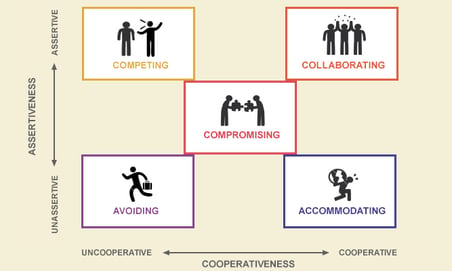
If I try to let something painful go and can’t, or if I feel like I need to address something in the moment so it doesn’t get bigger, my approach is to directly, honestly, bring it up with the person. I don’t ever intend to judge, and if someone does experience me as judging, I want to be told. If someone does something that hurts my feelings and I care about the relationship, I will either let it go or tell them. And if I do something that hurts someone, I need them to let it go or tell me so we have the opportunity to work through the pain and maintain integrity. Conflict creates opportunities to deepen intimacy, to heal, and to learn about ourself and someone else. I accept that navigating conflicts is part of being human. (Fodder for another post: Do you know your conflict style(s) ala the image above from here?)

What I find, though, is that we can know someone for a while, even a few years, and the first time we express annoyance, or say we feel disrespected or hurt, and directly, respectfully, confront a conflict, the other person does (1), (2), and/or (3) to avoid being honest. This prohibits intimacy and integrity and destroy relationships. I saw this behaviour in a new light this weekend through a relationship with a friend. I realised the way she identified as Christian is grounded in her human family, not the Earth, which placed humans hierarchically above the rest of nature. Even though she talked with me about my cosmology, expressed interest in indigenous healing, and was struggling with painful and deep patterns of narcissistic abuse. In my experience, narcissism can only heal through re-orienting ourselves into a holistic worldview.

holistic

There is a pattern to the universe and everything in it, and there are knowledge systems and traditions that follow this pattern to maintain balance, to keep the temptations of narcissism in check. But recent traditions have emerged that break down creation systems like a virus, infecting complex patterns with artificial simplicity, exercising a civilising control over what some see as chaos. The Sumerians started it. The Romans perfected it. The Anglosphere inherited it. The world is now mired in it.–Dr. Tyson Yunkaporta

He goes on to say:

Narcissism is not incurable…Entire cultures and populations recovering from this plague have been left like orphan children with no memories of who they are, longing for a pattern they know is there but can’t see…There are so many adolescent cultures in the world right now, reaching for the stars without really knowing what they are. Adolescent cultures always ask the same three questions. Why are we here? How should we live? What will happen when we die?

But if everyone around you sees the world through the lens of human supremacy except for one person (like your weird friend Valerie), are you willing to believe that person? In my experience, it takes a courageous person who’s ready for a new form of freedom, and even when we ask for something and it’s handed to us, sometimes we can’t see it and still reject it. I find it really painful watching people get so close only to give up and destroy their relationship with me through disrespect and existential judgment. I know they’ll get another opportunity, or two, or three, to heal the wound, but not with me. I use honesty and directness to maintain fierce protective boundaries…

giveheartIf you value this content, please engage in reciprocity by living, sharing and giving.
Healing Whiteness Trauma

Blog by Valerie

“The first step in liquidating a people…is to erase its memory…Before long a nation will begin to forget what it is and what it was. The world around it will forget even faster.”—Milan Kundera

Whether you are considered “white” or not, I feel confident saying you have been impacted by whiteness trauma, and as this quote suggests, that your people/s likely experienced and perpetrated genocide somewhere in your family line/s. Genocide is an intentional act to destroy a people, and whiteness is an intellectual construction based on traumatic social rejection from & disconnection with Mother Earth, self & cultural heritage, and other people. It was used as a tool by the ruling class to divide the working class, and so is also called “the bribe of whiteness.” David Dean gives a clear and compelling history of the creation and rise of the “white” identity in this article, People who have learned to identify as “white” tend to deny their own complex cultural heritage. Some people even study “whiteness theory” and “white fragility” to try to make sense of the shame they carry and the way this history of European identities being whitewashed and replaced by modern, nationalistic ‘Western’ identities still play out today. For example, did you know that assimilationist policies in the U.S. in the late 1800s and early 1900s led to companies like Ford running mandatory English classes and job training programs that finished with ceremonies in which people clad in traditional cultural clothing walked through a huge ‘melting pot’ then emerged in company uniforms? (Image from here)

fordschoolmeltingpot

David Dean cites the success of such policies & programs on two factors:

  1. The violent displacement of communities from their traditional lands in order to use that land for profit and create a dependent, exploitable workforce, and
  2. The replacement of traditional cultural identities that valued the welfare of the community and the Earth with a culture of capitalistic, possessive individualism with a social hierarchy divided along racial, gender, religious, and other identities.

As Tyson Yunkaporta points out in his new book, ‘Western’ is not an identity, because by its nature it is in reference to someone or someplace else (presumably ‘Eastern’); it is not inherent. To be ‘American’ or ‘Australian’ is also quite amorphous. I have out of curiousity asked a number of people what it means to them to be ‘Australian,’ and I have gotten one of two answers: (a) I am part of a multi-cultural modern soup, or (b) It means nothing to me, and I am English/Irish/Wiradjuri/Yuin/etc. living on this land we collectively call ‘Australia’.

My view is that whiteness trauma is based on a European history of intergenerational trauma, shame & pain. It was spread by the Romans & other empires dividing and subjugating peoples on their traditional lands; by the violent spread of Christianity through power & force, including the systematic desecration of indigenous & pagan sacred sites; and by horrendously hateful acts such as witch trials, inquisitions, slavery, rapes & genocides. It seems to me that over the last few thousand years, violence, terror & control became normalized as a method of asserting dominant leadership throughout Europe. Multi-generational disconnection with an innately human intimate & reciprocal relationship with the Earth were replaced by a power struggle for whose anthropocentric story is ‘right’, in a might-makes-right model. This led to land ‘discovery’ (i.e. colonisation) and other myths such as when upper class, white-skinned, Christian, land-owning males founded a ‘free’ government for ‘the people’ in the U.S. Ultimately, whitewashing & glomming together of many European peoples and cultures into “Western” expanded to non-‘white’ people, so that today millions of people around the world identify with a colonial nation rather than a traditional culture living within an empire.

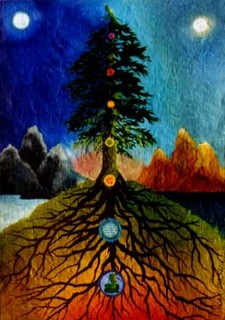
Here is a little poem I wrote about my own journey of healing ‘whiteness’ trauma:treechakras

Beneath the Roots

Ancestral trauma 
Has defined me
But I kept digging
Because I knew
My taproot was deeper
And drinking in peace
Somewhere down there

To heal from whiteness trauma, I have found many helpful approaches, including: honouring ancestors, grounding, re-defining tribe & belonging, bridging multiple identities, healing power dynamics, and healing existential wounds. The following quote is a humbling reminder of what our indigenous minds carry somewhere inside of us from an Australian Aboriginal culture more recently colonised:

“The first peoples of this land don’t need statues of our heroes, we have mountains that remind us of our people. We don’t need painted portraits, we have rivers that flow with the stories of our dreaming. Our songs are filled with culture, our language of the land. So we don’t need books. Our history, our connections, our hearts are true to this country.”–Baker, 2017, quoted in Koori Mail, Oct 23, 2019 p. 24

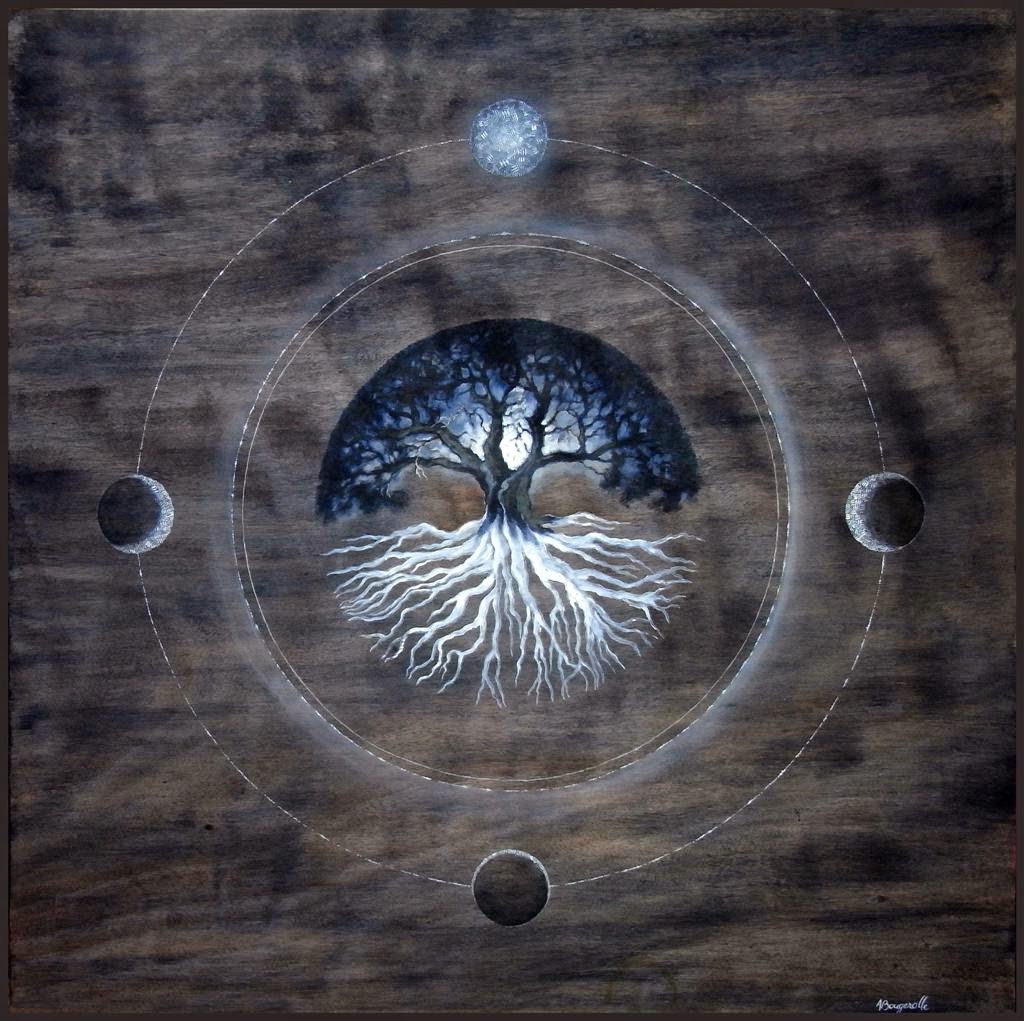
- Tree Annick Racines du Ciel

(Image from here, by artist Annick Bougerolle)

giveheartIf you value this content, please engage in reciprocity by living, sharing and giving.

Thanks-Giving at Solstice

Blog by Valerie

A few months ago somewhere in the outback around Broken Hill, I experienced a spiritual lightning strike inside. Something in me died, an old dream (maybe it was always a lie), and its energy has been emerging from my body in incredibly itchy rashes across my chest, back, face, and shoulders, and grief-laden tears. Sometimes I know certain things aren’t working but am reluctant to call them out or make a change, sitting in doubt and denial and dumbly hoping they’ll work out without conflict. I started to feel, for the first time in my life, like I could fully exist somewhere, and a community started to gently invite me in. Though it was not practical to join them, I can still see some smiles and hope and hear someone asking me to invite her to my housewarming when I move out there next year. It is possible. I’m sure I don’t know. All I know is the sand is shifting under my feet again, and some people and aspects of life I’ve been counting on are disappearing. I’ve been through this many times, and I know my role is to stay centred, be patient, accept the gifts I’m given, let go of that which is not working, and freefall into the unknown with as much grace as I can.

quote.jpgThough much trauma is being acted out in the world right now that is sometimes referred to as ‘white privilege,’ no one is merely ‘white’, and I cringe when I am referred to as such. We all have cultural heritage with gifts to unpack and celebrate. My modern, multi-cultural self includes a body born of Shawnee land carrying earth ethos teachings from my East Frisian roots as well as teachings about existential destruction from my Ashkenazi Jewish lineage, as well as wisdom from Native American, Anglo-Celtic Australian, Anglo-Saxon American, Irish-American, Hispanic-American, African-American, Asian-American, Peruvian, Indian, South African, Buddhist, Christian, Hindi, Aboriginal, and many other beautiful cultures. I saw a quote a few months ago that really resonated and went something like this:

Life was better before colonisation and mass migration, but now it is more beautiful.

I think there is much truth in that, as well as the inset quote a friend sent me. We each have much to celebrate and reconcile within our individual cultural mix. So on December 24, I finished baking some Stollen, sang Godewind songs in German and Platt, told stories and looked at photos to honour my East Frisian paternal ancestors and country.

solstice.jpgTo honour my earth ethos, I celebrated a fiery summer solstice in ceremony with loved ones. (Literally, there were, and are, many fires burning this country.) Sitting around a fire pit in the four directions, we embodied some of my heart’s favourite forms of expression: music, meditation, poetry, and art. Part of our ceremony was a poetic prayer in words & drumming to the Thanksgiving Address gifted to us all by the Haudenosaunee, which brings our minds together as one in thanks for: The people, The Earth Mother, The Waters, The Fish and Other Water Creatures, the Plants, The Food Plants, The Medicine Herbs, The Animals and Insects, The Trees, The Birds and Other Air Creatures, The Winds, The Thunder Beings, Grandfather Sun, Grandmother Moon, The Stars, The Wise Teachers, The Creator, and All Others Who Have Not Been Named. (Image from here of the People thanking Grandmother Moon)

May you enjoy the blessings of the season from Father Sun and Mother Earth whether you have just been through Summer or Winter Solstice.

giveheart If you value this content, please engage in reciprocity by living, sharing and giving.

My Jewish experience

Blog by Valerie

A few weeks ago I was watching a couple of rabbis and their wives driving around Australia looking for Jewish people. They said throughout history Jews have been hunted down by persecutors, so now they’re hunting down Jews to bring them back into the religious community. When they came across a few young men at Uluru who said they were Jewish, they outfitted them with yarmulkes and tefillin, prayed with them, danced the hora, and said, “Be proud to be Jewish.” That remark stung, because I rarely feel that. I’m deeply disgusted that since its inception, the largest number of UN resolutions on an issue has been against the Israeli occupation of Palestine. I’m deeply disgusted by how many Jewish people identify as victims while remaining in denial about their own offending. I’m deeply disgusted how little regard many Jewish people have for Mother Earth, and how often this results in over-the-top consumerism. And I’m deeply disgusted that in the name of belief, people mutilate their baby boys a few days after birth through circumcision while rarely reflecting on modern knowledge of the neurological consequences that sets into motion. (I have a short article on that coming out soon.)

Best 25+ Jewish humor ideas on Pinterest | Passover ...

I have spent over 30 years wrestling with my Jewish identity, trying to understand it and what it means to me. I have studied Eastern European Jewish folklore, the Yiddish language, the mitzvot, and sacred stories in the Bible. I have celebrated holy days, braided challah for Shabbat and charoset for Passover, done a bat mitzvah, adopted a religious name, and even visited Israel on a birthright trip that resulted in a stalker showing up across the country at my door afterwards which the rabbis leading the trip denied was an issue. At its core, my Jewish experience has involved studying and then freeing myself from a cult of belief forced upon me that embodies profound harshness and righteous judgment along with coping through humour. This judgment has been a tough way for people to uphold morals and values, some of which I agree with. And living nearly 6000 years waiting for a messiah is a long time to keep hoping and stubbornly stick to the same story that he’s coming, and he wasn’t Jesus. You need a strong sense of humour to uphold that cosmic joke!

But the way I’ve been taught to embody Jewishness feels fundamentally faulty. Rather than try to prove I’m a worthy person and feel like a failure, I’ve decided to think that worthy as I am. Rather than shame others’ behaviours, I focus on accepting what I feel ashamed about and speaking out with passion when I also have compassion. Rather than guiltily force myself to follow Jewish norms that feel wrong or abusive to me, I’ve set boundaries with people in my family that have resulted in my being socially shamed and having to abandon people I care about to avoid being abused.

My Jewishness has been so profoundly painful and dysfunctional that it required me to learn how to engage in practices of purification. I celebrate my ancestral resilience; we’ve collectively suffered and survived a lot of shit. And while I have compassion for acting quickly to survive traumatising situations, when we’re no longer desperate I believe we’re responsible for reflecting on our past actions and making amends for ourselves and our ancestors. Jesus, the Jew, definitely preached this. I’m proud of many Jewish people I know for being heart warriors, standing with those who are downtrodden and keeping cultural beliefs and practices alive that matter to them. But mostly I’m profoundly disgusted by and even ashamed of my Jewishness, and it’s been quite hard to be honest about that. So many of the beliefs and stories given to me I’ve found to be based in fears, lies, and mind games. I think there must be something more to the Jewish identity than being a people whose story begins with slavery and involves worship of a judgmental masculine sky god. I visited Israel and did not feel a Pachamama presence there, nor do I feel that biblical stories reflect my creator or people’s story fully. 

23 of the Funniest Religious Memes/Cartoons | Cartoon, God ...Resilience is especially necessary when one’s path is based on existential judgment and conditional love. Without an earth ethos grounding us in our bodies, environments, and communities, we can’t experience unconditional love. And the Jewish identity I inherited is completely ungrounded–it is not even connected to Israel. Outsiders may laugh at Jewish neuroticism in a Woody Allen film, but I grew up with such people failing to take care of themselves or me, convinced there was something wrong with them that doctors’ pills could fix, and never satisfied no matter what they achieved. Having lived intimately with this addiction, abuse, and neuroticism, I’ve come to see it as based in self-betrayal, self-hatred and self-abandonment. I don’t know what set my ancestors on Jewish paths many generations ago. I know some of the traumas they and I have been through, and I feel that staying on the Jewish diaspora path has served to make our traumas bigger. For example, my grandmother told me as a child that I can’t trust anyone, and I asked with surprise, What about you?! It’s a much harder road to judge, confront, and forgive than to just accept in the first instance. I thank my Jewishness for this hard learned lesson. My current path is one of accepting unconditionally. I don’t feel this aligns with my Jewishness, so I seek to uncover what lies underneath that for me. I’m moved to close with this quote from someone else who has dug beneath the roots of her inherited identity:

Freedom is uncomfortably unknowing yourself and a willingness to keep coming undone — Zen Buddhist nun and queer African American, angel Kyodo williams

giveheart If you value this content, please engage in reciprocity by living, sharing and giving.

Earthly nourishment

Blog by Valerie

All Law-breaking comes from that first evil thought, “I am greater-than,” that original sin of placing yourself above the land or above other people.

Tyson Yunkaporta

The above quote is the definition of “unsustainable” to me. I see this wisdom enshrined in the biblical story of the Tree of Knowledge that some of our ancestors were advised not to eat from before their curiosity and the trickiness of a snake got the better of them and taught them this lesson. I facilitated a workshop last weekend for healing professionals called “Space for Spaceholders” in order to create space for their nourishment. The embodied metaphor for nourishment that came to me was the placenta. The placenta is responsible for nourishing and protecting babies in the womb. It connects the mother to the baby by supplying blood through the umbilical cord to the developing child, secretes hormones that are required for pregnancy and for preparing the mother’s body for breastfeeding, and provides babies with antibodies of for protection for the first few months of their life.

The placenta is a symbol of a sacred life support system. There are so many cultural beliefs, stories and practices that honour this primal nourisher. Many Aboriginal Australians see the placenta as a person’s hologram that provides a map for their life. It is buried in the Earth to provide direction for the person once they reach puberty. The Navajo (Diné) in the Southwestern US bury the placenta in sacred ancestral ground so the person grows up with a strong cultural identity. Similarly, among the Maori in New Zealand the words for “land” and “placenta” are the same. In Hmong culture in Laos, people believe that a spirit will wander the Earth and not be able to join their ancestors in the spirit world without returning to the place their placenta was buried and collecting it, so it is the same word as “jacket” in their language. In Korea and China, many people burn the placenta and keep the ashes, then sprinkle them into a person’s food when they are sick to provide profound nourishment. In Indonesia the placenta is seen as a person’s older sibling or twin, and in Iceland as a person’s guardian angel. The Ibo of Nigeria and Ghana treat the placenta as the dead twin of the live child and give it full burial rites. And the Baganda of Uganda believe that the placenta is actually a second child. Not only is it the child’s double, but the placenta also has its own spirit that resides in the umbilical cord.

And then there’s modern Western culture that incinerates placentas in hospitals without honouring them whatsoever. This says a lot to me about the depth of desecration and unsustainable thinking that has permeated our lives. Thinking about honouring the tree of life, did you realise the art in the image above was a placenta print?

We miss so much when we are in a space of separation… A couple of months ago I symbolically reclaimed my placenta and its connection to Mother Earth. I used a work of art that symbolised my placenta and ceremonially thanked it and planted it in the Australian bush. It was a simple act and its effects have been gently rippling through my life ever since. About five or six years ago I took a short course in Vedic astrology. Reading the map of the stars and planets for the place and time I was born, the teacher told me that my life was never going to work until I was in my 30s after I went through a huge transition. She showed me a split in certain energies that would not align until then in my life. I felt moved, like she had given me permission not to blame myself for things being so difficult. And after symbolically planting my placenta recently, I came across the following quote that sums up how I see things today:

For many years I sensed my own darkness, my own Otherness, and the many ways in which I am an outlier in this world. I thought this was what was wrong with me. It took me a long time to recognise that this is what I have to bring to this world.

Mary Mueller Shutan

giveheart If you value this content, please engage in reciprocity by living, sharing and giving.