Category Archives: Indigenous Science

Lived Experience Knowledge

lovepain

Blog by Valerie

There is immense power in embodying healing through lived experience. As I work in facilitating & healing spaces, I feel it is important to be open about parts of my journey. If you want to learn more about my personal lived experience journey, please read on.

My healings, awakenings and navigations of grief and loss have been quite intense. I am the child of two lineages steeped in trauma and conflict: an Ashkenazi Jewish-American mother whose ancestors fled pogroms in Eastern Europe to the U.S. in the late 1800s, and an East Frisian father, an Indigenous northern German man who moved to the U.S. in the 1970s, and bonded to a lapsed Catholic Anglo-Celtic-American nanny as a mother. I was born on Shawnee land in Ohio, U.S., and from infancy until age 15 was sexually abused by an uncle who may be my biological father. My maternal bond to my nanny created resentment and jealousy for my mother, and a cross-country move separated me from my nanny, creating another layer of abandonment wounding. As my father was the first in his family to move off country, I inherited his abandonment of country wound, in addition to that of my mother’s family which for Jewish people is extensive.

I grew up primarily in Atlanta, Georgia, U.S., a city with a history of genocide, slavery, civil rights, and immense racial tension for over 300 years. It was the birthplace of Martin Luther King, Jr. and is home to the largest Confederate Memorial in the U.S. as well as being ceded Cherokee land that was the start of the Trail of Tears. Most my community was heavily Christian, and I lost many childhood friends who failed to ‘save me’ from being Jewish. 

Throughout childhood I had problems with my digestive and hormonal systems, and from ages 18 to 33 I endured intense physical health challenges, with my digestive, hormonal and nervous systems dis-functioning and shutting down. My body was so full pain, trauma, and loss, I could not digest or hold what I had experienced in childhood, nor be present in my environment. I did not know myself. I had poor boundaries and was almost entirely enmeshed in codependent and abusive relationships, including with my family of origin. I experienced my parents’ relationships as domestic violence and grew up with a lot of mental illness and intergenerational trauma impacting me and my family, though people denied it.

nightskyBecause of an interest in justice and meditation, I was pushed into law school, though the Western legal system is not my idea of justice at all. Determined to be of service, I spent years doing pro bono and low-paid work around the world with a focus on child advocacy, community building, and conflict resolution. In India I drafted a law to criminalise child sexual abuse that passed in 2012; in South Africa I led a small non-profit focused on community building and did conflict resolution with a rural Zulu communities; in Australia I worked with survivors of clergy sexual abuse, which ultimately led to a Royal Commission and systemic reform; and in Peru I worked with an inner-city restorative justice program. During this period of my life though I had already been through a lot of healing, I was still in spiritual crisis and had multiple near death experiences. Something in my life needed to dramatically shift as I was numb to dangerous situations.

sterntalerI met my life partner Lukas in Australia in 2011. Our journey to be together has been hard work, which has helped us both to realise our worth. We travelled South America to be together when my Australian visa ended, and I finally felt safe and distant enough from my family of origin for repressed memories of childhood sexual abuse to emerge. It was like a cork full of chaotic energy popped open and challenged my mind’s ‘knowns’. My life started to make more sense as dissociated and lost soul parts emerged in an intensely painful and dramatic awakening process. As I healed, every family of origin relationship and many others with close friends and trusted mentors faded away. The period of most profound grief and loss I weathered was when my father, nanny, and best friend all died within seven months, my husband moved across the country for work, and the professor I moved across the world to do my Ph.D. with behaved abusively and unethically, causing me to change the direction of my work from restorative justice and conflict resolution to Indigenous trauma healing and to founding Earth Ethos.

In my healing journey I have re-membered the medicine wheel, altar practices, totemic relationships, cultural lore, and ancestral healing practices. I have participated in plant medicine ceremonies in the Amazon; done a 10-day silent meditation retreat; danced three dry-fasting Native American knowledge-sharing healing ceremonies; apprenticed in sweat lodge-keeping; studied Indigenous grounding, movement, music, ritual and ceremony as medicine; and learned some wilderness, survival and first aid skills. I earned a Ph.D. in social work through doing three interrelated research projects on indigenous trauma healing focused on sexual trauma. 

For most of my life I have lived in denial about my value and worth, and it’s been a continual series of blessings to be freed of wounds and re-member who I am and why I am here. Through trauma healing and spiritual awakenings I have been on a journey of becoming free. I have learned to courageously speak my truth, embody sovereignty with dignity, and live interdependently with respect for all beings. My cosmology, identity, and placement continue to become clearer as I adopt and am adopted by the land, peoples, and ancestors of Australia. I find myself in flow navigating life through Indigenous Science. Though I am very far from ancestral lands, increasingly I feel, for the first time in this life, that I am centred and at home. I am grateful for all I have been through that has made me who I am and enables me to support others on their healing journeys.

giveheart If you value this content, please engage in reciprocity by living, sharing and giving.

Synchronicity

Blog by Valerie

Four years ago I wrote the following and saved it on my computer:

Imagine synchronicity as a lifestyle.

Inner & outer awareness/alignment

Today I was reminded of that document and moved to write this piece. For me, this is the essence of being alive and embodying an earth ethos, for in Indigenous science, timing is synchronicity. This underlies indigenous seasonal calendars, and many familiar sayings about there being a time and a season for things. You can’t force a caterpillar to become a butterfly, or a flower to go from bud into bloom – so why do we force ourselves and our environments to be out of alignment with nature? If you’re cold, be cold; if you’re hot, be hot. If you’re old, be wrinkled. (I find older botoxed faces scary and in denial, and wrinkled elder faces comforting and joyful, a sign of pride, dignity and wisdom – image from here.)

The Bamboo Project: Moving at the Pace of Nature

In the book Treading Lightly, it is described as telling “time in terms of synchronicity: an event will happen when all or a sufficient number of conditions are met.” The authors go on to say that this “view of the universe is thus more sophisticated and advanced than it first appears, and is close to quantum physics and the theory of relativity.” I too have found parallels between physics and Indigenous science and even did a reading group of the book Sand Talk with some physicists I used to do research with in the U.S. (And if you’re interested in a very nerdy outcome of this collaborative work, see chapter 4 of my dissertation).

A few months ago I was feeling drained and filled with grief as I had realised a big lie I had been told by a parent my whole life, and (of course) in synchronicity with this, big lies were exposed where I was living and working at that time. I prayed for a break, and I have been getting a break from the western workplace, with more time to spend in the bush and focusing on survival in the full medicine wheel sense of the word. This ‘break’ feels tough and unsustainable, also like a precious gift filled with wilderness medicine. Living in a way few people do, I experience a lot of shadow spaces that people in the western world do not go, and in these spaces, a lot of synchronicities that bring me peace and affirm the spiritual path of wholeness that I am embodying.

When we make space for all emotions, including our pains and sorrows, we honour ourselves and the spirits of those energies and everyone else who carries them. This allows things in our lives to flow – to release and emerge – without force, and a grounded power comes in that further centres us into our beings. A month ago, after nearly five years of repeated rejections, I received news that a paper on my indigenous science empathic dialogue work with sex offenders and their family members would finally be published. A few weeks later I found myself moved to publish a second poetry collection, entitled Mother Wound. To me these books have become power objects into which creative energy has been concentrated and birthed into being. And in synchronicity with the season this all happened right around the autumn equinox, as the season transitions into winter. I am curious to see what emerges as these energies are freed and released from being carried inside me.

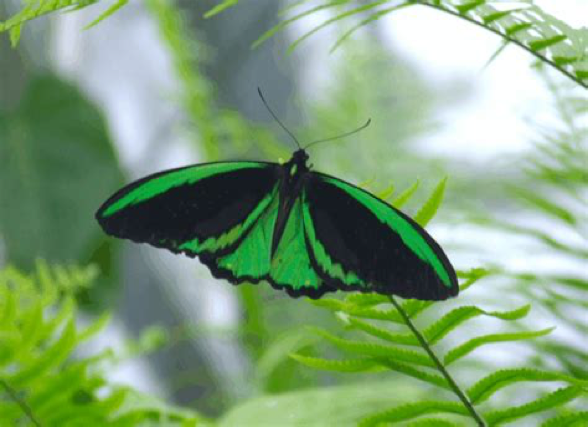
.: Lifecycle butterflyBut right now I am still experiencing a lot of thoughts, emotions, dreams, and earthly energies. Autumn is a time of harvesting. Fulfilling a wish from years ago, in imagining synchronicity as a lifestyle, I am currently living as a nomad and flowing where I feel called, connecting with places and people of Yuin country (south coast NSW). And I have faith that I will emerge from my current cocoon at the right time with the desire to expose my beauty to the world by flitting about as a butterfly for a while. Until that “I” dies and the cycle continues with my being reborn from a little egg once more… (Image from here).

giveheart

If you value this content, please engage in reciprocity by living, sharing and giving.

On Indigenous Science

Doing science with awe and humility is a powerful act of reciprocity with the more-than-human world.

— Robin Wall Kimmerer, Potowatami scholar

A blog by Valerie

Most of us when asked what ‘science’ is will start to think of beakers and men in lab coats doing chemistry experiments. However, that is a limited Western perspective on studying and cataloguing knowledge within a controlled environment. The root of the Latin word ‘science‘ is ‘to know’, which comes from an older root word meaning ‘to cut/split.’ This is why a Western scientist when trying to gain knowledge about a butterfly will likely describe the environment of its capture, then kill and preserve one to do things like measure its wing dimensions, look at parts of it under a microscope, document the patterns on its wings, and label it with a Latin title. This is a way to gain knowledge through cutting or splitting the butterfly from its environment.butterfly

In Indigenous science, we do not aim to gain knowledge through separation and examination in isolation with such an individual focus. We instead want to study the butterfly in its environment, and it might take a while, a year or more, to observe patterns of behaviours and direct relationships a butterfly is part of. For example, we may observe that the butterfly pollinates certain flowers that the bee does not tend to favour. We may observe that the butterfly blends very well against one tree, but is very visible against another tree, and this may tell us something about where its chrysalis is likely to be hiding. We may learn about cultural lore of an important butterfly dreaming site on country. And we may feel awe when a butterfly flutters by or, if we’re lucky, feels safe enough to land on our hand. We may feel inspired when reflecting on the butterfly’s lifecycle that is filled with immense physical change to make a change in our own lives, or to appreciate immense change we have been through ourselves. (Image from here)

Indigenous science offers us a different lens, a holistic perspective, for building and testing knowledge. Most of us are aware of the Western calendar with four seasons (winter, spring, summer, fall) and the equinoxes and solstices that mark celestial moments in an annual cycle. But many Indigenous cultures celebrated seasons specific to their country and its cycle of life. Here is a representation of the Jawoyn seasonal calendar from the land where we currently live around Katherine, NT:

jawoyncalendar

In nomadic or empire-building cultures where people travelled a lot, especially by boat, it made sense to mark seasons by celestial moments. But in Indigenous cultures where people developed deep relationships with a place where they experienced belonging, it made more sense to mark seasons by weather patterns, plant and animal movements and food sources. This included marking times of year to avoid certain foods too, like no fishing of barramundi during their breeding season out of respect. (For those of you in Sydney, here is a D’harawal seasonal calendar explaining six seasons of that country.)

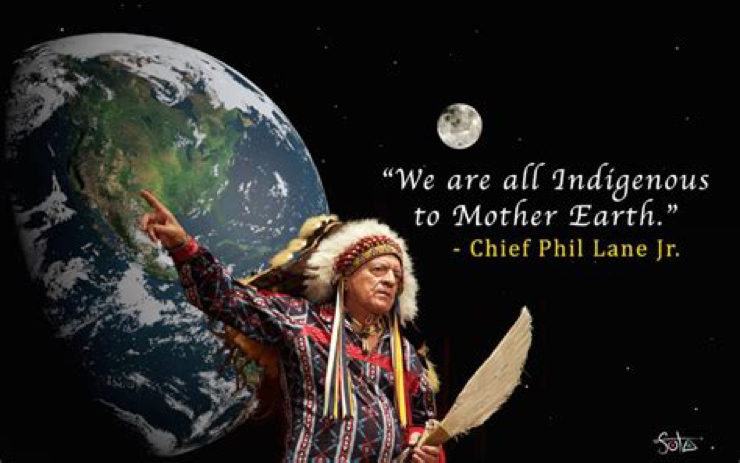
Considering the opening quote, I find that Western science may be done with awe, maybe even humility, but rarely reciprocity with our non-human kin. And for those of us living off of our traditional country, I find it helpful to keep in mind what Kenneth Jacob of Wellesley Islands, Queensland explains:

Our law is not like whitefella’s law. We do not carry it around in a book. It is in the sea. That sea, it knows. Rainbow knows as well. He is still there. His spirit is still watching today for law breakers. That is why we have to look after that sea and make sure we do the right thing. We now have to make sure whitefellas do the right thing as well. If they disobey that law they get into trouble alright.


I leave you with the following principles of Indigenous science to consider, based on work by Oneida-Gaul scholar Apela Colorado:

  • Nothing is objective
  • Non-humans are included in research
  • Research is done as a ceremony
  • Time is nonlinear & cyclical
  • Privileges relationships
  • Holistic, draws on all senses (spiritual, emotional, physical, psychic)
  • Healing, ends with feelings of peace, balance, vitality
  • At the end, we have not transcended but are more fully present and embodied
  • Humour and light-heartedness are important to the process

allindig

giveheartIf you value this content, please engage in reciprocity by living, sharing and giving.
Gifts of Colonialism

Blog by Valerie

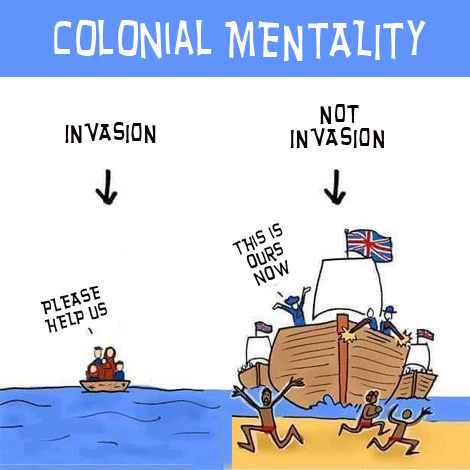
When we grow up feeling like no one’s in our corner, that life is us against the world and we can’t trust anyone, many of us go on a journey as adults of learning how to put ourselves first and practice self-care and fiercely healthy boundaries, as well as learning about personal limits of meaningful sacrifice and resentment-building martyrdom. Sometimes those of us with this wound feel the pain of it so acutely that we can’t focus on much else. We need the wound to heal so badly that we start to believe our needs matter more than others’, and like a baby crying to be taken care of, we often look for external care-taking even as adults, which tends to result in giving our power away and ultimately feeling victimised, reinforcing our distrust wound over and over again. People say when we don’t learn a lesson at a small scale, the universe keeps providing the lesson in bigger ways until we get it or it gets us. When this happens at a large scale, where many people share such a wound that it becomes an intergenerational trauma, entire families, cultures, and communities can collectively reinforce the wound in each other and embed it into social structures. (Image from here.)

TRANSCEND MEDIA SERVICE » Colonial Mentality

There are spiritual lessons in everything, and I’ve been thinking recently about the following teachings of colonialism:

  • corruption of power – giving us the opportunity to recalibrate how we view, carry and share power and re-order our social structures and governance;
  • corruption of trust – giving us the opportunity to let go of control within a separated individual identity to flow into a communal and interconnected identity;
  • corruption of belonging – giving us the opportunity to heal the wound of abandonment by feeling the grief and loss of disconnection from the Earth and allowing us to seek adoption by the country and traditional owners where we live;
  • corruption of faith – giving us the opportunity to re-place our faith into the creation of new cultures and institutions inclusive of all human and non-human kin to fulfil our special (species-specific, or speci-al) role as caretakers of this planet.

I’ll share a few stories and thoughts about each of these gifts.

Mahatma Gandhi Quotes Power | das leben ist schön zitate

Power: When power becomes too concentrated and reaches a human limit, people tend to explode out of their lands like volcanic lava and end up scattered all over the world spreading stories about how they didn’t steal or impose on others, ‘they conquered’ and ‘won’. Any superiority trip (an existential hierarchy) is corrupt, and it seems to me that over successive generations (such as after a colonial land grab), the nature of power becomes apparent to more and more people and passion for social justice activism and Indigenous knowledge revival emerge to re-balance us.

Trust: As a child, I didn’t have anyone around me I could fully trust, and I never felt safe because I wasn’t. I trusted untrustworthy (ill, innocent and/or naive) people as a survival strategy. So I learned trust through experiencing deep betrayal. It has been a powerful mirror of what not to do. Today I’m a highly sensitive person with increasingly fierce boundaries, and I find the fiercer my boundaries, paradoxically the gentler I am with people close to me. Seeing trust as a path and practice, as opposed to a given or a ‘should be’ taught me that it can be learnt and earned. And it showed me that at times I need to extend trust for practical reasons even if it feels dangerous, and at times that I can hold it back to protect myself from painful experiences. (Image from here)

Belonging: More painful than my wound of sexual abuse is my wound of maternal abandonment. I have felt for most of my life like I cannot cry enough to express this profound grief and pain. Lately, though, there are moments where I can hold this gift with awe. Last week I met a Walpiri lawman Wanta Jampijinpa Steven Patrick who has worked for years to share his understanding of Ngurra-kurlu (the home within) with his people and others. He told me the metaphor of Milpirri (see below), a festival he facilitates in the community of Lajamanu in partnership with a dance company in Brisbane every two years: the hot air from their desert country rises up, and the cold air from the sky falls down; as the air mixes, thunderclouds are formed that unite the energy and send lightning and rain to the earth, connecting the hot and cold air (the Aboriginal/yapa country, knowledge and culture and other/kardiya knowledge and culture from overseas). He asked me why so many people who come to his community want to share their culture and knowledge and do not learn from him so they can be adopted where they live and “we can all be Australian.” (Image from here)

Will There Be Faith? | Peg Pondering Again

Faith: Though growing up I was ostensibly taught to have faith in Western governments and their supposed ‘democracies’, capitalist markets, cleverness of mind, quick-wittedness, physical beauty, and a watered-down version of Jewish law, I steadily lost (or never placed) my faith in those spaces. Instead, I learned to have faith that peace can emerge from any violent conflict; that all trauma be healed; that there is value to experiencing evil, disgusting, and dangerous things. As Dr. Marcus Woolmbi Waters, a Kamilaroi man, wrote in his most recent column in the Koori Mail entitled Let’s not lose sight of who we are: “I am no victim of colonisation…We are survivors, enduring and ancient, who maintain a fight for justice and truth…Yes, our trauma is deep, it is intergenerational, it is historical and resides deeply in the present, but we are not our trauma” (emphasis added). (Image from here)

I am reminded of one of the biggest gifts of colonialism that we are still unpacking: a conscious awareness that we are all one big human family despite our diverse countries, cultures, communities and the conflicts between us, and that we are all in this together, human and non-human, in holy commun-ity. (Image from here) In the immortal words of Johnny Cash:

giveheart If you value this content, please engage in reciprocity by living, sharing and giving.

The Sacred Feminine

Blog by Valerie

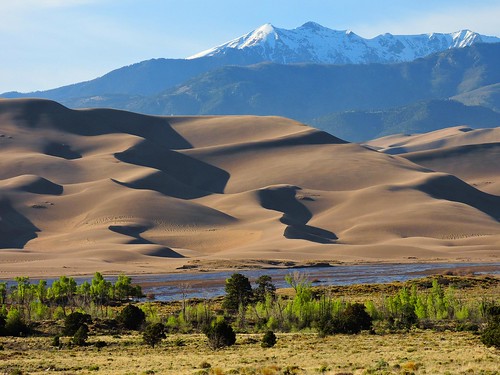
Springtime Cottonwoods, Dunes, and Medano Creek | NPS ...In 2016 I danced a healing ceremony on Tiwa country in view of their Place of Emergence (now the Great Sand Dunes National Park in Colorado, U.S., image from here.) It was the height of summer when we arrived, easily 40C, and a few people were already hard at work building a sweat lodge. Below are my photos of the bones of the lodge, including a medicine wheel made especially for the ‘crown’ facing the heavens (as you can see in the lodge’s shadow), as well as a photo of me. 

When I started writing this blog, it was the winter solstice where I now live, and two days ago marked the Aphelion here, when the Earth is farthest from the sun on its elliptical orbit. (In the other hemisphere you had summer solstice and the Periphelion where you were closest to the sun.)

During the ceremony, which was near summer solstice, it was stinking hot during the day and quite intense to be dry fasting in the desert. But the altitude meant that it cooled down at night, so in the morning when we woke at sunrise with chants and prayers of thanks as Grandmother Moon set and Grandfather Sun rose in the sky, it was pleasantly cool out. Without giving away more than is respectful, I can share that the ceremony started with a sweat lodge, then took place in a dance arbour with a small, resilient tree at the centre. There was drumming and chanting and dancing (and dry fasting as I mentioned), and sleeping outside for a few nights. During this dance I had the most profoundly sacred feminine healing experience of my life, and as I’m writing this, I’m realising that it’s significant that took place around summer solstice, when in my medicine wheel the sacred masculine is at its height of power.

Trail and Park Reviews: Zapata Falls, Frozen Glacial ...The desert strips away all that isn’t necessary, and like the bones of the sweat lodge, shows us what we are made of. During the ceremony I witnessed layer upon layer of trauma and grief being stripped from me. This was not new, but something I had been going through for some years. But when I found myself falling to my knees at tree in the centre of the arbour, I felt something different. I felt how deeply that tree, that country and those people loved me, and how very wanted I was by Mother Earth. I hadn’t realised how disconnected from my inherent worthiness I had been, and I cried tears of gratitude for the gift of knowledge reminding me of this. I felt quite weak at that point and soon after completed the dance, breaking my fast with a cup of mint iced tea. The next couple of days were filled with play, including hiking the sand dunes and finding oases to swim in the desert, such as an icy cold waterfall (Image of Zapata Falls from here) and a natural spring pool where I rented a swimsuit for $1. I didn’t know that was a thing, but I guess a few people show up in the desert surprised to find a natural spring pool and want to swim too!
When I left the desert after this experience, I felt raw and shaky, yet stronger in my body than I had been in this lifetime. And everywhere I went I kept seeing people who hadn’t yet connected with the Sacred Feminine and didn’t seem to know their worth, or how much we are all loved by Mother Earth, even as our behaviours and lifestyles wound Her. It helped me see the depth of wetiko in the world, and it helped me find my way to people who are as grounded as I am and consciously aware of the depth of pain and disconnection we are all in with our modern city living. It takes time and effort to integrate these teachings into our daily lives, and as one of Tiwa Elder Beautiful Painted Arrow’s (Joseph Rael’s) students shared in a recent blog, Joseph reminds us in his new book that “You have to go through separation before you can go through reunion” & “If everything is considered holy you are always in training.”

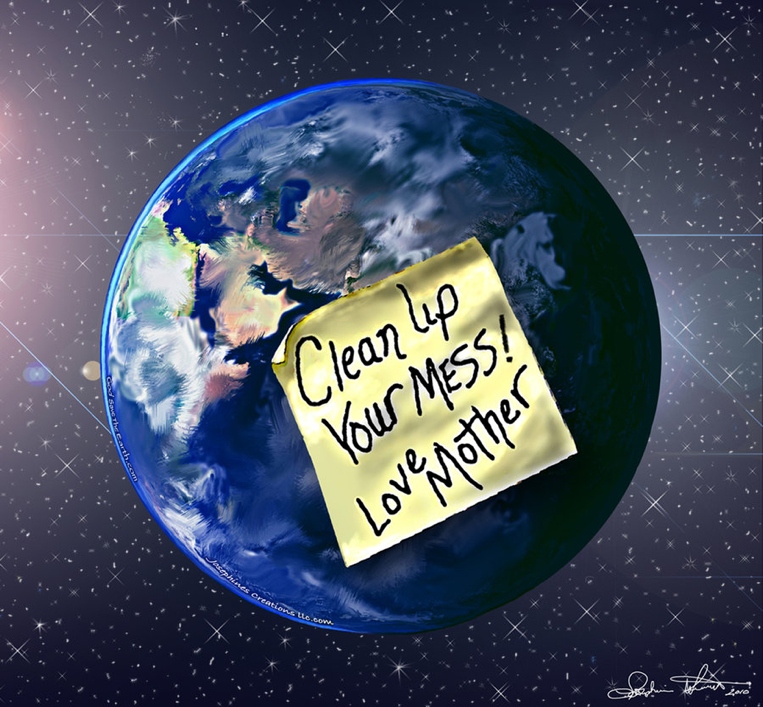
cleanupyourmess

At the winter solstice, where we connect deeply with the darkest light of our being, the light from which all coloured and bright light (and life) emerges, I remember this healing experience. And I give thanks for the Sacred Feminine, Mother Earth, and all mothers within and without. I give thanks for all the work I’ve put in so far to bring that knowledge fully into being in my world, and give thanks for the humility of how much work is still needed, mirrored in moments of trauma, pain and shadow emerging stronger than that sacred knowing of the worthiness of it all. Of every struggle. Here’s to us wild and crazy humans, and to Mother Earth who’s always supporting us whether we realise it or not. And to continuing to clean up our messes to show Her that we know how valuable we all are and that we want to honour that by living well. (Image from here.)

Wishing you a meaningful solstice season, whichever hemisphere you’re living in, and deepening of your conscious connection with the Sacred Feminine over the coming months.

If you value this content, please engage in reciprocity by living, sharing and giving. giveheart

Two-Eyed Seeing: Gift & Privilege

Blog by Valerie

The word gift has a very interesting etymology. I remember being surprised as a child to learn that Gift meant ‘poison’ in German. Turns out it means ‘poison’ in modern Dutch, Danish and Swedish too. The story goes that the proto-Germanic verb geftiz (to give) led to German’s geben (to give), and Gift (poison), the latter coming from dosis (a giving) in Greek (dose in English) being used to describe a portion (potion) of medicine given to a person who is sick. That this supposed medicine came to mean poison perhaps says a lot about how Germanic people felt about foreign medicines being brought in, but anyway.

Fungi - Wikipedia

This dichotomy got me thinking about gifts and how they differ from privileges. The etymology of privilege is from Latin meaning ‘private law’ – it is inherently an individualistic concept. The word privilege sure is thrown around a lot, and I do mean thrown – it often feels like it’s sent to people by throwing a word-spear with a poisonous arrow on the end. I can speak truthfully about painful gifts I’ve received in my life – familial betrayal, sexual violation, maternal abandonment, social rejection – and I can relate to both the English meaning of ‘gift’ and the germanic ‘poison’ meaning. In some parts of our lives we are all called up on to turn shit into fertiliser, to be like bacteria and fungi and allow the natural process of decay to enrich us and create space for rebirth.

The current mainstream social story around ‘privilege’ is to label people with certain perceived privileges from a Western materialist, capitalist, Euro-centric, Judeo-Christian (dare I say white supremecist) worldview, and expect people to be aware of them. From this perspective, I am privileged because I grew up middle class, in the U.S., I have light skin, received high-level formal Western education, have strong English language skills, etc. Yet from my Indigenous East Frisian worldview, this concept is an imposition – the only word that relates to this idea of privilege refers to whose turn it is to go when two people (or wagons) are at a crossroads. And from my Jewish-American worldview, the idea that Jews are accepted as ‘Western’ and ‘white’ is so new it feels incredibly insecure and desperate to consider myself part of that story, and I see many Jews become the neurotic caricatures outsiders expect them to be within a larger Western story. (Woody Allen anybody?)

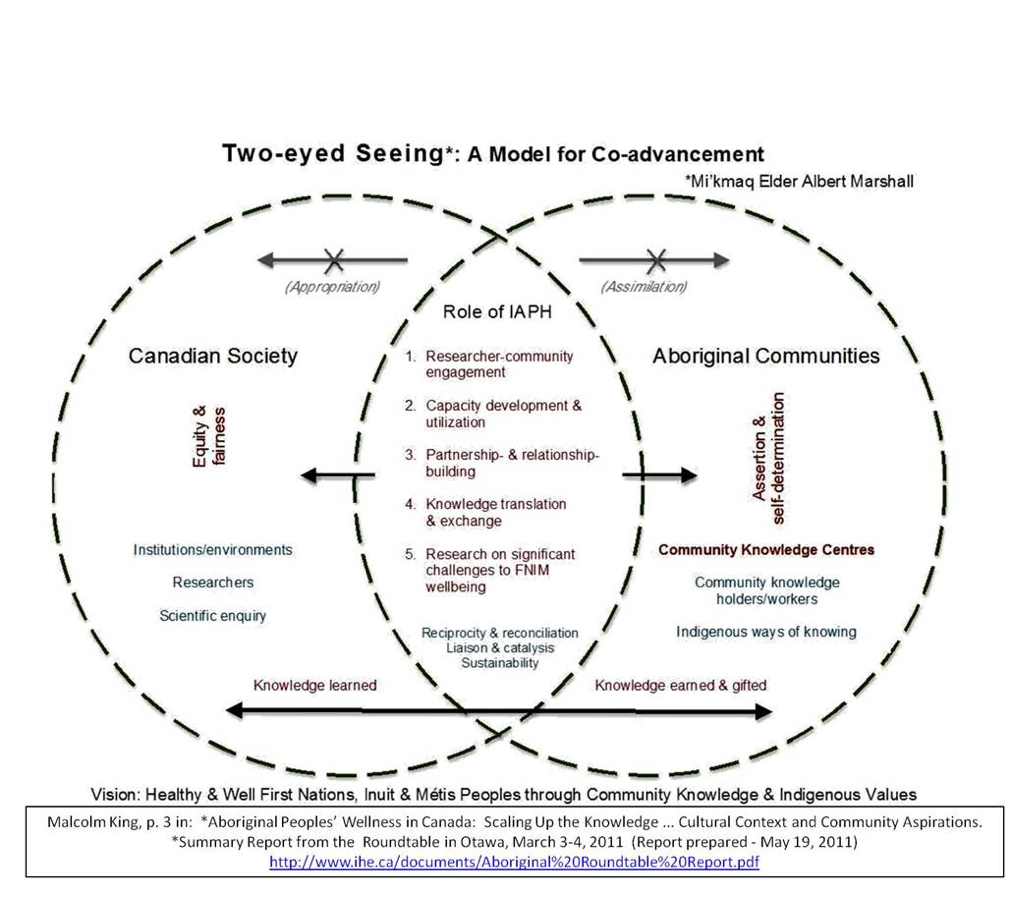
I find the concept of Two-eyed Seeing by Mi’kmaw Elder Albert Marshall is very useful here. It focuses on seeing the strengths of Western and Indigenous worldviews and making space for multiple perspectives and consciousnesses. (Image from here.)

Guiding Principles (Two Eyed Seeing) | Integrative Science

There are different ways that we can practice two-eyed seeing. For example, the Mi’kmaw model sees their cultural worldview and the Western worldview as somewhat overlapping and somewhat distinct, as in this Venn diagram showing room for knowledge-sharing and learning from each other:

twoeyed

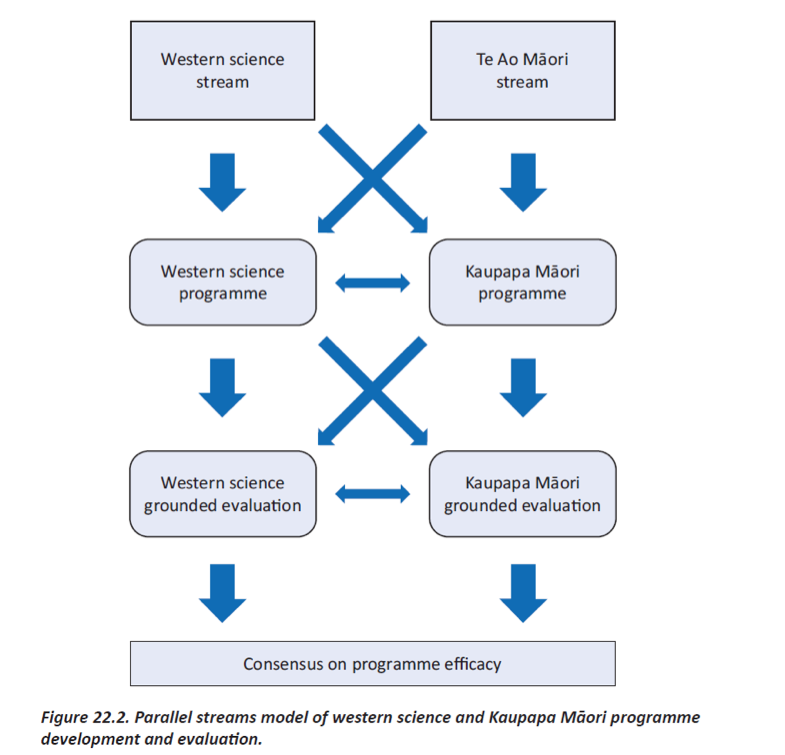
Another approach is the Braided Rivers approach that sees Maori and Western knowledges as distinct streams that need to be woven together to create a new system of knowledge based on the strengths of both worldviews.

maoririvers

As Indian psychoanalyst Sudhir Kakar said:

A degree of alienation from one’s culture, a deep exposure to other worldviews and even a temporary period of living ‘as others’ may indeed be necessary for heightening one’s perceptions about the culture and society one is born into.

poverty

By all means let’s confront our Western privilege, and while we’re at it, let’s reflect on what we privilege in our lives (and what we want to be privileging). For example, I privilege peace and balance. And when I think about the Western material privilege I grew up with, I also think about the imbalances that went along with it – spiritual desolation, mental illness, and physical and emotional pain – and to rebalance and find peace, my healing journey included many years of renouncing material privilege to strengthen other aspects of my being. The imbalance was a gift, to be sure, but a privilege? I’m not sure. I see that distinction as cultural. In closing, I am reminded of this photo from a small town in the Amazon that encapsulates my two-eyed seeing approach to gifts and privileges (translation: The poverty is in your head and not in your pockets…).

giveheart If you value this content, please engage in reciprocity by living, sharing and giving.

Our Trickster Nature

Blog by Valerie
Why does a crocodile hide underwater and then snap at prey (fight)? A sparrow swoop into a tree when there’s rustling on the ground nearby (flight)? A dog play dead (freeze)?  Because trickiness is a part of earthly nature. Sometimes we purposely trick ourselves, like when we feel pain and focus on “a happy place” to feel better. We often play tricks with children, such as pretending Santa Claus left kids gifts on Christmas. And there are downright scary ways we use trickster energy, like denying we have a drinking problem, going to a pub and getting wasted, then endangering ourself and others driving home.
Following the path of the mythical Raven (Light from ‘one ...I have heard people of many cultures say the world we’re living in was created by trickster. Some cultural creation stories are explicit about this, such as Raven Stealing the Light among First Nations peoples in the northwestern US and Canada, or a serpent tricking Eve who then tricked Adam in the Bible. In any case, trickster is an archetypal character across cultures. (Image of raven stealing the light from here.)
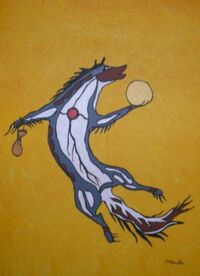
There are many ways to express and confront trickster energy, and having tools to navigate conflict is important. When we use binary thinking, when we judge right and wrong with bright line rules, when we identify as Good or Bad people and think our eternal existence depends on acting One Way, we close our hearts and minds to the inherent trickiness of nature, and we deny and dissociate our trickster aspect of being. Right now, some of us — including some of us with a lot of social power — are so unaware we’re being tricked that it’s costing human and non-human lives. Denial and dissociation tend to be destructive.
My view is that we’re all somewhat tricked into thinking that the collective ways we’re living are working, when deep down we feel pain, grief, conflict, helplessness, etc. about changing. We may be aware that current systems and ways of being and acting are unsustainable, and we may already be taking active steps to change ourselves and to advocate for bigger visions of change. Individual action does matter, miracles do occur, and self discipline and personal perseverance only takes us so far. As Isaac Murdoch, an Anishinaabeg elder (Canada) said recently in relation to corona virus:
The elders are reminding us to go back to the land. And so, for us, the land is the biggest healthcare system, and so we know that through the cultural practices of how we survived great sicknesses before, that the land is the answer.
(Image of common Native American trickster coyote from here.)
I am aware there’s something tricky about an online platform for Earth Ethos. I am aware my relationship with traditional owners of the lands where I’m living is a work in progress and that I don’t yet feel fully safe and secure living here. I see people behave in dissociated ways daily, and social graces, cultural expectations, choosing battles, and behaving with ‘professionalism’ mean that I don’t always address it. I choose to focus on working through tricks in my private life where I have greater depth of intimacy with people. With many people I can at best plant a seed or hold them in compassion and be supportive in spirit.

Native American Trickster Stories: Lesson for Kids | Study.com

It helps when I’m truthful with myself and witnessed by someone else about tricks I’m navigating in my inner and outer world. I aim to avoid the trick of blindly acting on ‘shoulds’ in my head, and the trick of excusing what happens as ‘meant to be’ without using it as a learning opportunity. Being honest about trickster energy demands self-awareness. I cultivate that through grounding practices such as earthing, centring practices such as meditation and ceremony, purification practices such as rituals of letting go, reflection practices such as empathic dialogue, being receptive signs and feedback such as engaging in altar practices. (Image from here about the essence of Native American trickster tales.)
I am also aware that the nature of trickster energy is that it changes forms, or shape-shifts. There’s no one trick that can save you from being killed by an attacking mountain lion (puff up and try to appear big), a bear (extra strength pepper spray and run away), corona virus (ride it out and hospitalise if you can’t breathe), or an angry human with a gun (?). And I accept that trickiness is part of life. When I deny it, I feel stuck in a loop acting out the so-called battle between Good and Evil, and I need more compassion and grace. When I accept it, I am aware there’s good and evil mixed into everything and everyone, and I’m more likely to have an I-don’t-know mind and be able to flow in the present moment…
giveheart If you value this content, please engage in reciprocity by living, sharing and giving.

Our Primal Nature

Blog by Valerie

Right now it’s easy to feel survival fears, to observe deeply ingrained panic behaviours and to hear people talk about ‘these strange times.’ I understand the sentiment, but I think it’s strange that so many of us have become used to unsustainable and imbalanced ways of being; where our grocery store shelves and medical centres rely on supplies shipped from across the planet, where in countries like Australia the government has created a “free market” (more accurately a corrupt gambling scheme) for one of our most precious elements: water; and where ultra-deep sea mining and drilling is going into the Earth’s crust in our seemingly endless exploitations of this planet.

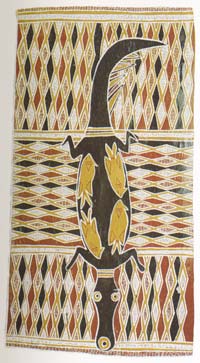
Crocodile and fishCrocodile and fishCrocodile and fishCrocodile and fishimage22Crocodile and fishI’m reminded of a beautiful book called Singing the Land, Signing the Land written by European-Australian researchers in collaboration with Yolgnu indigenous scientists and traditional knowledge-holders. The researchers remind us that in the European Middle Ages, “nature actually was a book to be read, like the Bible, in order to discover God’s purposes. There were ‘books in the running brooks, sermons in stones’.” And the Yolgnu hold up a very telling mirror when it comes to how they, and their European-Australian counterparts, see the crocodile (which the early Australian-European explorer quoted below mistakenly referred to as an alligator). Consider these two very different views:

I see a crocodile as an animal that is part of me and I belong to him, he belongs to me. It’s a commoness of land ownership. Everything that I have comes from the crocodile. Crocodile, he’s the creator and the land giver to the Gumatj people. In my group of people, and the forefathers, we have always treated crocodile in a way that it is part of a family…Aboriginal people, through thousands of years of living with crocodiles, never have considered that they are dangerous animals. We have always lived with them. They lived their own life and we lived our own ways, as long as there is common respect for each other.–Gularrwuy Yunupil’u

I had stripped to swim across a creek, and with gun in hand was stealthily crawling to the outer edge of the flat where my intended victims were, when an alligator rose close by, bringing his unpleasant countenance much nearer than was agreeable … My only chance of escaping the monster was to hasten back to the boat, and to cross the last creek before the alligator, who appeared fully aware of my intentions…the race began. I started off with the utmost rapidity, the alligator keeping pace with me in the water. After a sharp and anxious race, I reached the last creek, which was now much swollen; while the difficulty of crossing was aggravated by my desire to save my gun. Plunging in I reached the opposite shore just in time to see the huge jaws of the alligator extended close above the Spot where I had quilled the water. My deliverance was providential, and I could not refrain from shuddering as I sat gaining breath upon the bank after my escape, and watching the disappointed alligator lurking about as if still in hopes of making his supper upon me.–John Lort Stokes

(Image from the book, cited as art by Bede Tungatalum, Bathurst Island entitled Crocodile and fish, woodcut).

I was recently listening to an Aboriginal Australian view of the St. George & the dragon myth in which Europeans first saw their animal, primal nature as a scary monster, then attacked and tried to kill it. And then re-enacted that nightmare in the form of colonisation, slavery, exploitation, and all manner of destruction around the world. It reminded me of some of my previous learning about serpents. It is thought-provoking to consider how in Judeo-Christian mythology the serpent enticed Eve into mankind’s fall from Eden, whereas other cultural myths about serpents include:

  1. creation of life emanating from underground and water-dwelling part-human part-snake beings called nagas in Indian and Buddhist mythology;
  2. water, the coming of spring, resurrection and rebirth associated with meso-American winged serpent God Quetzalcoatl;
  3. the Hopi’s annual snake dance honoring serpent God Awanyu celebrating water, fertility, and the arrival of spring;
  4. the rainbow serpent creator God of Aboriginal Australians that controls the water;
  5. Fu Xi and Nu Gua who had male and female heads and snake bodies and created human life in Chinese mythology;
  6. the kundalini snake that animates the body and spirit in Vedic mythology; and
  7. Western medicine’s use of the Asclepius symbol of a snake wrapped around a staff to represent healing based on Greek and Roman mythology.Rainbow serpent and snake

Interesting note for Western culture: Freud cited a fear of snakes as fear of the penis. While many cultures see snakes as wild and potentially dangerous, they are generally highly respected and seen to symbolise fertility, the creation and resurrection of life, springtime, and a connection with water and emotional wellbeing. On the medicine wheel, water is often connected with our emotional life, and since snakes are connected with water, a negative or fearful view of snakes is linked with negative or fearful emotion. (Image from the rainbow serpent link.)

These myths, and especially creation stories and the emotions they evoke are embedded into the foundation of a culture’s collective psyche. When creation stories evoke negative or fearful emotions, these emotions emanate beneath the surface of conscious everyday thought, and other aspects of culture are built on top of them. This is something for those of us carrying Western creation stories to consider. Tyson Yunkaporta points out that in Greek mythology the ouroboros was meant to represent infinity, but “how can this serpent be a symbol of infinity if it will eventually eat itself?” I too find this symbol disturbing and have a visceral memory of someone I was getting to know showing me a silver ouroboros ring she had made, which so repulsed me I must’ve expressed that in my energy because we never met again. I find the symbol to be celebrating sabotage or suicide, but it seems many people feel otherwise! I am trying to understand, for as the authors of Singing the Land, Signing the Land say, “The world is now too well connected to allow the luxury of alienation within one conceptual system.” I hope our current circumstances are helping remind us of this and of our innately interconnected primal nature.

giveheart If you value this content, please engage in reciprocity by living, sharing and giving.

Reciprocity & the Resentment-Denial Dance

Blog by Valerie

This week I am moving through some grief. I had known that a friendship would end had been observing it fade away for a while, and I was hoping it would just fade and drift gracefully into nothingness, but that was not what occurred. Not only was there a calling out of disrespectful behaviour that resulted in denial, blame, and spite being projected onto me, but following that was additional denial about the state of the relationship. I felt resentment that my former friend was so in denial that she needed me to explicitly spell out that we had already co-created the ending of our relationship, and this resulted in even more blame and spite being projected onto me. What a mess of pain we were in.

It reminded me of Torres Islander writer Nonie Sharp‘s concepts of mateship and in-mateship, where in-mateship creates feelings of worthlessness, self-hate, denial. She says that the very presence of superiority creates shame, and a fear of shame causes people to oscillate between seeking revenge and prestige, resulting in psychic bullying, social violence, and denying reciprocity; if you judge someone as an inmate, you control & define social and existential boundaries. I see this as narcissistic…

lotusIn processing this resentment, I realised that when there is a lack/denial of reciprocity in a relationship, we dance between resentment and denial — resentment within the person who feels stifled/unseen because the other person isn’t holding them in wholeness, and lack/denial/not good enough within the other person who feels cut off from their wholeness (and may or may not want to heal that rift inside themself). Those of us who live with an Earth Ethos embody a knowing that we are all interconnected, and we are not lost playing out myths of superiority and inferiority based on existential judgement.

In some people’s minds I “cut off” this friend, but I have not experienced this. I can no more cut her off than I can cut off the air I breathe; she has become part of me and the space she has in my heart and mind will remain throughout my life in a linear sense of time, and is always there in a nonlinear sense of time. Thoughts and feelings related to her will emerge, and I will pray and send love and feel pain whether we are actively engaged in our relationship or not. It was and it is, and through time and space relationships move through various forms, or trans-form.

Reciprocity is a core Earth Ethos value. As Potowatami writer Robin Wall Kimmerer says:

In the old times, individuals who endangered the community by taking too much for themselves were first counselled, then ostracized, and if the greed continued, they were eventually banished… It is a terrible punishment to be banished from the web of reciprocity, with no one to share with you and no one for you to care for.

My view is that such punishment/banishment on a mass scale underlies the current mainstream Western culture and results in the extreme levels of narcissistic wounding we are witnessing. Aboriginal writer Tyson Yunkaporta explains:

In Dreaming stories, Emu is often a narcissist who damages social relationships. These stories teach us about the protocols for living sustainably, and warn us about unsustainable behaviours. The basic protocols of Aboriginal society, like most societies, include respecting and hearing all points of view…Narcissists demand this right, then refuse to allow other points of view…They destroy the basic social contracts of reciprocity (which allow people to build a reputation of generosity based on sharing to ensure ongoing connectedness and support), shattering these frameworks of harmony with a few words…They apply double standards and break down systems of give and take until every member of a social group becomes isolated, lost in a Darwinian struggle for power and dwindling resources that destroys everything…

Australian Indigenous Astronomy: July 2011Yet in Aboriginal cultures in Australia, the Emu is so highly regarded that people traditionally organised their lives around following the wisdom of the Dark Emu in the sky, which is the constellation of darkness within the Milky Way. The image is from here and shows the Dark Emu during one season of the year, and corresponding rock carving honouring the Emu in Sydney.

Something that I continually find challenging in embodying reciprocity is moving through a world where so many people around me believe in individuality and are lost in saviour complexes that convince them they are working for the collective good. I live on land my ancestors are not indigenous to, and I do not yet know what lands my mother’s family is interconnected with. And when I move through the dance of denial and resentment in an intimate relationship, it helps to remember that once I fully see the Dark Emu I will be wiser and more capable of orienting myself in my centre; and as this unfolds, it helps to have compassion and keep strong in my convictions of the worthiness of this healing journey, as Rumi reminds me. Wuradjuri healer Randal Ross said that we don’t realise how free we are until we see that freedom disintegrate; and I feel that correspondingly, those of us who have been abused and denied are re-membering how free we are through calling it out with compassion and creating healthy, whole lives in the midst of collective wounding.

Exercise: Consider this Robin Wall Kimmerer quote and how you might apply it in your life: “Restoration is imperative for healing the earth, but reciprocity is imperative for long lasting, successful restoration… We restore the land, and the land restores us…The land is the real teacher. All we need as students is mindfulness. Paying attention is a form of reciprocity with the living world, receiving the gifts with open eyes and open heart…For all of us, becoming indigenous to a place means living as if your children’s future mattered, to take care of the land as if our lives, both material and spiritual, depend[] on it.”

giveheart If you value this content, please engage in reciprocity by living, sharing and giving.

Outliers

Most of us are familiar with outliers from mathematics, as illustrated by this image:

OUTLIER DETECTION AND TREATMENT

I have always felt like an outlier. Outliers can be inspiring leaders, and can also be absolutely crazy. Most outliers, in my experience, embody a bit of brazen madness that carries us outside the mainstream. Others have written about the challenges of honouring a multi-cultural identity, and of digging deeply into their roots to claim their full identities. I will write about something else. About the outlier as a leader and a madman.

To me, leadership must create an opening, which shows that it is alive. It may open someone up to joy or to pain, open up space between people or open up connection, but it creates opportunities to become more fully embodied and alive. Much of what we call leadership I feel leads us to dead ends. A leader unwilling to step aside and help someone else into their place, who clings to their standing, is not a leaders but a childish dictator in my eyes. Leaders know there is always somewhere else to go. To me, true leadership is a pioneering into unknown, lost, forsaken, and forgotten spaces. Aboriginal scholar Tjanana Goreng Goreng defined sacred leadership as people:

  • Embodying humility & being a model of respectful behaviour;
  • Leading through bottom-up empowerment & mentorship;
  • Sharing wisdom, holding initiation rites, and sharing culture in layers when people are of a strength of character;
  • Who are chosen by a community, not self-selected;
  • Carrying specific knowledge, lore, beliefs who ensure the safety & security of the teachings.

Ultimately, the difference between an outlier who goes mad and one who becomes a leader is one who is able to move beyond personal self-interest and live with a heart of service. This means balancing self-care with asking for support and taking risks, sometimes putting oneself Mad Hatter Lewis Carroll Quotes. QuotesGrampurposely into trauma or danger, but not to the point of becoming a martyr and building resentment. It can be a challenging line to walk. It requires very high personal standards along with loads of compassion for self and others. It can be isolating and incredibly fulfilling. Instead of being outraged about whatever stupid action Trump did this week, I was in awe to learn that fish underwater sing the water and reefs awake at dawn, just like birds on land.

I have struggled to connect with many people around me, and I’ve worked really hard to understand Judeo-Christian, Western, and Anglo worlds. But I don’t innately understand them, and they don’t innately understand me. There must be something that makes each of us feel like an outlier, even in a small way. What if we focus on enjoying that breadth of our diversity, on learning from each other, and on exploring the outer limits of our inner worlds? We may just find, like these side-by-side images of Western microscopic art and Aboriginal Australian art that we outliers are redefining social structures in ways that align with Mother Earth better and can inspire others through our own leadership into owning our outlier statuses. (Image: Gum leaves under a microscope & Gathering Bushtucker painting)

Gum Leaf and Gathering Bush Tucker.

giveheart If you value this content, please engage in reciprocity by living, sharing and giving.